On this page
How to identify it
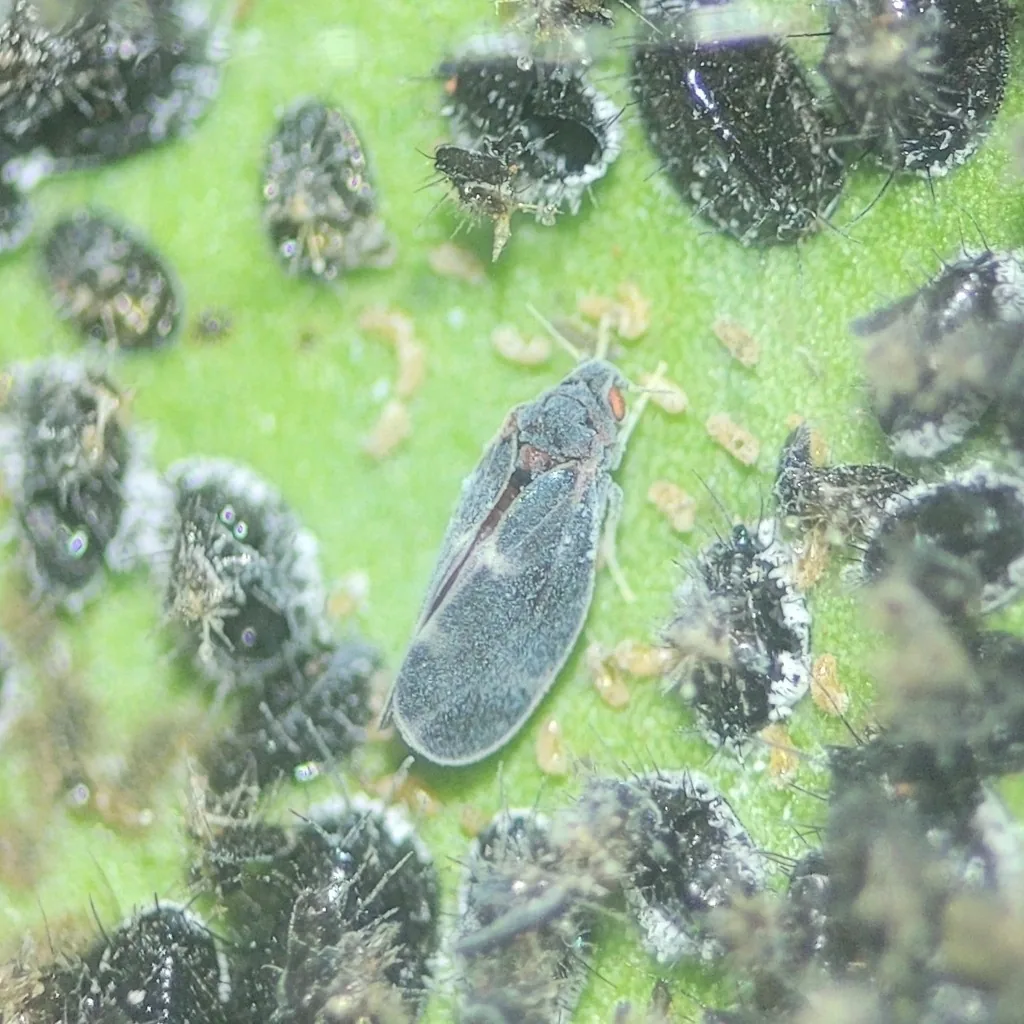
- Adults are tiny, about 1.7 mm long in females and up to 1.35 mm in males. At rest they look metallic gray-blue, the color of the wings that cover most of the body.[1]
- Eggs are laid in a characteristic spiral on the undersides of leaves, each attached by a short stalk. A female lays from 35 to 100 or more eggs.[1][2]
- The nymphs look almost black on the leaf and carry radiating spiny filaments; later stages are dark brown to black with obvious spines.[1]
- The last nymphal stage (the 'pupa case' or puparium) is oval and shiny black, about 1.24 mm long in females.[1]
- UF/IFAS describes the adult as slate blue: within 24 hours of emerging it is covered with a fine wax powder that gives it that color, and this dark look earned it the name blackfly.[7]
- Each female lays two to three egg spirals during her 10- to 14-day life.[7]
- The first nymph is brown, about 0.30 mm long, with two glassy filaments curving over the body; the second is dark brown and spiny, about 0.40 mm; the third is shiny black, about 0.87 mm, with stouter spines.[7]
- The black 'pupa case' has a marginal fringe of white wax. Females average 1.24 mm long and males 0.99 mm, and the adult leaves through a T-shaped split at the front end.[7]
Look-alikes
| Look-alike | How to tell them apart |
|---|---|
| Citrus whitefly | Most whiteflies, including citrus whitefly, are covered in mealy white wax, and citrus whitefly pupae have a Y-shape on their backs. Citrus blackfly adults look gray-blue, its eggs sit in spirals, and its nymphs are black and spiny. UF/IFAS adds that citrus whitefly adults are all white, with no dark spots on the wings.[3][1][7] |
| Woolly whitefly | Woolly whitefly immatures are covered with curly, waxy filaments, unlike the shiny black, spiny immatures of the citrus blackfly. The adult female is white and lays her eggs in a circle while resting at its center.[3][1][7] |
| Cloudywinged whitefly | The adult is white with a darkened area at the end of each wing, unlike the dark slate-blue citrus blackfly.[7] |
Where it lives
Native to Southeast Asia, it was first recorded in the Western Hemisphere in Jamaica in 1913 and spread to Cuba in 1916 and Mexico in 1935. It was found at Key West, Florida, in 1934 and eradicated there by 1937, then rediscovered at Fort Lauderdale in 1976; it spread county by county, reaching Alachua County in 1992, and is now widespread from north-central through south Florida. It was recorded in Texas in 1955. The European Union regulates Aleurocanthus whiteflies on citrus, and climate modeling suggests its potential range there could move north and to higher elevations by 2050.[7][1][2][4]
Biology and life cycle
It has more than 300 host plants, including pear, rose and grape, but it is primarily a citrus pest; serious infestations of other hosts are usually found close to citrus groves.[2]
Eggs hatch in 4 to 12 days. The young pass through four nymphal stages, the life cycle generally takes 2 to 4 months, and adults live 6 to 12 days.[1][2]
There are up to six generations a year; three to four have been reported in South Florida.[1][2]
UF/IFAS gives the nymph stages as lasting seven to 16, seven to 30 and six to 20 days, and the whole life cycle from egg to adult as 45 to 133 days, depending on temperature.[7]
Citrus is the most suitable host for large populations. Whiteflies on citrus depend on new growth and are active only during periods of flush.[7][8]
Damage and signs
- Immatures and adults suck sap from the leaves. Plants weaken, leaves wither and drop, and the tree bears less fruit.[1]
- The nymphs excrete honeydew that grows sooty mold on leaves and fruit, which reduces photosynthesis and fruit quality.[2][1]
- UF/IFAS adds that sooty mold makes citrus leaves look black and can severely impair leaf respiration and photosynthesis.[7][8]
Health risk
The sources treat it only as a plant pest; none mentions bites, stings or other risk to people or pets.[7][1][2]
Control
Prevention
Avoid sprays that undercut its natural enemies: copper sprays for fungal diseases also inhibit 'friendly fungi' and lead to more whiteflies, and more than one sulfur application a year can harm the parasites.[7]
Chemical control lowers blackfly numbers only temporarily, and mineral and vegetable oils are reported to have minimal effects on biological control agents.[1]
Keep them out
Plants for planting and cut flowers or branches are the main pathways for Aleurocanthus whiteflies to enter new regions, and researchers advise against importing untreated host material into areas where the blackfly could establish.[2][4]
Biological control
Parasitic wasps such as Encarsia perplexa and Amitus hesperidum have kept it below economically damaging levels in South Florida, Texas, Mexico and elsewhere. In southern Texas, an augmentation program released Amitus hesperidum and Encarsia opulenta, and monitoring suggested both became re-established in the citrus groves.[1][5]
UF/IFAS names Encarsia perplexa and Amitus hesperidum as the most effective agents in Florida. An Amitus female can produce up to 70 offspring in four to five days, and Amitus works best on dense blackfly populations in cool, humid seasons, but it searches poorly and dies out once the blackfly is suppressed. Encarsia reproduces more slowly but searches better and generally holds blackfly at a lower level.[7]
Whiteflies in Florida groves are normally under good biological control by parasitoids, predators and an Aschersonia fungus, and populations are rarely high enough to warrant treatment unless that control has been disrupted.[8][7]
Pesticides
In Texas, organic growers use sulfur, oils and microbial products against it.[1]
Florida growers seldom spray just for whiteflies, which are also controlled by sprays aimed at scale insects; spray oil is used mainly to remove sooty mold. Recommendations for dooryard and commercial citrus differ, so follow the management guide for your situation.[7]
Where the sources disagree
Adult color: UF/IFAS describes the adult as slate blue; the EPPO datasheet calls it metallic gray-blue.[7][1]
Generations: UF/IFAS says six generations a year are produced in south Florida; the EPPO datasheet gives up to six a year in general but cites a report of three to four in South Florida.[7][1]
Egg hatch and adult life: UF/IFAS gives seven to 10 days to hatch and a 10- to 14-day adult life; EPPO gives 4 to 12 days to hatch and an adult life of 6 to 12 days.[7][1]
Life cycle: UF/IFAS gives 45 to 133 days from egg to adult; EPPO says it generally takes 2-4 months.[7][1]
Common questions
- Why are my citrus leaves black and sticky?
- Honeydew from sap-sucking insects grows black sooty mold. If you find gray-blue whiteflies, spiral egg clusters or spiny black nymphs under the leaves, citrus blackfly is a likely cause.[2][1]
- Is the citrus blackfly a fly?
- No. Despite the name it is a whitefly; the adult looks metallic gray-blue rather than white.[1]
- Should I spray citrus blackfly on my backyard tree?
- Usually not. Parasitic wasps have kept it below damaging levels in South Florida and Texas, and chemical control lowers its numbers only temporarily.[1]
- How did the citrus blackfly get to Florida?
- UF/IFAS reports it was found at Key West in 1934 and eradicated by 1937, then rediscovered at Fort Lauderdale in 1976, after which it spread north through the state.[7]
Sources
- European and Mediterranean Plant Protection Organization (EPPO Global Database), “EPPO Datasheet: Aleurocanthus woglumi (last updated 2022-06-03).” gd.eppo.int/taxon/ALECWO/download/datasheet_pdf (accessed 2026-11-14)
- European Food Safety Authority (EFSA Journal), “EFSA Panel on Plant Health. Pest categorisation of Aleurocanthus spp. EFSA Journal 16(10):5436 (2018) (abstract).” doi.org/10.2903/j.efsa.2018.5436 (accessed 2026-11-09)
- University of California Statewide IPM Program, “Whiteflies (Citrus: Agriculture Pest Management Guidelines).” ipm.ucanr.edu/agriculture/citrus/whiteflies/ (accessed 2026-11-12)
- Elsevier (Current Opinion in Insect Science), “Lemic D et al. Global change and adaptive biosecurity: managing current and emerging Aleurocanthus woglumi threats to Europe. Current Opinion in Insect Science 62:101164 (2024) (abstract).” doi.org/10.1016/j.cois.2024.101164 (accessed 2026-11-09)
- Florida Entomologist; copy hosted by USDA Agricultural Research Service, “Augmentation of Parasitoids for Biological Control of Citrus Blackfly in Southern Texas (Meagher and French, Florida Entomologist 87(2), 2004).” ars.usda.gov/ARSUserFiles/11809/AUGMENTATION%20OF%20PARASITOIDS.pdf (accessed 2026-11-12)
- iNaturalist, “Aleurocanthus woglumi taxon page (order and family).” www.inaturalist.org/taxa/907079 (accessed 2026-11-09)
- University of Florida IFAS Extension (EDIS), “Citrus Blackfly, Aleurocanthus woglumi Ashby (Featured Creatures EENY-042, R. Nguyen, A.B. Hamon and T.R. Fasulo; revised 2010).” ask.ifas.ufl.edu/publication/IN199 (accessed 2026-11-14)
- University of Florida IFAS Extension (EDIS), “2026-2029 Florida Citrus Production Guide: Soft-Bodied Insects Attacking Foliage and Fruit (CPG vol. 1 ch. 24).” ask.ifas.ufl.edu/publication/CG004 (accessed 2026-11-14)