On this page
How to identify it
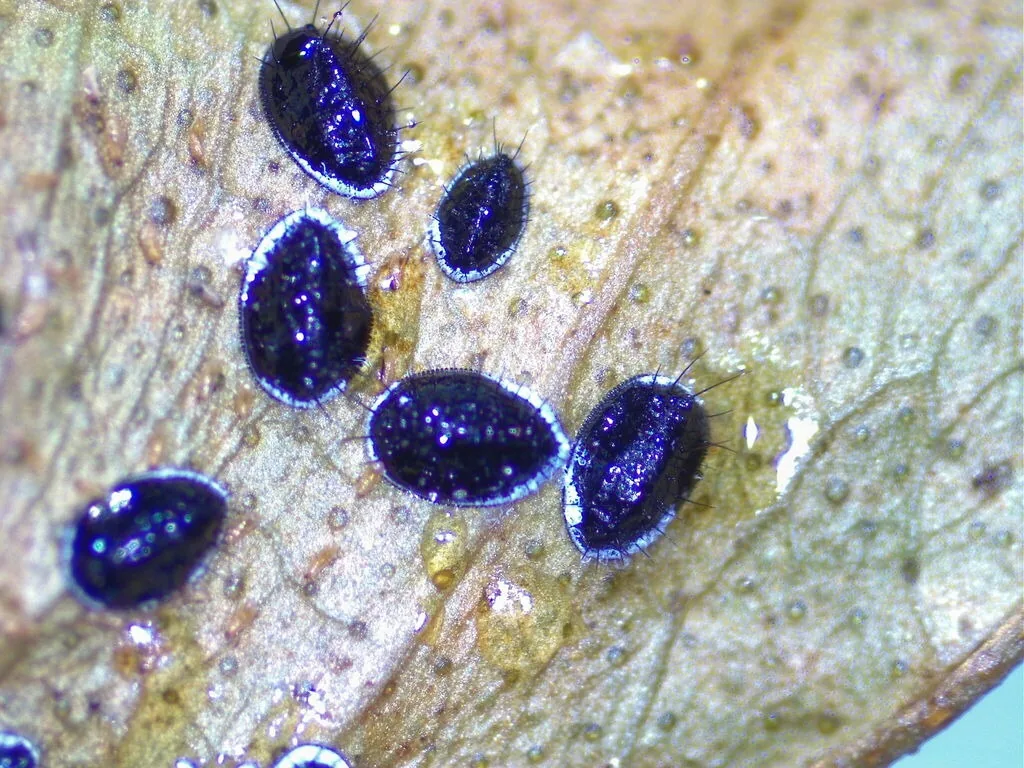
- Nymphs are dark brown to black, with a short fringe of white wax around the edge and glandular spines on the upper side. UF/IFAS describes the pupa (fourth instar) as oval, jet black and convex, about 1.23 mm long and 1.88 mm wide, with strong, dark spines on the back and a compact, short, cottony wax fringe around the edge.[1][5]
- Adults have blue-grey wings with white markings, while many other whiteflies are mostly white. UF/IFAS calls the adults slate blue and says they cannot be told apart from citrus blackfly adults.[1][5]
- The genus is easy to recognize even from photos, but telling Aleurocanthus species apart takes a specialist examining slide-mounted puparia under a microscope.[1][2]
- In the second and third instars, each side of the back carries a single row of strong, heavy spines, eight on the abdomen and six on the thorax, UF/IFAS says.[5]
- Eggs are minute (0.2 by 0.1 mm), yellow, curved and marked with polygonal areas, and a short stalk holds each one more or less upright on the leaf, UF/IFAS says.[5]
Look-alikes
| Look-alike | How to tell them apart |
|---|---|
| Citrus blackfly | A close relative in the same genus that causes identical damage. The species differ only in microscopic features of the puparium, so expert identification is needed. UF/IFAS gives one field clue: the white wax fringe around the pupal case is generally twice as large on orange spiny whitefly as on citrus blackfly, which is established in Florida.[2][3][5] |
| Common whiteflies | Most other whiteflies have mostly white wings; orange spiny whitefly adults are blue-grey with white markings and the nymphs are black and spiny.[1] |
Where it lives
Native to tropical Asia, it has spread across the Pacific, to central, eastern and southern Africa, and into southern Europe, where it was first found in Italy in 2008 and later in Croatia, Montenegro, Greece, Albania and, in 2023, mainland France. It was found on Oahu in 1974, and citrus whiteflies have been rare in Hawaii in recent years. UF/IFAS adds that it was recorded as an occasional citrus pest in Jamaica in 1922 and first recorded on Guam in 1951, reached Swaziland in 1987 and South Africa in 1988, and says established populations are not yet known in the continental United States.[1][6][2][3][5]
Biology and life cycle
It develops through egg, four nymphal stages (a mobile first instar, two settled instars and a pupa-like fourth instar) and the winged adult. All stages except the resting fourth instar feed on phloem sap.[2]
Generations per year depend on climate: about four in Japan, two to three in India, and as many as seven under ideal lab conditions. UF/IFAS adds five or six generations on Guam and says a mild temperature with high relative humidity is ideal for its growth.[2][5]
It feeds on about 90 plant species in 38 families. Citrus is the main host; in Hawaii it was first detected on rose foliage in Honolulu in 1974. On Guam it was seen on citrus, rose, grape, peach, pear and guava, UF/IFAS says, and later Hawaii surveys found it on navel orange, lime, tangerine and pear, with low infestations.[2][6][3][5]
It moves between regions on nursery stock and infested fruit. Adults fly only a short way downwind, but they can ride in cars or stick to people.[2]
Development time varies widely, especially in the third and fourth instars. In a Japanese study cited by UF/IFAS, the egg stage lasted 11 to 22 days, the first instar seven to 11 days, the second five to seven days, the third seven to 130 days and the pupal stage seven to 34 days.[5]
Damage and signs
- Nymphs and adults suck sap, and the honeydew they excrete grows sooty mold that covers the upper leaf surface and downgrades fruit. Sap loss and honeydew weaken plants.[2][3][6]
- Heavily infested citrus trees can turn almost completely black, and the fruit becomes unmarketable. UF/IFAS warns that citrus fruit quality and production could suffer if it were introduced into Florida, and that it is also a potential threat to ornamental plants there.[4][5]
Health risk
The sources treat it only as a plant pest; none mentions bites or other risk to people or pets.[2][1]
Control
Prevention
Infested nursery stock and fruit are the main pathway. EPPO recommends inspecting host plants, especially citrus, during the growing season before shipment, and in the EU it is under official control. If you spot black, spiny whitefly nymphs on citrus in an area where it is not known, report them: in France in 2023 the first record came from a gardener's photo posted to a citizen-science site.[2][1]
Biological control
In Hawaii the parasitic wasp Encarsia smithi, introduced from Japan in 1974, was the most important species in bringing it under control, and citrus whiteflies have been rare there in recent years. A 2022 survey found Encarsia perplexa was the only parasitoid emerging, with parasitism of 11 to 65% on Oahu and 0 to 28% on the island of Hawaii. UF/IFAS says Japan's 1925 introduction of parasitoids from China killed more than 74% of the population, wasps on Guam reached 80% to 95% parasitism, and Encarsia cf. smithi in southern African orchards gave a mean parasitism rate of about 72.9%, though the wasps did less well on rose and grape.[3][5]
In Italy the whitefly-specialist lady beetle Clitostethus arcuatus has been recorded feeding on it.[6]
UF/IFAS suggests the wasps Encarsia opulenta and Amitus hesperidum, which are effective against citrus blackfly in Florida, might also control orange spiny whitefly if it arrived there.[5]
Pesticides
Sprays have a poor record. In Italian field trials, sweet orange essential oil, a butterfly pea (Clitoria ternatea) extract, mineral oil, pyrethrin and azadirachtin caused no statistically significant nymph mortality; pyrethrin gave the largest, near-significant, drop in young nymphs. The authors add that heavy, untimed use of synthetic insecticides in Italy was ineffective and may have led to resistance. UF/IFAS likewise says chemical control has not been shown to be effective against this or other whiteflies in crop systems, though a low-concentration petroleum spray oil gave acceptable control on sweet orange and pummelo in China.[4][5]
Where sources disagree
Host range: EFSA and a 2020 review count about 90 plant species in 38 families, while a 2023 French study counts more than 100 host plants from 37 families.[2][6][1]
Common questions
- Where has orange spiny whitefly spread?
- From tropical Asia it has spread across the Pacific, including Hawaii since 1974, to central, eastern and southern Africa, and into Europe: Italy in 2008, Croatia in 2012, Montenegro in 2013, Greece in 2016, Albania in 2018 and mainland France in 2023.[1][6][3]
- How can I tell it from citrus blackfly?
- Not reliably by eye: the species differ only in microscopic features of the pupal case, so a specialist has to examine a slide-mounted specimen. One field clue from UF/IFAS: the white wax fringe around the pupa is generally twice as large on orange spiny whitefly.[2][1][5]
- Does spraying control it?
- Natural enemies have done better. Introduced parasitic wasps brought it under control in Hawaii, while field trials in Italy found oils, plant extracts and organic insecticides gave no significant nymph mortality.[3][4]
- Can it hitch a ride on me or my car?
- Yes. EFSA notes adults can enter cars or stick to people, which moves them farther than they fly.[2]
- Is orange spiny whitefly in the continental United States?
- UF/IFAS says established populations are not yet known in the continental United States. It has been in Hawaii since 1974, and UF/IFAS warns it could hurt citrus and ornamentals if introduced into Florida.[5]
Sources
- Insects 14(12), 2023, via PubMed, “Incursion preparedness, citizen science and early detection of invasive insects: the case of Aleurocanthus spiniferus in France.” pubmed.ncbi.nlm.nih.gov/38132590/ (accessed 2026-11-12). Cited from the PMC full text.
- European Food Safety Authority (EFSA Journal), “Pest categorisation of Aleurocanthus spp. (EFSA Panel on Plant Health 2018, EFSA Journal 16: e05436; PubMed abstract).” doi.org/10.2903/j.efsa.2018.5436 (accessed 2026-11-12). Re-checked 2026-11-12 via the NCBI PMC full text; the publisher page returned 403.
- MDPI (Insects), “A survey in Hawaii for parasitoids of citrus whiteflies, for introduction into Greece (Giakoumaki et al. 2023, Insects 14: 858; PubMed abstract).” doi.org/10.3390/insects14110858 (accessed 2026-11-12). Re-checked 2026-11-12 via the NCBI PMC full text; the publisher page returned 403.
- Scientific Reports 10, 2020 (Mokrane et al.), via PubMed, “Field trials of plant products and pesticides against Aleurocanthus spiniferus (orange spiny whitefly) in Italy.” pubmed.ncbi.nlm.nih.gov/32978466/ (accessed 2026-11-12). Cited from the PMC full text.
- University of Florida IFAS Extension (EDIS), “Orange Spiny Whitefly, Aleurocanthus spiniferus (Quaintance), EENY341/IN618 (Featured Creatures; J. Gyeltshen, A. Hodges and G. S. Hodges; January 2005, revised March 2011 and August 2017).” ask.ifas.ufl.edu/publication/IN618 (accessed 2026-11-14)
- Insects 11(1), 2020, via PubMed, “Spread of the invasive orange spiny whitefly Aleurocanthus spiniferus in Europe.” pubmed.ncbi.nlm.nih.gov/31936015/ (accessed 2026-11-12). Cited from the PMC full text.
- iNaturalist, “Aleurocanthus spiniferus taxon page (order and family).” www.inaturalist.org/taxa/514346 (accessed 2026-11-12)