On this page
How to identify it
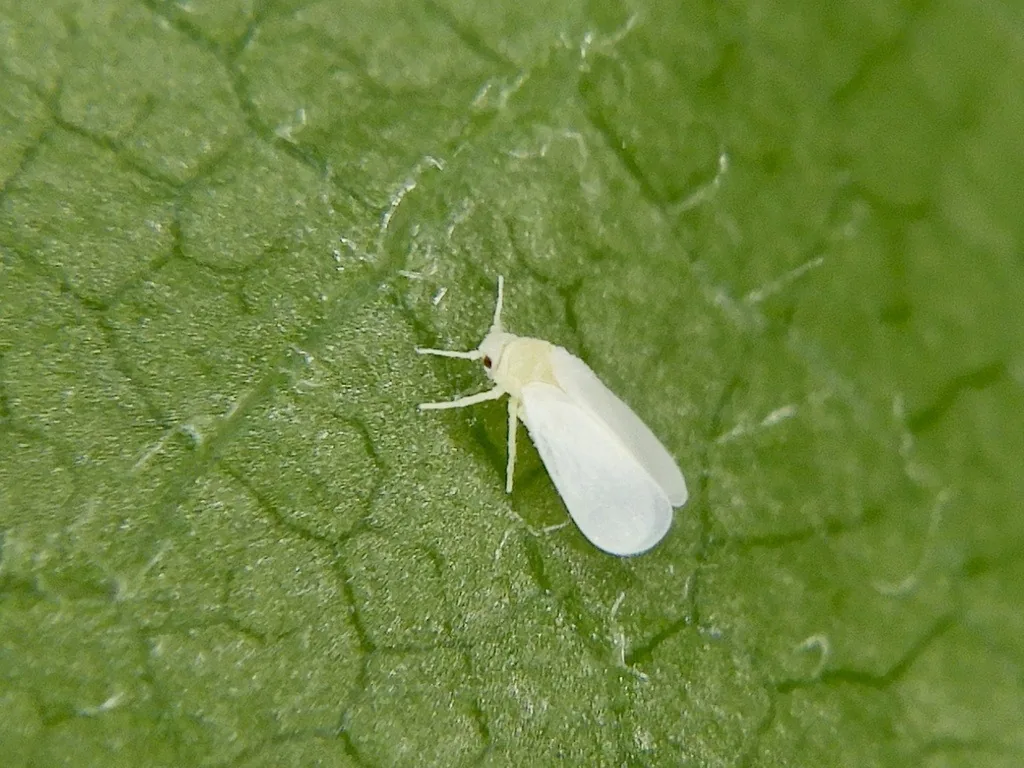
- Adults are tiny and almost totally white. Shake an infested branch and the small white adults fly away.[1][2]
- Nymphs are small, flat and yellowish, fixed to the lower leaf surface. They look more like scale insects than like the adults, and they are often easier to notice than the adults.[1][2]
- The pupa has a distinctive Y-shape on its back, and adults leave through T-shaped splits in the pupal skin.[3][1]
Look-alikes
| Look-alike | How to tell them apart |
|---|---|
| Woolly whitefly | Woolly whitefly pupae and other young stages are covered with curly, waxy filaments.[3] |
| Ash whitefly | Ash whitefly pupae have a thick band of wax down the back and a fringe of tiny tubes, each with a liquid droplet at the end.[3] |
Where it lives
It was introduced from Asia, and before modern insecticides it was a major citrus pest in Florida and the Gulf states. It is a major foliage pest of Satsuma mandarins in Alabama, Clemson's diagnostic clinic sees it on citrus in South Carolina, NC State covers it in North Carolina, and UC IPM's citrus guidelines include it among the whiteflies on citrus.[1][4][2][3]
Biology and life cycle
Each female can lay up to 125 eggs, partly inserting them into the lower leaf surface; in heavy infestations the eggs can be numerous enough to malform leaves. Eggs hatch in 6 to 21 days.[1]
Pale green crawlers move about until they insert their threadlike mouthparts in the leaf, then settle, lose their legs and antennae after the first molt, and pupate inside the last nymphal skin.[1]
Summer broods take about 2 months to develop, and the last brood spends the winter as nymphs.[1]
In Alabama Satsuma orchards it was more abundant on leaves from the interior of the canopy than on outer leaves, and it was more common in unsprayed orchards than in sprayed ones.[4]
In a laboratory study in China, adults transmitted citrus yellow vein clearing virus from infected to healthy citrus seedlings, the first report of this whitefly spreading that virus.[5]
Damage and signs
- Feeding drains sap, and the upper sides of infested leaves turn pale or spotted. Honeydew grows a black sooty mold that makes plants look unhealthy and can cut photosynthesis; heavily infested gardenias may drop leaves early.[1][2]
- It has been reported on at least 38 genera of evergreen and deciduous plants. Preferred hosts are citrus, chinaberry, gardenia, privet, prickly ash, pomegranate and Japanese persimmon, and gardenias seem to be highly susceptible.[1]
- Ants feed on the honeydew; ants on a citrus plant are a sign to check the leaf undersides for whiteflies and other sap feeders. Ants also interfere with the natural enemies of whiteflies.[2][3]
Health risk
It feeds only on plants; none of these sources reports any risk to people or pets.[1][2]
Control
Prevention
Natural enemies can give partial to complete control when they aren't disrupted by ants, dust or insecticides, so control sugar-feeding ants and avoid broad-spectrum sprays for other pests.[3]
Biological control
A tiny introduced wasp, Encarsia lahorensis, helps control citrus whitefly in several states, including North Carolina. In Alabama orchards this wasp and the fungus Aschersonia aleyrodis were the main causes of whitefly death. Lady beetles and lacewing larvae also eat the young.[1][4]
Pesticides
Horticultural oil aimed at leaf undersides works when well timed and repeated, does less harm to beneficial insects than pyrethroids, and helps sooty mold weather away. Clemson uses a 2% oil solution (5 tablespoons per gallon) when temperatures are between 45 and 85 °F, no stronger than 3 tablespoons per gallon when fruit is present, and not during bloom.[1][2]
Insecticidal soap sprays applied to the undersides of leaves are also very effective; repeat in 5 days if needed. Systemic products containing imidacloprid or dinotefuran also work when used properly. Read and follow the label.[2][1]
Where sources disagree
Generations: NC State counts three broods a year, while a two-year survey of Alabama Satsuma orchards recorded two distinct population peaks at most sites.[1][4]
Whether to spray: NC State says insecticides can be applied any time citrus whiteflies are noticed, while UC IPM says spraying citrus for whiteflies is generally not necessary except where biological control has been badly disrupted.[1][3]
Common questions
- Why are my gardenia leaves black and sticky?
- Citrus whitefly honeydew feeds a black sooty mold fungus. Look for flat, yellowish nymphs on the leaf undersides.[1][2]
- What are the tiny white flies under my citrus leaves?
- Likely citrus whiteflies. Shake a branch to see the white adults fly, and check the leaf undersides for flat nymphs.[2][1]
- How do I get rid of citrus whitefly?
- Horticultural oil or insecticidal soap sprayed thoroughly on the leaf undersides, repeated as needed, controls them and is easier on beneficial insects; keep ants off the plant so natural enemies can work.[1][2][3]
Sources
- NC State Extension, “Citrus Whitefly (PDIC Factsheet).” content.ces.ncsu.edu/citrus-whitefly (accessed 2026-11-11)
- Clemson Cooperative Extension, Home & Garden Information Center, “Citrus Insects & Related Pests (HGIC 2221).” hgic.clemson.edu/factsheet/citrus-insects-related-pests/ (accessed 2026-11-11)
- University of California Statewide IPM Program, “Whiteflies (Citrus: Agriculture Pest Management Guidelines).” ipm.ucanr.edu/agriculture/citrus/whiteflies/ (accessed 2026-11-11)
- Environmental Entomology, via PubMed, “Seasonal occurrence of key arthropod pests and associated natural enemies in Alabama Satsuma citrus (Fadamiro et al. 2008).” pubmed.ncbi.nlm.nih.gov/18419929/ (accessed 2026-11-11)
- Plant Disease, via PubMed, “Identification of Dialeurodes citri as a Vector of Citrus yellow vein clearing virus in China (Zhang et al. 2019).” pubmed.ncbi.nlm.nih.gov/30444466/ (accessed 2026-11-11)
- iNaturalist, “Dialeurodes citri taxon page (order and family).” www.inaturalist.org/taxa/370909 (accessed 2026-10-06)