On this page
How to identify it
- Adults are about 0.05 inch long, with a light yellow body under white wings; the yellow may show through.[1][4]
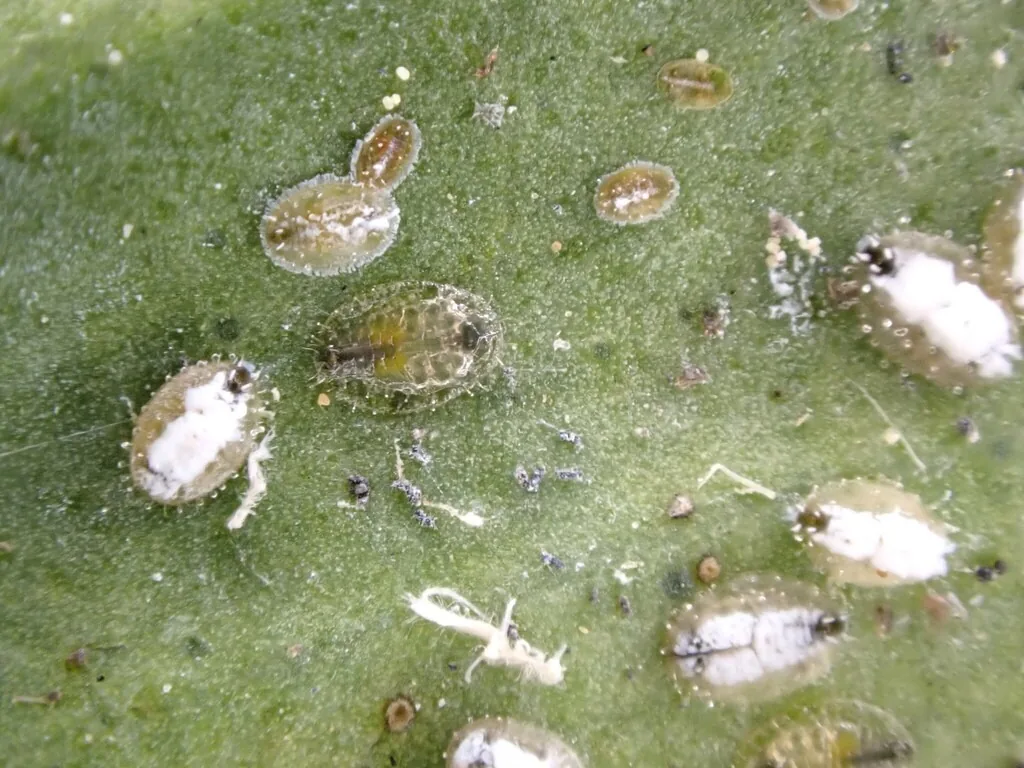
- Nymphs start nearly translucent and become more opaque, covered with tufts of white wax. Fourth-stage nymphs have a very thick band of wax down the back and a fringe of tiny tubes, each tipped with a liquid droplet.[1][4][3]
- Infested leaves carry a sticky mess of waxy eggs, nymphs, pupal cases and honeydew.[1]
Look-alikes
| Look-alike | How to tell them apart |
|---|---|
| Citrus whitefly | Also found on ash and pomegranate, but its fourth-stage nymphs have no fringe around the edge and carry a distinctive Y shape on the back.[3] |
Where it lives
Detected in California in 1988 and found in Oregon by 2014, where whitefly clouds appear in the Willamette Valley in late summer and fall. Oregon State also lists Arizona, Florida (2010), Georgia, Nevada, New Mexico, North Carolina (1993) and South Carolina.[1][4]
Biology and life cycle
Females lay eggs under leaves. Nymphs settle and feed on sap through four juvenile stages, then emerge as winged adults. At 77°F it can go from egg to adult in 25 days.[1][4]
It can breed year round, more slowly in cool weather. Adult females live about 30 to 60 days, with several generations a year.[1][4]
Adults move from summer hosts such as ash, pear and hawthorn to evergreen hosts for the winter; see where the sources disagree on which stages overwinter there. Oregon State says overwintering adults on nursery stock can be a shipment contaminant.[1][4]
In California it has been recorded on 40 species of plants, including ash, citrus, Bradford pear and other flowering fruit trees, pomegranate, redbud and toyon.[2][3]
Damage and signs
Health risk
It feeds on plants. UC Riverside says that during California's outbreak swarms of adults disrupted outdoor activities and honeydew ruined the paint on cars; the PNW handbook, UC Riverside, UC IPM and Oregon State don't mention any other risk to people or pets.[2][1][3][4]
Control
Prevention
Watch for clouds of tiny whiteflies, or sticky honeydew and sooty mold under infested leaves. Tapping branches or slowly turning leaves over shows adults and young stages; plants with all stages are the ones the whitefly can breed on.[1][4]
Traps and physical control
Strong streams of water aimed at leaf undersides can dislodge or injure the various stages; sticky traps and screening give some protection.[1]
Biological control
A tiny parasitic wasp, Encarsia inaron, brought ash whitefly under control in California and was also effective in Florida (see where the sources disagree on parasitism rates). UC IPM says it is now rarely seen in high numbers in California.[1][4][2][3]
A small lady beetle, Clitostethus arcuatus, also feeds on it. In Iran, each female beetle laid 181 eggs on average, and beetle numbers peaked in late August as whitefly numbers fell.[3][5]
Pesticides
Spraying was avoided in California so the wasp could build up. Avoid pesticides that kill whitefly natural enemies.[1][3]
Where it came from
The ash whitefly comes from the Middle East and the Mediterranean, where it is widespread, and reached California on infested plant material in the late 1980s.[2]
It has also spread to other parts of the world, including New Zealand, Mexico and Argentina, and biological control has been achieved in these invaded areas.[2]
Where the sources disagree
Parasitism: the PNW handbook and Oregon State say Encarsia inaron parasitized 80% to 98% of ash whitefly nymphs in California; UC Riverside says parasitism averaged 63% to 97% one year after releases began in 1992.[1][4][2]
Winter: the PNW handbook says adults overwinter and breed on evergreen hosts but often linger there without developing other life stages; Oregon State says all stages of the whitefly can overwinter on evergreen hosts.[1][4]
Common questions
- What are the clouds of tiny white insects around my ash tree in fall?
- They may be ash whiteflies, which fly in clouds in late summer and autumn as they move toward evergreen plants for the winter.[1][4]
- Is there a natural control for ash whitefly?
- Yes. The parasitic wasp Encarsia inaron was the most successful control in California and Florida, and a lady beetle, Clitostethus arcuatus, also eats it.[1][4][3]
Sources
- Pacific Northwest Pest Management Handbooks (OSU, WSU, University of Idaho), “Emerging Insect Pests in the Pacific Northwest: Ash whitefly (2015).” pnwhandbooks.org/insect/emerging-insect-pests/emerging-insect/ash-whitefly-2015 (accessed 2026-11-13)
- Center for Invasive Species Research, University of California, Riverside, “Ash Whitefly, Siphoninus phillyreae (Paine, Bellows and Hoddle).” cisr.ucr.edu/ash_whitefly.html (accessed 2026-11-13)
- University of California Statewide IPM Program, “Pest Notes: Whiteflies (Publication 7401).” ipm.ucanr.edu/PMG/PESTNOTES/pn7401.html (accessed 2026-11-13)
- Oregon State University, College of Agricultural Sciences, “Ash Whitefly (nursery pest page, R. Rosetta).” agsci.oregonstate.edu/nurspest/insects/ash-whitefly (accessed 2026-11-13)
- Journal of Insect Science, via PubMed, “Biology and feeding behaviour of ladybird, Clitostethus arcuatus, the predator of the ash whitefly, Siphoninus phillyreae, in Fars Province, Iran (Tavadjoh et al. 2010).” pubmed.ncbi.nlm.nih.gov/20874601/ (accessed 2026-11-13)
- Global Biodiversity Information Facility (GBIF), “Siphoninus phillyreae (Haliday, 1835) (GBIF Backbone Taxonomy).” api.gbif.org/v1/species/2012130 (accessed 2026-11-13)
- iNaturalist, “Siphoninus phillyreae taxon page (order and family).” www.inaturalist.org/taxa/397210 (accessed 2026-10-06)