On this page
How to identify it
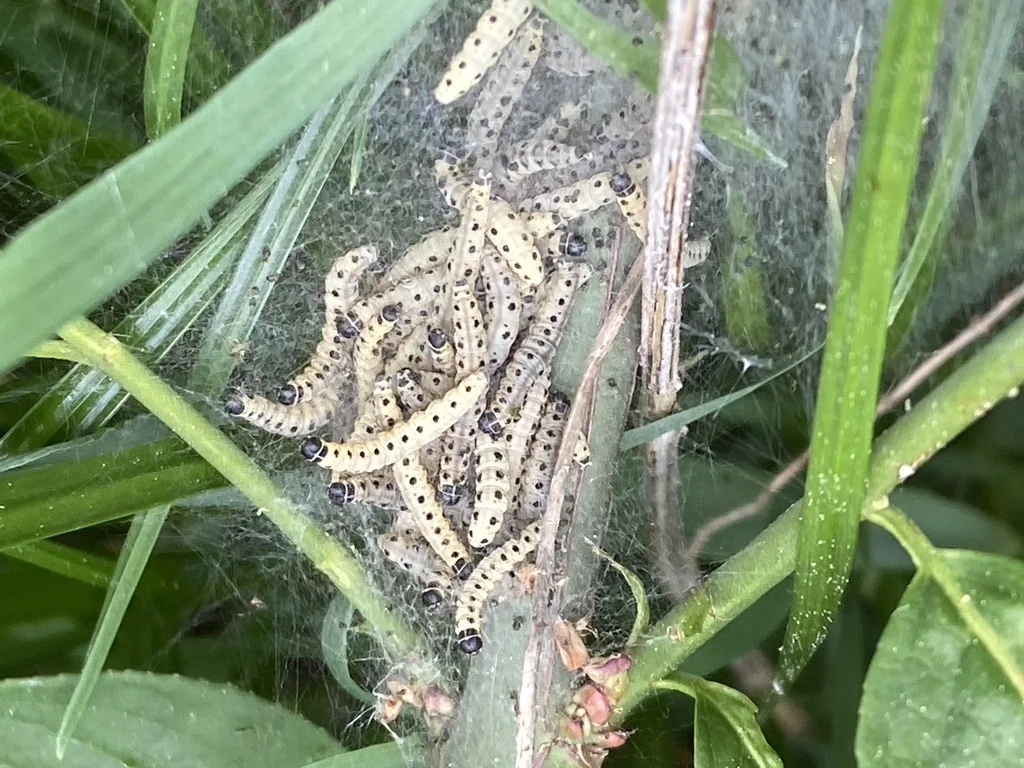
- Caterpillars are cream-colored to creamy yellow-gray with a black head and rows of black spots along the sides. Iowa State and the Wisconsin DNR put grown caterpillars at about 3/4 inch; UMass says just under an inch.[2][3][1]
- Adults are small white moths covered with black spots, about 1 inch across per Iowa State; UMass gives a wingspan just under an inch.[2][1]
- The heavy silk webbing over the plant, and sometimes the ground below, is the most noticeable sign.[1][2]
Look-alikes
| Look-alike | How to tell them apart |
|---|---|
| Apple ermine moth | A related ermine moth whose caterpillars web apple foliage instead.[1] |
| Eastern tent caterpillar | Can be active at the same time, but its tents look different and it feeds mainly on fruit trees.[3] |
Where it lives
A European species first detected in North America in Ontario in 1967. It was first found in Wisconsin in 1989 and has turned up sporadically in Illinois and Michigan; Iowa State's diagnostic clinic received its first sample in 2012. UMass calls it relatively widespread in the United States.[1][2][3]
Biology and life cycle
Moths lay eggs in mid to late July on twigs, branches and near buds and cover them with a gummy coating that hardens. UMass says eggs hatch by August and the tiny caterpillars stay inactive in the eggshells until spring; Iowa State says they emerge several weeks after laying and feed briefly before overwintering under the egg mass.[1][2]
Caterpillars feed in groups on new leaves in spring and are most noticeable in May and June; the Wisconsin DNR says feeding lasts about three weeks. By late June they pupate in white oval cocoons, often grouped upright in cracks or webbed leaves. UMass says moths emerge in late June in most places; Iowa State says July.[1][2][3]
There is one generation a year, so once the caterpillars pupate no more damage happens that season.[1][3]
Damage and signs
- It prefers European spindle tree but also feeds on eastern wahoo, wintercreeper, spreading euonymus and winged euonymus (burning bush), sometimes defoliating plants completely.[1][2][3]
- In heavy infestations the webbing coats the whole plant and the ground or lawn below, and can spread onto nearby plants. Caterpillars drop from the shrub on strong silk strands.[1][2]
- Defoliated shrubs usually grow new leaves. Iowa State warns that defoliation repeated over several years can weaken and kill plants.[3][2]
Health risk
No cited source describes any risk to people or pets; the caterpillars feed on euonymus leaves.[1][2][3]
Control
Prevention
Consider not planting euonymus, many of which are invasive. Winged euonymus is listed as a Restricted invasive species in Wisconsin.[1][3]
Traps and physical control
Scout new foliage in spring, especially where there's a history of damage, and remove webbed nests while they are still small. Iowa State says early to mid-May is the usual time to start looking, earlier in a warm spring.[1][2]
Biological control
Several parasitoid wasps and a predator of the spindle ermine moth are on record, but UMass says how much they hold down populations in Massachusetts isn't known.[1]
Pesticides
Sources differ on spraying. The Wisconsin DNR says no management is needed, since there's one generation and shrubs usually grow new leaves. Iowa State says large populations can be treated with insecticides labeled for caterpillars on ornamentals, including Bt, followed by a check a few days later to see whether it worked. Follow the label.[3][2]
Its scientific name
Extension sources write the name Yponomeuta cagnagella; GBIF spells it Yponomeuta cagnagellus. UMass notes two closely related species in the genus feed on hawthorn and apple.[4][1][2]
Common questions
- What caterpillars are covering my euonymus in webbing?
- Most likely euonymus caterpillars of the spindle ermine moth.[1][2]
- Will my euonymus recover?
- Usually. The Wisconsin DNR says defoliated shrubs typically grow new leaves, and Iowa State says plants recover from a single defoliation, though years of repeated stripping can weaken and kill them.[3][2]
Sources
- UMass Extension Landscape, Nursery and Urban Forestry Program (Landscape Insect & Mite Guide), “Yponomeuta cagnagella (Euonymus Caterpillar).” www.umass.edu/agriculture-food-environment/landscape/publications-resources/insect-mite-guide/yponomeuta-cagnagella (accessed 2026-11-13)
- Iowa State University Extension and Outreach (Horticulture and Home Pest News), “Euonymus Caterpillars Munch Through Windbreak (2012).” yardandgarden.extension.iastate.edu/article/2012/6-13/euonymuscaterpillar.html (accessed 2026-11-13)
- Wisconsin DNR Division of Forestry (Forestry News), “Non-Native Caterpillars Attacking Non-Native Euonymus (July 2025).” forestrynews.blogs.govdelivery.com/2025/07/03/non-native-caterpillars-attacking-non-native-euonymus/ (accessed 2026-11-13)
- Global Biodiversity Information Facility (GBIF), “Yponomeuta cagnagellus (Hübner, 1813) (GBIF Backbone Taxonomy).” api.gbif.org/v1/species/4525369 (accessed 2026-11-13)