On this page
How to identify it
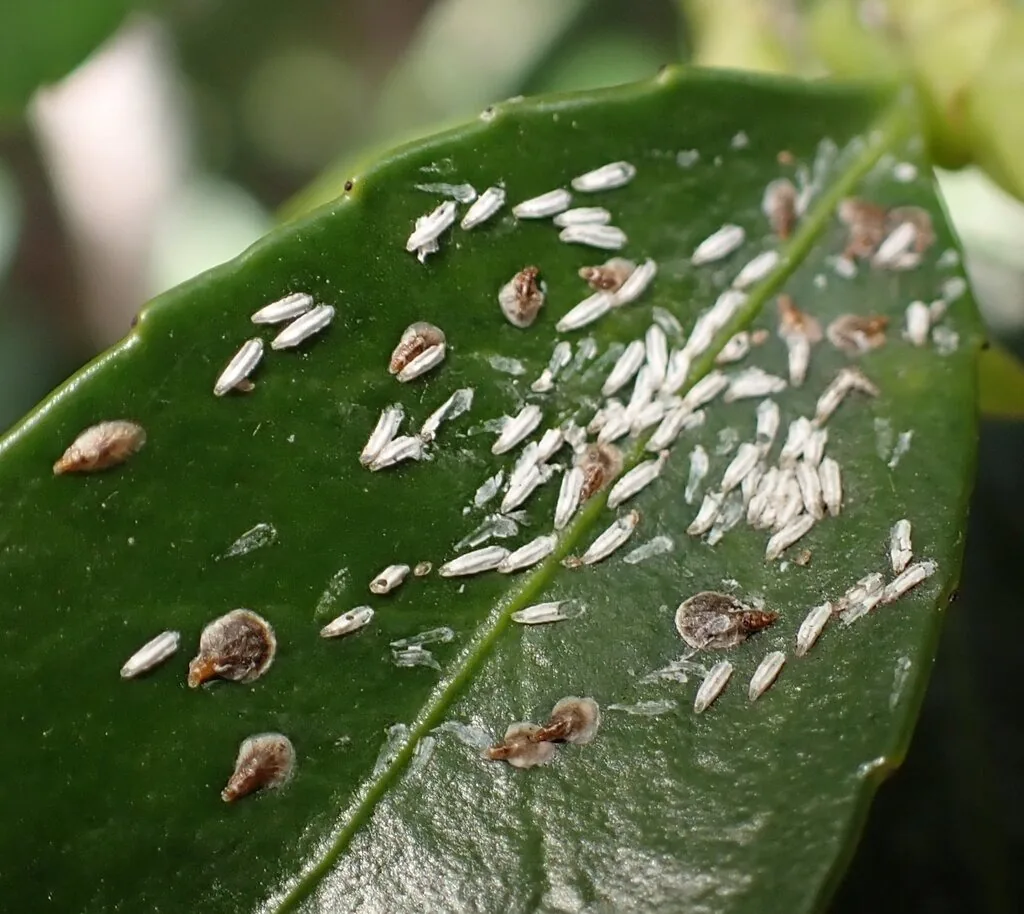
- Male covers are white, narrow and waxy; female covers are brown to grayish-brown, flat and pear- or oystershell-shaped. Sizes vary by source: Penn State gives males about 0.8 mm and females about 2 mm, Utah State says males are 1/16 inch, UMass puts females at about 1/8 inch and WSU at 1/16 inch.[1][4][2][3]
- Crawlers are tiny and yellowish-orange: about 0.3 mm per Penn State, 3/64 inch per Utah State.[1][4]
- Feeding causes yellowish or whitish spots on leaves. Heavily infested plants look coated in white from the male scales, and scale-covered stems look bumpy, corky or frosted.[1][2][4][3]
- Males settle mostly on leaf undersides, while females are found mostly on stems and leaf stalks.[4]
Look-alikes
| Look-alike | How to tell them apart |
|---|---|
| Other scale insects | Euonymus scale is an armored scale native to Japan and China, now established in the U.S. and Canada.[1] |
Where it lives
Native to Japan and China, it is established in the United States and Canada; UMass says it now occurs in many temperate regions of the world.[1][2]
Biology and life cycle
Penn State says fertilized females spend the winter; Utah State adds male pre-pupae, while UMass says immature scales don't survive the winter. Females lay eggs under their covers in late April and May (Penn State) or May to June (Utah State), and the eggs hatch over two to three weeks.[1][4][2]
Development takes four to six weeks. Penn State places the second crawler generation in late July through August, UMass in mid-July in New England, and Utah State lists crawlers from July to October. UMass says two generations a year in New England and up to three farther south; WSU says two to three.[1][2][4][3]
Crawlers spread by walking or on the wind, and because life stages overlap, foliar sprays aimed at crawlers are hard to time.[4]
Damage and signs
- Heavy infestations on twigs or leaves can defoliate plants, kill twigs or kill the whole plant; UMass reports dieback after two to three years of heavy infestation. Plantings next to buildings and walls are often hit harder.[1][2][4]
- Besides euonymus, pachysandra and bittersweet, Utah State lists camellia, boxwood, daphne, ivy, hibiscus, holly, jasmine, privet, honeysuckle, olive and others as hosts.[4][1]
Health risk
No cited source describes any risk to people or pets; it is a sap-feeding scale on plants.[1][2][4]
Control
Prevention
To watch for crawlers, wrap black electrical tape sticky side out around infested twigs. Check stems at ground level first, where scales are best protected.[2]
Traps and physical control
Prune and destroy heavily infested branches.[1]
Wipe off small infestations by hand where practical.[3]
Biological control
USDA released the lady beetle Chilocorus kuwanae and a Cybocephalus beetle against euonymus scale starting in the early 1980s. UMass says both established in southern New England and C. kuwanae became common enough to cut the share of heavily infested landscape euonymus. WSU cautions that natural predators may help but may not prevent damage.[1][2][3]
Pesticides
Spray timing aims at crawlers. Penn State says late May through June for the first generation and late July through August for the second; WSU says May, and again in June or July if needed. Penn State notes scale at the base of plants near the ground is hardest to reach, especially on vine types. Follow the label.[1][3]
Utah State recommends a systemic dinotefuran soil drench, granules or bark band in May instead of crawler sprays, and says imidacloprid is ineffective against hard (armored) scales.[4]
Which euonymus resist it
UMass says spreading euonymus (Euonymus kiautschovicus) seems resistant even when planted among heavily infested plants.[2]
WSU says winged euonymus, especially 'Compacta', and Euonymus fortunei 'Acutus' are seldom infested, and advises against planting evergreen euonymus (E. japonicus), which is extremely susceptible.[3]
UMass also suggests avoiding euonymus species with invasive tendencies, which sidesteps the scale problem on those plants.[2]
Common questions
- What are the white specks covering my euonymus?
- Probably the white male covers of euonymus scale.[1]
- When should I spray?
- When crawlers are active. Penn State says late May through June and again late July through August; WSU says May, then June or July if needed. Utah State finds crawler sprays hard to time and prefers a spring systemic treatment.[1][3][4]
- Which euonymus are least likely to get scale?
- UMass names spreading euonymus as resistant, and WSU says winged euonymus 'Compacta' and E. fortunei 'Acutus' are seldom infested. WSU advises against evergreen euonymus, which is extremely susceptible.[2][3]
Sources
- Penn State Extension, “Euonymus Scale.” extension.psu.edu/euonymus-scale (accessed 2026-11-13)
- UMass Extension Landscape, Nursery and Urban Forestry Program (Landscape Insect & Mite Guide), “Unaspis euonymi (Euonymus Scale).” www.umass.edu/agriculture-food-environment/landscape/publications-resources/insect-mite-guide/unaspis-euonymi (accessed 2026-11-13)
- Washington State University Extension, “Euonymus: Euonymus scale (HortSense).” hortsense.cahnrs.wsu.edu/fact-sheet/euonymus-euonymus-scale/ (accessed 2026-11-13)
- Utah State University Extension IPM, “Euonymus Scale (Ornamental Pest Guide).” extension.usu.edu/pests/ipm/ornamental-pest-guide/arthopods/scales/euonymus-scale (accessed 2026-11-13)
- Global Biodiversity Information Facility (GBIF), “Unaspis euonymi (Comstock, 1881) (GBIF Backbone Taxonomy).” api.gbif.org/v1/species/2088481 (accessed 2026-11-13)