On this page
How to identify it
- Adults are long, narrow moths up to 0.4 inch long, with white wings dotted with small black spots and long antennae that sweep back.[1]
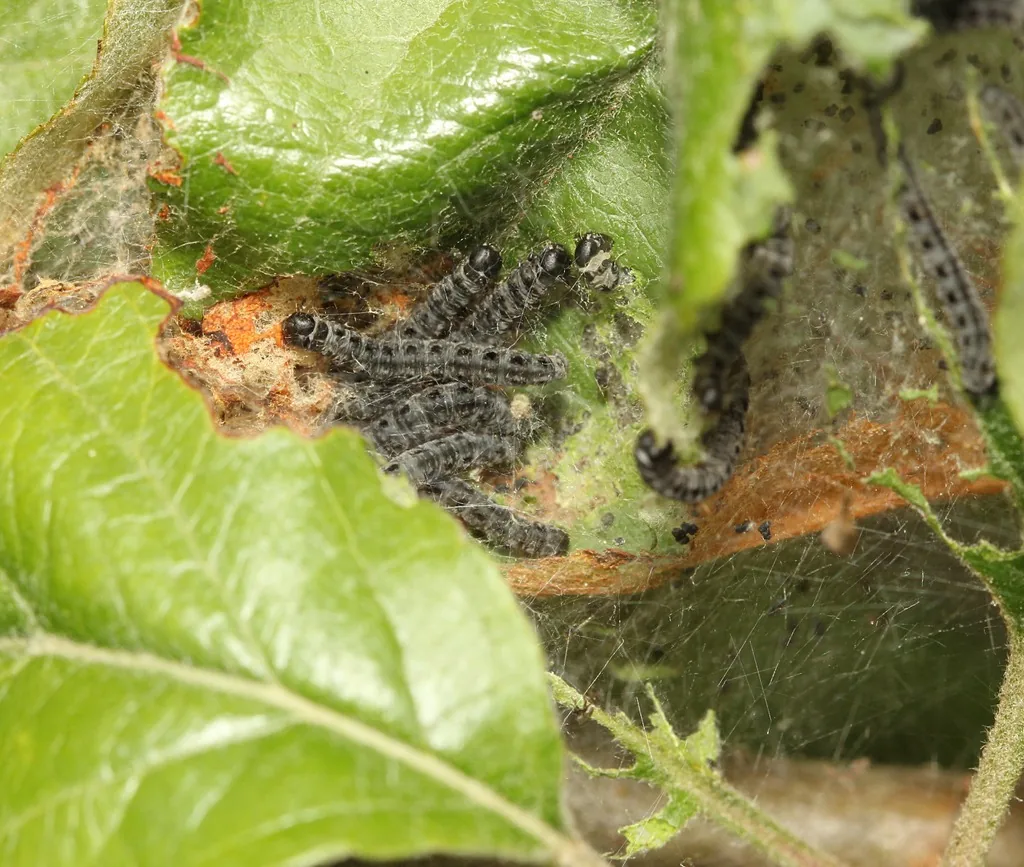
- Larvae are greenish-yellow caterpillars about 1/2 inch long with two rows of black spots.[1]
- They pupate in clusters of spindle-shaped white cocoons inside the webbing.[1]
Look-alikes
| Look-alike | How to tell them apart |
|---|---|
| Fall webworm | Fall webworm tents are much larger than apple ermine moth nests.[1] |
| Tent caterpillars | Their tents are also much larger than apple ermine moth nests.[1] |
Where it lives
Native to temperate Europe, North Africa and Asia. In North America it was found in British Columbia in 1981 and in Washington and Oregon in 1985, and CFIA says it hasn't established anywhere else, even though the U.S. doesn't regulate it.[2]
Biology and life cycle
Young larvae overwinter under their egg masses on the bark. Counts per cluster vary by source: the PNW handbook says 10 to 80 eggs, laid in overlapping rows like shingles, while CFIA gives an average of 60 (14 to 81).[1][2]
Larvae mine leaves at budbreak, then tie leaves into nests up to 3 inches across, several caterpillars to a nest.[1]
They pupate in clusters around June, and adults emerge from late June on, laying eggs into fall; there's one generation a year.[1]
Apple is the main host, with occasional reports on pear. The adults fly weakly, so the moth spreads slowly on its own; CFIA says dormant nursery stock carrying egg masses is the main way it moves.[2]
Females attract males with a two-part sex pheromone, and USDA researchers found synthetic lures caught more males than live females did.[3]
Damage and signs
Health risk
CFIA's risk review says it is unlikely to cause human or animal health problems.[2]
Control
Traps and physical control
Pick off or prune out egg masses on the bark in fall, prune out and destroy nests in May, and remove pupating clusters when you see them.[1]
Biological control
Natural enemies do much of the work. CFIA notes a tachinid fly and an ichneumon wasp attack larvae, predatory mites can kill up to 35% of eggs, and the introduced parasitoid wasp Ageniaspis fuscicollis can cause over 40% mortality in the Pacific Northwest.[2]
Pesticides
The PNW handbook lists zeta-cypermethrin for home use and notes it's highly toxic to bees. CFIA says Bacillus thuringiensis var. kurstaki (Bt) also helps keep orchard populations low.[1][2]
Regulation and naming
Canada treated it as a quarantine pest from 1988 but dropped that status in 2014, after a 2009 risk review rated it low risk. The U.S. does not regulate it.[2]
Names differ. GBIF's backbone taxonomy lists Yponomeuta malinella as a synonym of the orchard ermine, Y. padella, while the PNW handbook and CFIA treat the apple ermine moth as its own species, Y. malinellus.[4][1][2]
Common questions
Sources
- Pacific Northwest Pest Management Handbooks (OSU, WSU, University of Idaho), “Apple: Apple ermine moth (Insect Management Handbook).” pnwhandbooks.org/insect/tree-fruit/apple/apple-apple-ermine-moth (accessed 2026-11-13)
- Canadian Food Inspection Agency, “RMD-14-03: Deregulation of Yponomeuta malinellus (apple ermine moth).” inspection.canada.ca/en/plant-health/invasive-species/directives/pest-risk-management/rmd-14-03 (accessed 2026-11-13)
- J Chem Ecol 1990;16(2):477-486, via PubMed, “Apple ermine moth, Yponomeuta malinellus Zeller: two components of female sex pheromone gland highly effective in field trapping tests (McDonough et al., 1990).” pubmed.ncbi.nlm.nih.gov/24263504/ (accessed 2026-11-13)
- Global Biodiversity Information Facility (GBIF), “Yponomeuta malinella Zeller, 1838 (synonym of Yponomeuta padella in the backbone) (GBIF Backbone Taxonomy).” api.gbif.org/v1/species/1830470 (accessed 2026-11-13)
- iNaturalist, “Yponomeuta malinellus taxon page (order and family).” www.inaturalist.org/taxa/324938 (accessed 2026-10-06)