On this page
How to identify it
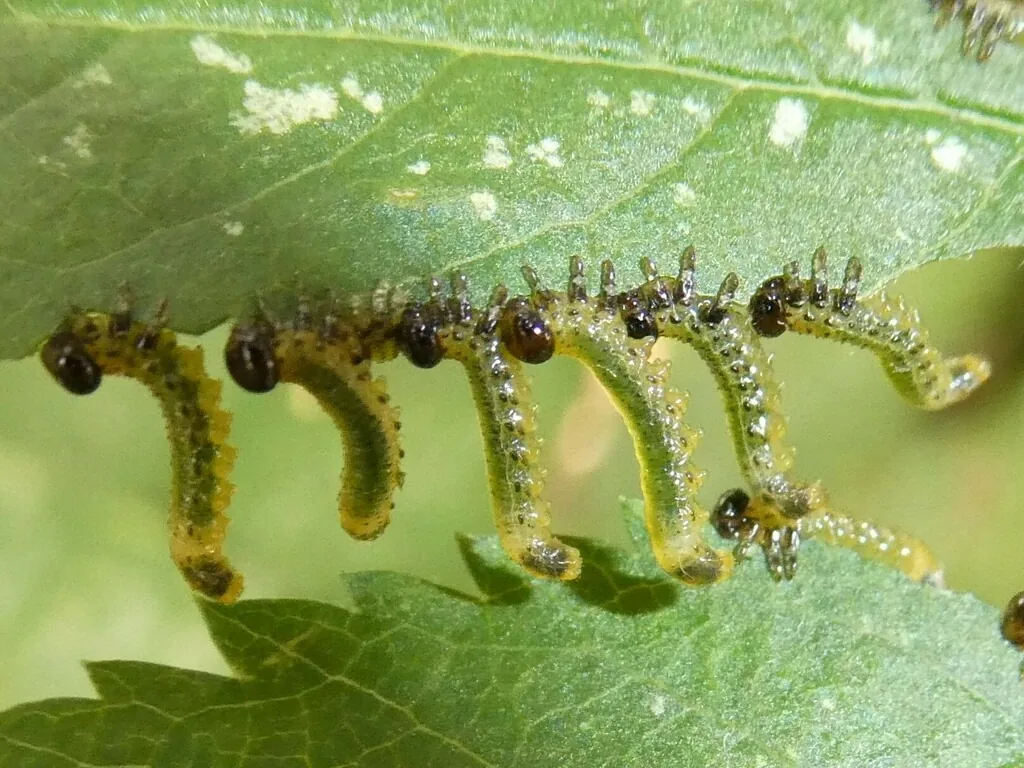
- Young larvae are pale yellow and somewhat translucent; older ones are orange-yellow or yellow with black spots or flecks and grow to 0.6 to 0.75 inch.[1][2][3]
- Larvae line up nearly head to head along a leaflet edge and swing their tail ends away from the leaf; when disturbed, they rear up into an S shape.[1][2][3]
- Adults look like small dark flies but have four wings; they are sawflies, in the same order as bees, ants and wasps.[1]
- Eggs are inserted in the edges of leaflets and look like tiny, swollen brown ovals along the serrated margin.[2]
Look-alikes
| Look-alike | How to tell them apart |
|---|---|
| Moth caterpillars | Sawfly larvae have 6 or more pairs of fleshy prolegs on the abdomen (or none), while moth and butterfly caterpillars have 5 or fewer pairs, with tiny hooks on the bottom.[2] |
Where it lives
The Canadian Forest Service says it came from Europe and was first reported in North America in New York in 1926, reaching Ontario by 1938; it now occurs across much of the northeastern U.S. and eastern Canada. UMass notes scientists were long unsure whether it was native to Europe. In the West, it was confirmed in Snohomish County, Washington, in 2009, a new western record, and has spread to several counties.[3][2][4][1]
Biology and life cycle
It overwinters in a brownish-tan cocoon in the soil. From late May, adults emerge over about six weeks, some into early July; each lives about a week, and females insert eggs into slits cut in the leaflet edges.[1][2][3]
Sources differ on generations. The PNW handbook says two and possibly three a year; UMass describes two, with a second adult flight by mid-August and larvae in September; the Canadian Forest Service says two in the south of Canada but only one in the north. Prepupae can stay dormant for two or three years.[1][2][3]
UMass lists American, European and showy mountain-ash and the hybrid Sorbaronia hybrida as hosts; the Canadian Forest Service also lists hawthorns among its main hosts.[2][1][3]
Larvae feed for about three weeks, then drop to the soil and spin a cocoon in an earthen cell.[2]
Damage and signs
- Larvae eat all but the midribs and stalks of the leaflets, often starting in the top of the crown and moving to lower branches, where damage is usually worse. The second generation can defoliate trees in midsummer, but UMass says trees usually keep enough food reserves that health isn't affected, and the Canadian Forest Service says it rarely kills them.[1][3][2]
Health risk
It feeds on mountain ash leaves, and no cited source describes any risk to people or pets.[1][2][3]
Control
Prevention
Check leaflet edges for eggs by late May or early June and look for young larvae a week later. Scout every year, since a heavily infested tree one year may be free of larvae the next; sticky traps can show when adults emerge.[2][1]
If a tree is defoliated, water it and give it light fertilizer to push new growth.[1]
UMass says this sawfly usually doesn't need chemical control and should be tolerated.[2]
Traps and physical control
Hand-pick or prune off leaves with eggs or young larvae as soon as you notice them. Early removal limits midsummer defoliation by the second generation, since older larvae can strip whole branches.[1][2][3]
Biological control
Bt (Bacillus thuringiensis kurstaki) won't work: it kills only moth and butterfly caterpillars, not sawfly larvae.[2]
In eastern Canada, an introduced ichneumonid wasp, Olesicampe geniculatae, was released in the 1980s; by 1990 it was established at some sites and sawfly numbers had dropped below damaging levels.[2][3]
How the larvae defend themselves
A 1990 Journal of Chemical Ecology study found that the larvae's defensive secretion contains seven volatile compounds, including benzaldehyde and mandelonitrile.[5]
Disturbed larvae rear up into an S shape, and the young feed in groups before older larvae spread out through the crown, some feeding alone.[2][3]
Where the sources disagree
Hosts: the Canadian Forest Service says this pest attacks only mountain ash, yet lists hawthorns among its main hosts; UMass lists three mountain-ashes and Sorbaronia hybrida, and the Pacific Northwest handbook names American and European mountain ash.[3][2][1]
Origin: the Canadian Forest Service and the Pacific Northwest handbook say it came from Europe, while UMass says scientists were historically uncertain whether it came from Europe.[3][1][2]
Generations and timing: the Pacific Northwest handbook says two and possibly three a year; UMass says a second generation of adults occurs by mid-August, with larvae in September; the Canadian Forest Service says two in the south of Canada and one in the north, with the second generation, when there is one, starting at the end of July and usually small.[1][2][3]
Winter stage: UMass says the prepupa overwinters and the Canadian Forest Service says it overwinters in a cocoon in the soil; the Pacific Northwest handbook says both that larvae stay as prepupae in winter and that winter is spent in the pupal stage.[2][3][1]
Chemical control: UMass says it typically does not require chemical management and should be tolerated, while the Pacific Northwest handbook refers readers to its chemical control table for sawflies.[2][1]
Common questions
- What are the spotted yellow larvae eating my mountain ash?
- Likely mountain ash sawfly larvae, which feed in lines along leaflet edges and rear up in an S shape when disturbed.[1][2]
- Are mountain ash sawfly larvae caterpillars?
- No. They're sawfly larvae, related to bees, ants and wasps, so Bt products made for caterpillars won't control them.[1][2]
Sources
- Pacific Northwest Pest Management Handbooks (OSU, WSU, University of Idaho), “Emerging Insect Pests in the Pacific Northwest: Mountain ash sawfly (2009).” pnwhandbooks.org/insect/emerging-insect-pests/emerging-insect/mountain-ash-sawfly-2009 (accessed 2026-11-13)
- UMass Amherst Extension Landscape, Nursery and Urban Forestry Program, “Pristiphora geniculata (Insect & Mite Guide).” www.umass.edu/agriculture-food-environment/landscape/publications-resources/insect-mite-guide/pristiphora-geniculata (accessed 2026-11-13)
- Natural Resources Canada, Canadian Forest Service, “Mountain-ash sawfly (Forest Invasive Alien Species).” www.exoticpests.gc.ca/es-details/insect/1000090 (accessed 2026-11-13)
- Oregon State University, College of Agricultural Sciences, “Mountain Ash Sawfly (Nursery Pests).” agsci.oregonstate.edu/nurspest/insects/mountain-ash-sawfly (accessed 2026-11-13)
- Peer-reviewed literature (PubMed), “Mandelonitrile in larval secretion of mountain ash sawfly,Pristiphora geniculata (Hymenoptera: Tenthredinidae) (Duffield RM et al., Journal of chemical ecology, 1990).” pubmed.ncbi.nlm.nih.gov/24263715/ (accessed 2026-11-13)
- Global Biodiversity Information Facility (GBIF), “Pristiphora geniculata (Hartig, 1840) (GBIF Backbone Taxonomy).” api.gbif.org/v1/species/5023190 (accessed 2026-11-13)