On this page
How to identify it
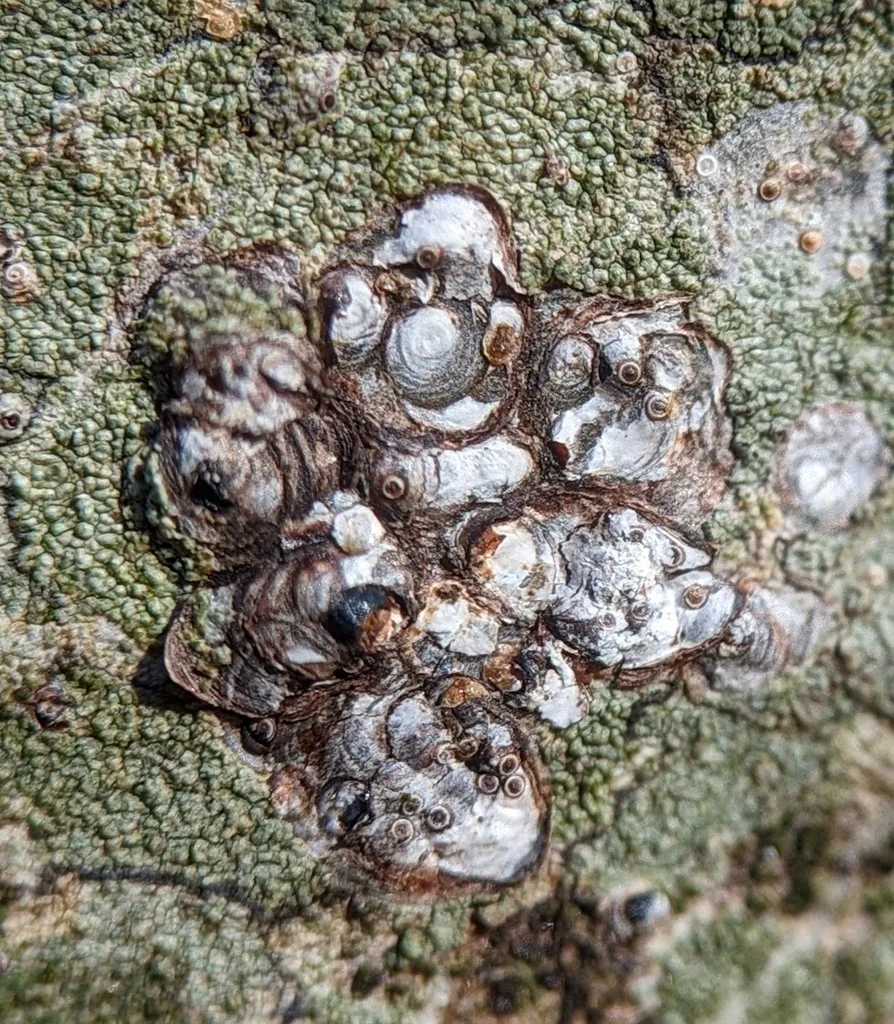
- The female's waxy cover is flat, about 1/8 inch (3 mm) across and dirty gray, with a slightly off-center black cap. Underneath is the yellow or cream-colored insect.[1][2]
- Up close, infested branches can look sprinkled with wood ash or silver glitter, and badly infested bark may carry three or four layers of waxy covers.[1][2]
- Touching infested bark can knock loose layers of scales and waxy armor.[1]
Where it lives
Hosts include oaks (especially pin and willow oaks), beech, dogwood, hackberry, hickory, maple, pecan and willow, on the trunks and limbs of young and mature trees. Penn State notes it is not a pest of these trees when they grow in the forest.[1][2]
Biology and life cycle
It overwinters as nymphs on twigs and branches. Females mature in late April to early May and males during May; males mate and die, and each female lays about 50 pink eggs over several months.[1][2]
Because egg laying is drawn out, crawlers appear over a long stretch. Kentucky Extension gives early summer to the end of August; Penn State says mid-July through September.[1][2]
Early crawlers often settle under the covers of dead scales, while later ones move to uninfested bark and spread the infestation. Second-stage nymphs build their own waxy cover in early fall, and there is one generation a year.[1][2]
Damage and signs
Health risk
Obscure scale feeds on tree sap; neither Kentucky nor Penn State Extension describes any risk to people.[1][2]
Control
Prevention
Keep trees vigorous with proper watering and fertility, but don't over-fertilize, which favors scale buildup. Check 3- to 4-year-old twigs, especially on pin oak, for the gray covers, since early detection matters.[1][2]
Sanitation
Prune out heavily infested twigs and branches to slow the spread and make other treatments more effective.[1][2]
Biological control
Penn State lists four parasitic wasps, one predatory mite and three lady beetles that attack obscure scale; short-residual insecticides help conserve them.[2]
Pesticides
Sources differ on spray timing. Kentucky's fact sheet treats crawlers in May or July with a pyrethroid or oil-based insecticide, or uses a systemic dinotefuran product instead, and suggests checking for crawlers with sticky tape in July and August. Penn State times sprays for when crawlers peak and parasitic wasps are least active: late July for red oaks and mid-August for white oaks, with two applications.[1][2]
It is hard to control. Crawlers shelter under old covers, the wax shields developing scales, and once crawlers start forming their armor, sprays have little or no effect. Horticultural oil may fail where several layers of covers have built up, and control can take repeated treatments over a couple of seasons.[1][2]
Checking whether treatment worked
Results may not show right away. Crush a few scales: live ones give off liquid, while dead ones are dry. Once the scale burden drops, new foliage should look healthier, with buds breaking a little earlier and leaves of normal color.[1]
Common questions
- What's the gray crust on my oak's bark?
- Possibly obscure scale. Infested bark looks dusted with ash or silver glitter and may carry layers of flat, gray waxy covers.[1][2]
- Why is it called obscure scale?
- Kentucky Extension says it gets its name from being hard to see. Penn State says infestations are easiest to recognize by the layers of dead scales crusted on branches.[1][2]
Sources
- University of Kentucky Entomology (ENTFACT), “Obscure Scale (ENTFACT-432).” entomology.mgcafe.uky.edu/ef432 (accessed 2026-11-13)
- Penn State Extension, “Obscure Scale.” extension.psu.edu/obscure-scale (accessed 2026-11-13)
- Global Biodiversity Information Facility (GBIF), “Melanaspis obscura (Comstock, 1881) (GBIF Backbone Taxonomy).” api.gbif.org/v1/species/8052545 (accessed 2026-11-13)
- iNaturalist, “Melanaspis obscura taxon page (order and family).” www.inaturalist.org/taxa/319358 (accessed 2026-10-06)