On this page
How to identify it
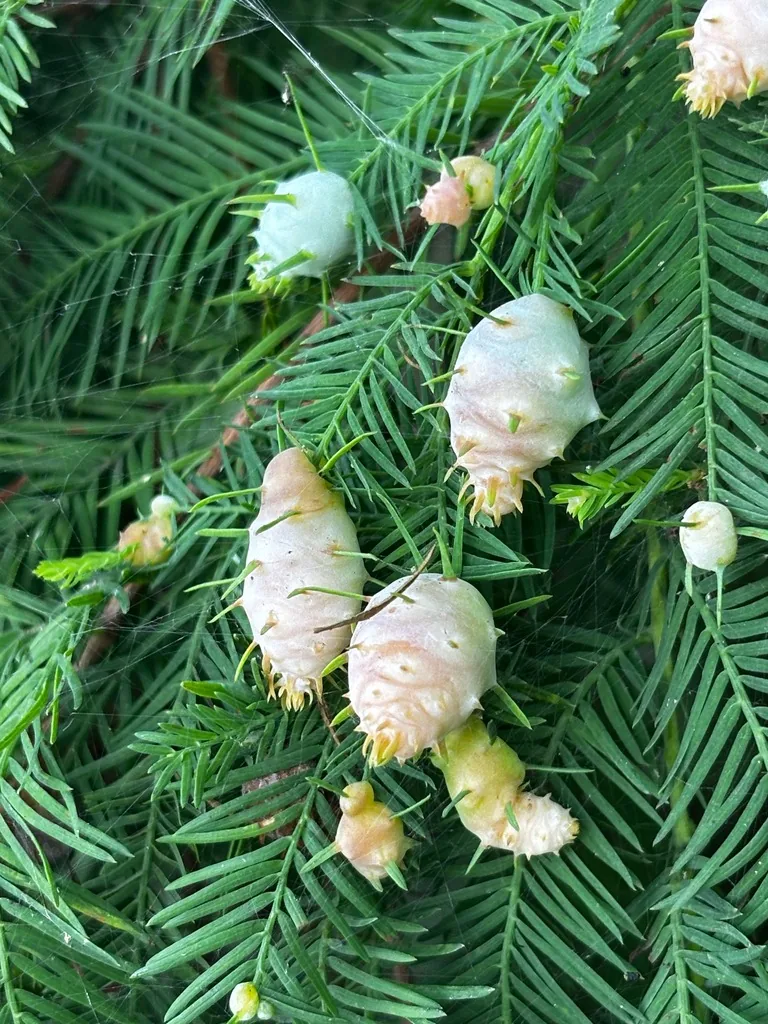
- Galls are 3/4 to 1 1/4 inches long. New ones are pink or pale green with a white bloom; they are spongy and turn brown with age. Despite the name, they form on the midribs of the compound leaves, not on the twigs.[1][2]
- Each gall can hold a dozen or more maggots, and bigger galls hold more. Mature maggots are fat, yellow to orange-red and about 1/16 inch long.[1][2]
- Adults are tan, gnat-like flies under 1/8 inch long with clear wings. Females have red-orange abdomens; males are smaller, with tan-orange abdomens.[1]
- Eggs are bright orange and slender, laid in clusters of about 15 on young leaves.[1]
Look-alikes
Where it lives
GBIF has about 2,900 U.S. records since 1990. Most come from Florida, Louisiana, Texas, North Carolina, Maryland and Virginia, and they reach north to Illinois, Indiana, Ohio, Pennsylvania and New York. In 2025 researchers reported it in Mexico for the first time.[3][4]
Biology and life cycle
Maggots usually overwinter inside fallen galls, then pupate there and emerge as adults the following spring.[1][2]
Adults may also emerge later in the season from galls still on the tree. Mississippi State says these complete a second generation; NC State counts one, possibly two, generations a year in North Carolina.[1][2]
Galls turn brown and drop from the tree as the leaves are shed.[1][2]
Damage and signs
- NC State and Mississippi State say it infests only bald cypress and pond cypress. The leaf dies beyond the gall, and brown galls can be so abundant that branches droop.[1][2]
- In central Mexico, though, researchers in 2025 reared it from galls on Montezuma cypress (Taxodium mucronatum), Mexico's national tree; before that it had been reported only from the U.S. on bald cypress.[4]
Health risk
NC State and Mississippi State describe it only as a cosmetic pest of cypress and mention no effect on people or pets.[1][2]
Control
Prevention
Outbreaks are sporadic. A tree heavily galled one year may have only a few galls in following years.[1][2]
Sanitation
Collect and destroy fallen galls in autumn or early spring, before the midges become active and lay eggs.[1]
Biological control
At least four species of tiny parasitic wasps attack the midge and help keep it in check. In the Mexican study, 35.3 percent of the midges were parasitized by one of them, Aprostocetus fidius.[1][2][4]
Pesticides
Insecticides are not recommended: the galls don't really harm the tree and there is no good, practical treatment.[1][2]
Common questions
- What are the little white cone-like balls on my bald cypress?
- Galls made by cypress twig gall midge maggots. They are often mistaken for cones.[1][2]
- Do the galls hurt the tree?
- No. They're unsightly, especially once brown, but don't really harm the tree.[1][2]
- How can I reduce them next year?
- Rake up and destroy fallen galls in fall or early spring, and expect numbers to swing from year to year.[1][2]
Sources
- NC State Extension, “Cypress Twig Gall Midge (PDIC Factsheet).” content.ces.ncsu.edu/cypress-twig-gall-midge (accessed 2026-11-11)
- Mississippi State University Extension Service, “Cypress Twig Gall Midge (Bug's Eye View, Vol. 4, No. 29, B. Layton 2018).” extension.msstate.edu/newsletters/bugs-eye-view/2018/cypress-twig-gall-midge-vol-4-no-29 (accessed 2026-11-11)
- Global Biodiversity Information Facility (GBIF), “Taxodiomyia cupressiananassa: U.S. occurrence records since 1990 by state (GBIF occurrence search).” api.gbif.org/v1/occurrence/search?taxonKey=1595940&country=US&hasGeospatialIssue=false&occurrenceStatus=PRESENT&year=1990%2C2026&facet=stateProvince&facetLimit=400&limit=0 (accessed 2026-11-11). Exact count at access: 2,931 U.S. records since 1990 (Florida 705; Louisiana 340; Texas 248; North Carolina 227; Maryland 218; Virginia 183).
- Revista Árvore, “First record of galling dipterans and its parasitoid on Taxodium mucronatum Ten. in Mexico (Sánchez Cisneros et al. 2025).” doi.org/10.53661/1806-9088202650264073 (accessed 2026-11-11). Read from the article page abstract (Portuguese) at revistaarvore.ufv.br.
- iNaturalist, “Taxodiomyia cupressiananassa taxon page (order and family).” www.inaturalist.org/taxa/133713 (accessed 2026-10-06)