On this page
How to identify it
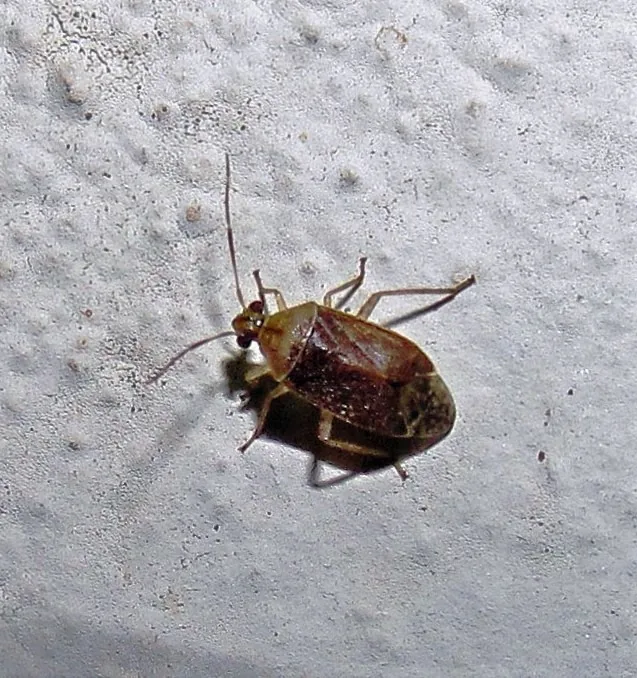
- Adults are slender, oval bugs about 1/4 inch long, green to light brown, with a distinct yellow triangular spot in the middle of the back.[1][2][5]
- Nymphs reach about 1/8 inch and range from pale yellow or red to brown or almost black; they look like large, fast-moving aphids.[1][5]
- Both leave shiny black, sticky specks of excrement (varnish spots) on the undersides of leaves.[1][2][5]
Look-alikes
Where it lives
UMass calls it an eastern species now widespread through the nursery trade; several other plant bugs feed on ash elsewhere. Minnesota lists green, white and black ash as hosts, while Iowa State and UMass name green and white ash.[4][1][2]
Biology and life cycle
Eggs hatch in spring as the leaves expand, given as late April or early May in Montana and mid-May in Massachusetts. First-generation adults appear in June (Minnesota, Montana) or late June to early July (Iowa).[1][2][3][4]
First-generation females lay eggs along leaf midribs; the second generation feeds until the first hard frost and lays the eggs that overwinter on twigs, bud scales and bark crevices. There are two generations a year.[1][3][4]
Damage and signs
- Feeding makes tiny yellow-white spots on the upper leaf that merge into blotches; leaves may twist, wilt, brown and look scorched.[1][2][4]
- The first generation does more damage because young leaves are more sensitive to plant bug saliva.[1][5][4]
- Sources differ on leaf drop. Minnesota says ash plant bug damage shouldn't make leaves fall in spring and damaged leaves can stay on until autumn, while Iowa State, Montana State, UMass and SDSU say heavily infested leaves can drop early.[1][2][3][4][5]
Health risk
It feeds on ash leaves; none of the extension sources mentions any risk to people.[1][2]
Control
Prevention
Usually ignore it. Healthy trees replace lost leaves, and by the time damage shows it's usually too late to treat; watering and mulching to keep trees vigorous helps most.[1][2][4][5]
Traps and physical control
On small trees, shake the branches or hose nymphs off the leaves early in the season.[3]
Pesticides
Sources differ on treating. SDSU sees no need for any treatment, while Iowa State says stressed or newly transplanted trees may justify it: start checking for nymphs when redbuds bloom. If you do spray, insecticidal soap or pyrethrins only work when they hit spring nymphs directly, and later sprays do less.[5][2][1]
Common questions
- Why do my ash leaves look blotchy and twisted?
- Ash plant bug nymphs feeding on young leaves cause speckling, blotches and twisting.[1]
- Do I need to treat?
- Usually not; the damage is cosmetic on healthy trees. Iowa State makes an exception for stressed or newly planted trees, treated while nymphs are small.[1][2][5]
- Will the leaves fall off?
- Usually they hang on. Minnesota says spring leaf drop usually means anthracnose or stress, though other extension services note heavy infestations can drop leaves early.[1][2][4]
Sources
- University of Minnesota Extension, “Ash plant bugs (Yard and garden insects).” extension.umn.edu/garden-and-home/yard-and-garden/yard-and-garden-insects/ash-plant-bugs (accessed 2026-11-13)
- Iowa State University Extension and Outreach, “Ash plant bug.” yardandgarden.extension.iastate.edu/encyclopedia/ash-plant-bug (accessed 2026-11-13)
- Montana State University Extension, “Ash Plant Bug (A Guide to Pests, Problems and Identification of Ornamental Shrubs and Trees in Montana).” www.montana.edu/extension/Full_HTML_Pubs/a-guide-to-pests-problems-and-identification-of-ornamental-shrubs-and-trees-in-montana/insects/ash-plant-bug.html (accessed 2026-11-13)
- UMass Amherst Extension, Landscape, Nursery and Urban Forestry Program, “Tropidosteptes amoenus (Insect & Mite Guide).” www.umass.edu/agriculture-food-environment/landscape/publications-resources/insect-mite-guide/tropidosteptes-amoenus (accessed 2026-11-13)
- SDSU Extension and South Dakota Department of Agriculture and Natural Resources, “Tree Pest Alert, May 21, 2025 (Turner County, ash plant bug).” extension.sdstate.edu/sites/default/files/2025-05/S-00014-158.pdf (accessed 2026-11-13)
- Global Biodiversity Information Facility (GBIF), “Tropidosteptes amoenus Reuter, 1909 (GBIF Backbone Taxonomy).” api.gbif.org/v1/species/2010855 (accessed 2026-11-13)