On this page
How to identify it
- The main sign is semicircular holes or irregular notches along eucalyptus leaf edges.[1]
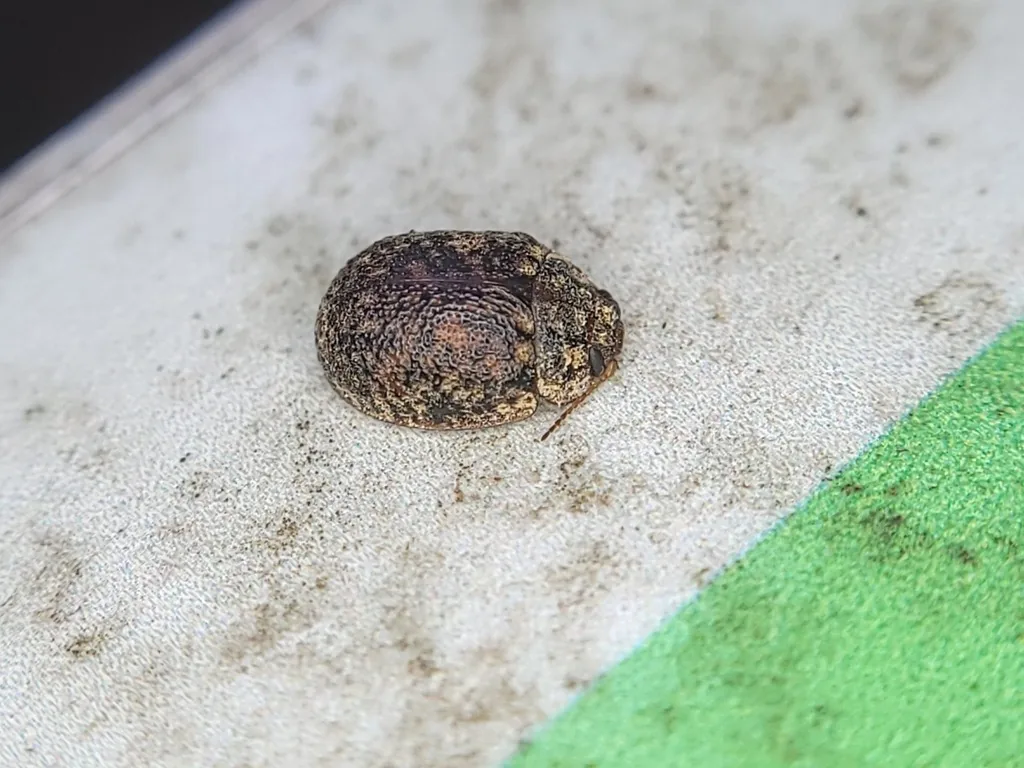
- Adults are hemispherical, about 1/4 to 3/8 inch long, and look a bit like a large lady beetle. Trachymela sloanei, the widespread species, is dark brown with blackish mottling; Chrysophtharta m-fuscum is lighter, gray to reddish brown.[1]
- Larvae look like caterpillars or sawfly larvae but have no prolegs on the abdomen. T. sloanei larvae are dark green to reddish brown with a black head and a black shield just behind it; C. m-fuscum larvae are greenish gray with a black head.[1]
- T. sloanei hides under loose bark by day and feeds mostly at night, often high in the tree; if no beetles are on the leaves, look under loose bark for adults, eggs, larvae and pupae.[1]
Look-alikes
| Look-alike | How to tell them apart |
|---|---|
| Eucalyptus snout beetle | The eucalyptus snout beetle (gumtree weevil) is a reddish-brown weevil with an obvious snout. Its legless, slimy yellowish-green young larvae scrape leaf surfaces, leaving discolored trails and holes in the middle of leaves rather than notches along the edges, though older snout beetle larvae also chew leaf margins.[1] |
Where it lives
T. sloanei was found in Riverside County in 1998 and now occurs in most of California where eucalyptus grows; C. m-fuscum was found in Orange County in 2003 and has spread to at least four nearby counties. In 2025 T. sloanei was reported for the first time in Africa, from ornamental eucalyptus in northeastern Algeria, and a niche-modeling study predicted a large climatically suitable range for it in Brazil.[1][2][3]
Biology and life cycle
T. sloanei females lay 5 to 40 or more eggs side by side on leaves or under loose bark; the eggs start pinkish or light brown and turn orange or dark brown to purplish. C. m-fuscum lays 1 to 40 or more bright orange eggs on leaves.[1]
Larvae pass through four stages, then pupate under loose bark or drop to pupate in soil or litter. In warm weather egg to adult can take as little as 5 weeks, with several generations a year from late winter through fall.[1]
Damage and signs
- Adults and larvae chew semicircular holes or notches along leaf edges and can strip a leaf down to the midvein; heavy infestations can strip most leaves, adding stress to trees already hit by more than a dozen other introduced eucalyptus pests.[1]
- Sources weigh the threat differently. UC IPM says tattered leaves are usually just an annoyance and the beetles alone aren't known to kill trees, though C. m-fuscum is a serious pest of Baby Blue eucalyptus grown for cut foliage. The Algerian report calls T. sloanei a recognized eucalyptus defoliator and warns of possible impacts on plantations and urban trees in North Africa.[1][2]
Health risk
It feeds on eucalyptus leaves, and no cited source describes any risk to people or pets.[1][2]
Control
Prevention
Good cultural care is the main defense. UC IPM says to water drought-stressed trees deeply and infrequently with drip rather than sprinklers, avoid fertilizing, prune only in December or January to avoid borer attacks, and choose well-adapted eucalyptus species; no control is needed in many landscapes.[1]
Biological control
UC scientists released an Australian egg parasite, Enoggera reticulata, against T. sloanei, but it hasn't been recovered in California surveys and probably didn't establish; it did control another eucalyptus tortoise beetle in South Africa. Avoid actions that harm the natural enemies of other eucalyptus pests.[1]
Pesticides
UC IPM says most infestations don't need pesticides, which should be a last resort because they disrupt biological control of other eucalyptus pests. There is no published research in landscapes; in nurseries and eucalyptus stands, soil-applied systemic neonicotinoids (imidacloprid, or clothianidin for commercial applicators only) gave long-term control. UC does not recommend broad-spectrum foliar sprays such as carbaryl or pyrethroids on landscape eucalyptus because of drift, runoff and harm to natural enemies. Follow the label.[1]
Common questions
- What's chewing notches in my eucalyptus leaves?
- In California, eucalyptus tortoise beetles are a common cause of semicircular notches along leaf edges. If you see no beetles on the leaves, UC IPM says to look under loose bark, where T. sloanei hides by day.[1]
- Will they kill the tree?
- Not on their own. UC IPM says the beetles alone aren't known to kill trees, but combined stress from many pests and poor growing conditions could eventually lead to tree death.[1]
Sources
- University of California Statewide IPM Program, “Pest Notes: Eucalyptus Tortoise Beetles (Publication 74104).” ipm.ucanr.edu/PMG/PESTNOTES/pn74104.html (accessed 2026-11-13)
- Zootaxa (via PubMed), “First report of the invasive Australian tortoise beetle Trachymela sloanei (Blackburn, 1897) (Coleoptera: Chrysomelidae) in Algeria (Hadiby et al. 2025) (abstract).” pubmed.ncbi.nlm.nih.gov/42407653/ (accessed 2026-11-13)
- Pest Management Science (via PubMed), “Suitable areas for invasive insect pests in Brazil and the potential impacts for eucalyptus forestry (Mota et al. 2022) (abstract).” pubmed.ncbi.nlm.nih.gov/35338563/ (accessed 2026-11-13)
- Global Biodiversity Information Facility (GBIF), “Trachymela sloanei (Blackburn, 1896) (GBIF Backbone Taxonomy).” api.gbif.org/v1/species/1048549 (accessed 2026-11-13)