On this page
How to identify it
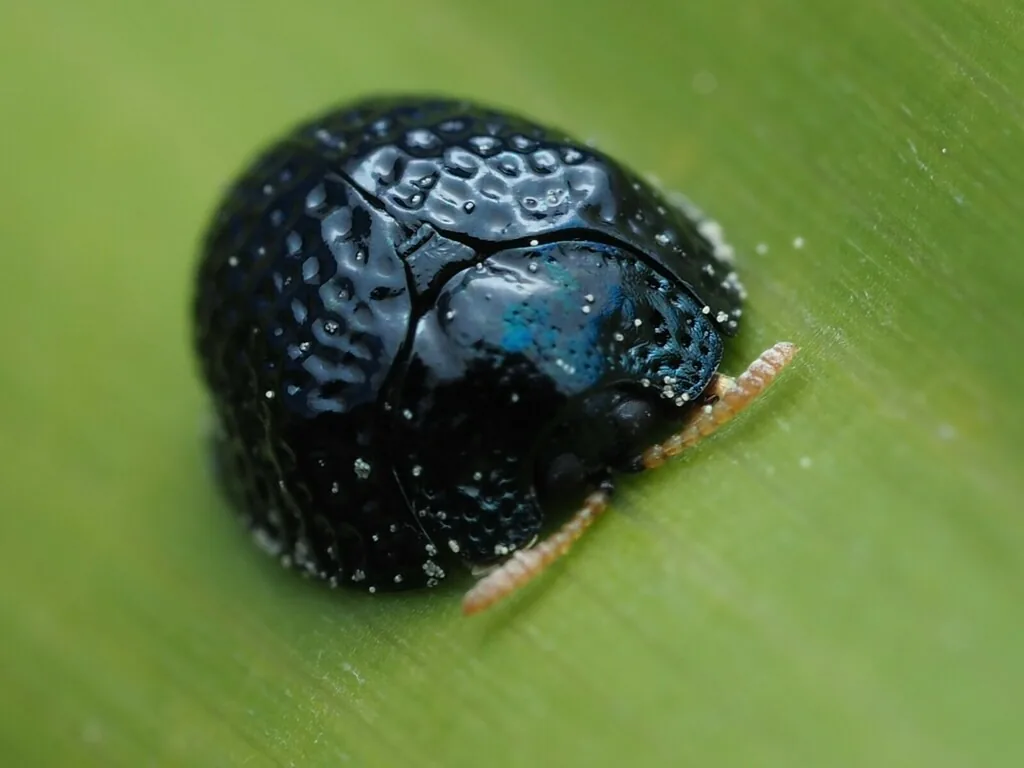
- Adults are about a quarter inch long and shaped like a turtle or tortoise shell. UF/IFAS describes adults as dark blue to purple with alternating lengthwise rows of pits and ridges on the wing covers, and yellow antennae with a black first segment.[1][7]
- The last segments of the legs (tarsi) are greatly enlarged pads; Cornell researchers counted some 60,000 adhesive bristles on them, each ending in two tiny pads. UF/IFAS gives about 10,000 bristles on each of the enlarged feet.[1][3][7]
- Larvae hide under a shield of coiled strands of dry droppings that looks like the fibers hanging from palm fronds.[1][4]
- Eggs are yellow and elongated. The female cements them to the leaf and covers them with a double row of fecal pellets, which probably protects them from predators and parasitoids.[7]
Where it lives
Clemson Extension describes it from the coast and coastal plain of the Southeast. GBIF records since 1990 come mostly from Florida, then Georgia and South Carolina, with smaller numbers from Texas, Alabama and Mississippi. UF/IFAS records it from Florida, Georgia, Alabama and Texas and says it probably also occurs in Louisiana and Mississippi where palms grow.[1][2][7]
Biology and life cycle
When disturbed or in high wind, the adult presses its feet flat so that nearly all the bristles touch the leaf and releases an oil that holds it in place. In lab tests it resisted a pull of 0.8 g, about 60 times its body weight, for 2 minutes, and more than 3 g for shorter periods.[1][3]
A later engineering study described the grip as about 120,000 microscopic liquid bridges between the feet and the leaf, and concluded that the beetle can adjust the type and size of the load on them in real time.[5]
Larvae start building the fecal thatch as soon as they hatch, add to it as they grow instead of shedding it at each molt, and pupate underneath it.[4][1]
In Georgia, viable eggs were found from early March to mid-April. Larvae and pupae turn up through mid to late summer, and adults all year. Larvae hold their fecal shield in place with a fork at the tip of the abdomen.[7]
Damage and signs
- It feeds on saw palmetto, cabbage palmetto (Sabal palmetto) and dwarf palmetto. UF/IFAS says it is most common on saw palmetto, also feeds on cabbage palm, dwarf palmetto, scrub palmetto (Sabal etonia) and probably other native palms, and has been reported from a variety of exotic palms in Florida.[1][7]
- It occasionally causes damage, but most of the time it lives on the palm unnoticed. UF/IFAS says larvae scrape the leaf surface in trough-like marks but rarely cause significant economic damage.[1][7]
Health risk
None reported. It feeds only on palms, and neither Clemson Extension nor the research on its defenses mentions any harm to people or pets.[1][3]
Control
Prevention
Control is rarely needed, since the beetles mostly go unnoticed and only occasionally scar fronds.[1]
Biological control
Ants usually give up on adults clinging to a frond, but the wheel bug can feed on them, probably because its venom breaks the beetle's grip. The larval thatch stops a lady beetle larva and a predatory stink bug, while one ground beetle routinely forces its way under it.[3][4]
How it defends itself
By holding on longer than an attacking ant keeps trying, the adult beetle escapes ant attacks. The assassin bug Arilus cristatus (wheel bug) is one predator that can still eat it. UF/IFAS adds that the oils on the feet are similar to those on ordinary insect cuticle and aren't thought to be special to this defense.[3][7]
In feeding tests the larval thatch protected larvae from a lady beetle larva (Cycloneda sanguinea) and a stink bug (Stiretrus anchorago), but the ground beetle Calleida viridipennis either squeezed beneath the thatch or chewed through it.[4]
Where the sources disagree
Range: UF/IFAS lists Florida, Georgia, Alabama and Texas, probably Louisiana and Mississippi, and does not mention South Carolina; Clemson Extension covers it on the South Carolina coast, and GBIF holds South Carolina records.[7][1][2]
Color: UF/IFAS describes adults as dark blue to purple; Clemson Extension describes them as metallic dark blue-green.[7][1]
Common questions
- What are the tiny blue beetles stuck to my palmetto?
- Likely palmetto tortoise beetles, which clamp onto fronds with oily, bristly feet when disturbed.[1][3]
- What is the straw-like tuft on my palm leaf?
- Often a palmetto tortoise beetle larva hiding under its coiled shield of dry droppings, which mimics palm fibers.[1][4]
- When are palmetto tortoise beetle larvae around?
- UF/IFAS says larvae and pupae are found through mid to late summer, while adults can be seen all year.[7]
Sources
- Clemson Cooperative Extension Home & Garden Information Center, “Palmetto Tortoise Beetles: Masters of Camouflage.” hgic.clemson.edu/palmetto-tortoise-beetles-masters-of-camouflage/ (accessed 2026-11-11)
- Global Biodiversity Information Facility (GBIF), “Hemisphaerota cyanea: U.S. occurrence records since 1990 by state (GBIF occurrence search).” api.gbif.org/v1/occurrence/search?taxonKey=1048551&country=US&hasGeospatialIssue=false&occurrenceStatus=PRESENT&year=1990%2C2026&facet=stateProvince&facetLimit=400&limit=0 (accessed 2026-11-11)
- Proceedings of the National Academy of Sciences, via PubMed, “Defense by foot adhesion in a beetle (Hemisphaerota cyanea) (Eisner and Aneshansley 2000).” pubmed.ncbi.nlm.nih.gov/10841556/ (accessed 2026-11-11)
- Proceedings of the National Academy of Sciences, via PubMed, “Defensive use of a fecal thatch by a beetle larva (Hemisphaerota cyanea) (Eisner and Eisner 2000).” pubmed.ncbi.nlm.nih.gov/10681467/ (accessed 2026-11-11)
- Biointerphases, via PubMed, “Adaptive adhesion by a beetle: manipulation of liquid bridges and their breaking limits (Macner and Steen 2014).” pubmed.ncbi.nlm.nih.gov/24739008/ (accessed 2026-11-11)
- iNaturalist, “Hemisphaerota cyanea taxon page (order and family).” www.inaturalist.org/taxa/126416 (accessed 2026-10-06)
- University of Florida IFAS Extension, EDIS (Featured Creatures), “Palmetto Tortoise Beetle, Florida Tortoise Beetle, Hemisphaerota cyanea (Say), EENY232/IN388 (Featured Creatures).” ask.ifas.ufl.edu/publication/IN388 (accessed 2026-11-14)