On this page
How to identify it
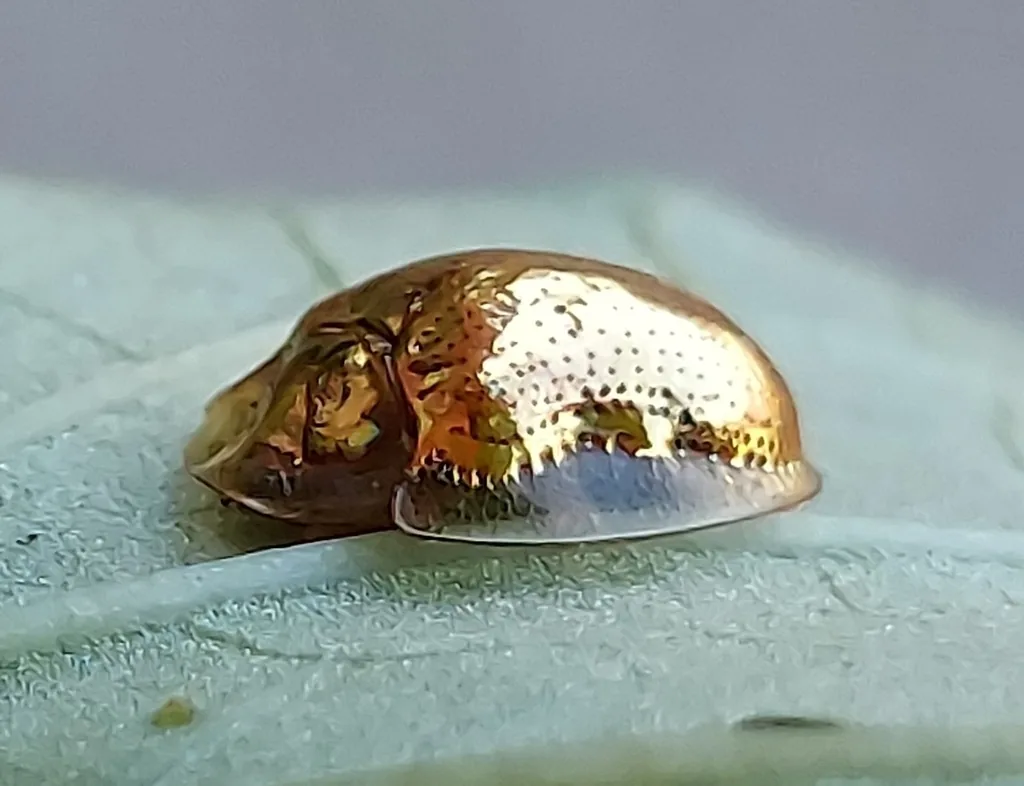
- Adults are nearly round and somewhat flattened, like a safari hat, and the shield behind the head covers the head completely. Colorado State gives a length of about 5 to 6 mm; Missouri's field guide says less than 1/4 inch.[1][2]
- Living beetles are brilliant metallic gold or orange, and the edges of the wing covers are clear. Two spots may show on the wing covers, making the beetle look a little like a lady beetle.[2][1]
- The color changes. A beetle may later look more bronze or reddish with spots, it may change color when disturbed, and the gold is lost when it dies. Colorado State explains that moisture moving into or out of the shell's surface makes the difference: hydrated, the surface acts as a perfect reflector.[1][2]
- When disturbed, adults clamp flat against the leaf with the legs tucked underneath, the way a tortoise pulls into its shell.[1]
- Colorado State describes the larvae as flattened and spiny, with a movable fork at the tail end, and both sources say they carry their own droppings on their backs, Colorado State adding old skins (see where the sources disagree on their shape).[1][2]
- Eggs are laid on the leaves of host plants.[1]
Look-alikes
| Look-alike | How to tell them apart |
|---|---|
| Mottled tortoise beetle | Same shape and also gold, but it always has some darker markings; the golden tortoise beetle can be nearly uniform gold.[1] |
| Lady beetles | A spotted golden tortoise beetle is about lady beetle size and can pass for one, but look for the clear, flattened edge around the body and a shield that completely covers the head.[1][2] |
Where it lives
Colorado State says that in Colorado it can likely be found wherever its morning glory family hosts grow. GBIF has about 3,900 U.S. records since 1990 from 44 states and Washington, D.C., the most from New York, Texas, Ohio, Vermont and Pennsylvania, with only a few from Rocky Mountain and desert states such as Montana, Arizona and New Mexico.[1][3]
Biology and life cycle
Adults spend the winter in sheltered spots such as plant debris and move to host plants in spring to mate. Field bindweed, a perennial that comes up in mid-spring, is likely an important early host; morning glories and sweetpotato are colonized later.[1]
Larvae feed on the undersides of leaves and pupate on the plant, the pupa also covered with old skins and droppings. New adults emerge after a week or two, feed through late summer, and don't breed until after winter.[1]
Larvae are noticed far less often than the shiny adults, and their shield of droppings helps deter enemies.[1][2]
Weather may shape their numbers. In a study by Auburn University researchers, golden tortoise beetle larvae lost water faster than mottled tortoise beetle larvae, and golden larvae were scarce in a drought year and more plentiful in two wet years.[4]
Damage and signs
- Adults and larvae chew holes in leaves; larval feeding leaves characteristic holes in the middle of the leaf.[1]
- Every host is in the morning glory family, including morning glories, sweetpotato and field bindweed.[1][2]
- The Missouri Department of Conservation lists tortoise beetles among the leaf beetles that can be crop and garden pests.[5]
Health risk
Colorado State Extension and the Missouri Department of Conservation describe it only as a leaf feeder on morning glory family plants and don't mention any risk to people or pets.[1][2]
Control
Prevention
Neither Colorado State nor Missouri's field guide gives a treatment for golden tortoise beetles. Because field bindweed is likely an important early-season host, beetles can start there before moving to morning glories and sweetpotato.[1][2]
Where the sources disagree
Name: Colorado State lists the golden tortoise beetle as Charidotella sexpunctata bicolor (formerly Metriona bicolor), the Missouri Department of Conservation as C. sexpunctata, and the Auburn study as C. bicolor; GBIF's backbone taxonomy treats C. sexpunctata as the species and C. s. bicolor as a subspecies.[1][2][4][6][7]
Larvae: Colorado State describes flattened, spiny larvae with a movable fork at the tail; Missouri calls them pudgy and grublike.[1][2]
Common questions
- What is the shiny gold beetle on my morning glory?
- A golden tortoise beetle. People seeing one for the first time often call it a gold bug or golden lady bug.[1][2]
- Why did the gold beetle turn dull brown?
- Its gold comes from moisture in the surface of its shell. The color can shift on a live beetle and fades to reddish brown when it dies.[1]
- What's the spiny little thing with debris on its back?
- Probably a tortoise beetle larva, carrying its own droppings and old skins as a shield.[1][2]
Sources
- Colorado State University Extension (Colorado Insects of Interest), “Golden Tortoise Beetles (Colorado Insects of Interest).” wci.extension.colostate.edu/wp-content/uploads/sites/14/2017/03/GoldenTortoiseBeetle.pdf (accessed 2026-11-13)
- Missouri Department of Conservation, “Golden Tortoise Beetle (Field Guide).” mdc.mo.gov/discover-nature/field-guide/golden-tortoise-beetle (accessed 2026-11-13)
- Global Biodiversity Information Facility (GBIF), “Charidotella sexpunctata (golden tortoise beetle): occurrence records in the U.S., 1990-2026 (GBIF occurrence search).” api.gbif.org/v1/occurrence/search?taxonKey=1047598&country=US&hasGeospatialIssue=false&occurrenceStatus=PRESENT&year=1990%2C2026&facet=stateProvince&facetLimit=400&limit=0 (accessed 2026-11-13). State counts are records reported (iNaturalist research-grade, museum specimens, surveys), not abundance. 3,941 records on 2026-11-13.
- Comparative Biochemistry and Physiology Part A, via PubMed, “Hull-Sanders HM, Appel AG, Eubanks MD (2003), Comparative water relations of adult and juvenile tortoise beetles: differences among sympatric species, Comparative Biochemistry and Physiology A 135(4):625-634.” pubmed.ncbi.nlm.nih.gov/12890552/ (accessed 2026-11-13). Cited from the PubMed abstract.
- Missouri Department of Conservation, “Leaf Beetles (Chrysomelids) (Field Guide).” mdc.mo.gov/discover-nature/field-guide/leaf-beetles (accessed 2026-11-13)
- Global Biodiversity Information Facility (GBIF), “Charidotella sexpunctata (Fabricius, 1781) (GBIF Backbone Taxonomy).” api.gbif.org/v1/species/1047598 (accessed 2026-11-13)
- Global Biodiversity Information Facility (GBIF), “Charidotella sexpunctata bicolor (Fabricius, 1798) (GBIF Backbone Taxonomy).” api.gbif.org/v1/species/6272100 (accessed 2026-11-13)
- iNaturalist, “Charidotella sexpunctata taxon page (order and family).” www.inaturalist.org/taxa/133439 (accessed 2026-11-11)