On this page
How to identify it
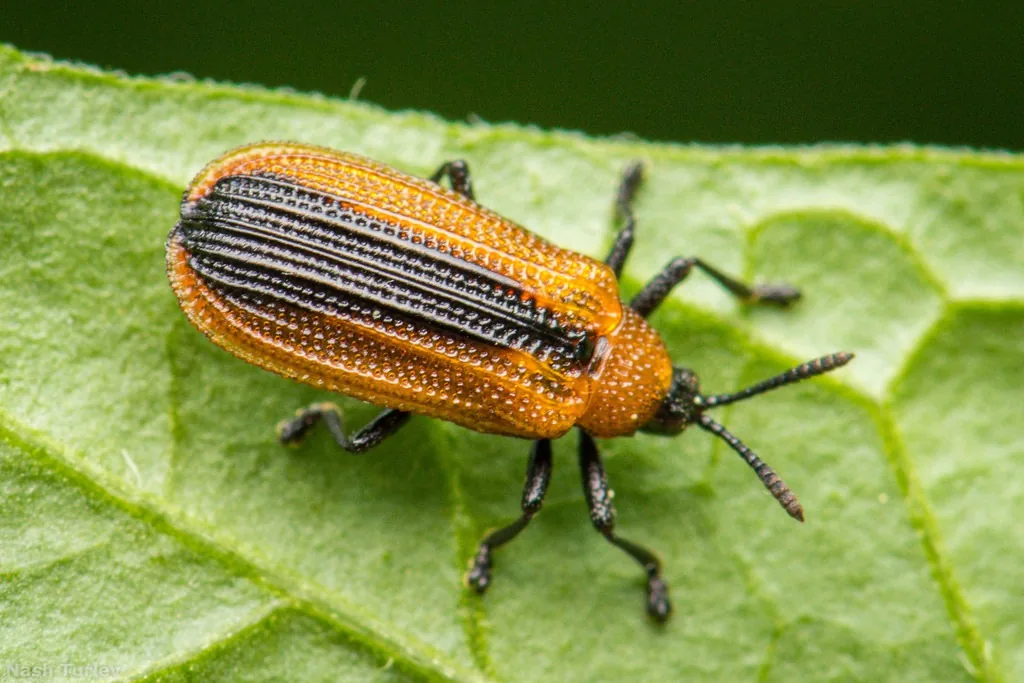
- Adults are flat, elongate beetles about 1/4 inch (6 mm) long with a black head and orange wing covers bearing a broad black stripe down the center that widens toward the rear. Clemson says they look a bit like lightning bugs.[1][2][3]
- The wing covers are deeply pitted with three long ridges each.[1]
- Larvae are flat and creamy yellow with a black head, legs and tail shield, slightly longer than adults, and live inside translucent mines that soon turn brown.[1][2][3]
Look-alikes
| Look-alike | How to tell them apart |
|---|---|
| Sumitrosis rosea | A second leaf-mining beetle that also feeds on locust and can turn up in the same trees.[3] |
Where it lives
Outbreaks occur almost every year throughout the range of black locust. Clemson notes black locust is a common roadside tree in South Carolina, and that browned stands are easy to spot from the highway in July and August.[1][2]
Biology and life cycle
Adults overwinter in bark crevices and leaf litter and emerge in spring as leaves unfold to feed on leaf undersides and lay eggs.[1][2]
Eggs are laid in overlapping groups of three to five cemented with excrement; larvae mine between the leaf surfaces and may mine several leaflets.[1][2]
Larvae pupate in their mines and new adults appear around July. NC State and Clemson describe two generations a year in the Carolinas, though NC State's sheet also says one or two, and UMass says a second generation occurs in parts of the range such as southern Ohio.[1][2][3]
Larvae favor the tips of leaflets and make irregular blotch mines. New adults skeletonize the undersides of the leaves.[3]
Damage and signs
- Black locust is preferred; honey locust, apple, beech, birch, cherry, elm, oak and hawthorn are occasionally attacked.[1][2]
- Damaged trees look frost- or drought-scorched, and whole stands can turn brown by midsummer; outbreaks seldom hit the same trees for more than a couple of years.[1][2]
- Sources differ on how often trees die. Clemson says infested trees rarely die, and NC State says death is a risk when severe defoliation combines with other stresses. UMass warns that a tree losing both its first and second flush of leaves in several seasons will die.[2][1][3]
Health risk
It feeds on leaves. None of the cited extension sources describes any risk to people or pets.[1][2][3]
Control
Prevention
Water a valued locust during summer and drought, and keep it growing well, to help it withstand defoliation.[2][3]
Biological control
Several parasites and predators attack it, which may be why populations don't stay high in one area for long. UMass names three parasitic wasps (Trichogramma odontotae, Spilochalcis odontotae and Closterocerus tricinctus), and in the South the wheel bug preys on larvae inside the leaves.[1][3]
Pesticides
For landscape trees, spray in late May or early June while adults are active and mines are under 1/4 inch long; a product with systemic activity works best.[1]
When to look
Watch for adults as new leaves open in spring, and turn leaves over to look for egg masses on the undersides.[3][1]
Damage often isn't noticed until leaves look scorched or brown by midsummer. NC State's spray window is earlier, in late May or early June while mines are still under 1/4 inch long.[3][1]
Common questions
- Why are the locust trees along the road brown in July?
- Usually locust leafminer larvae have mined the leaves.[1][2]
- Will my black locust die?
- Usually not. Clemson says infested trees rarely die, especially with summer watering, but NC State and UMass warn that trees under other stress or stripped repeatedly over several seasons can die.[2][1][3]
- When should locust leafminer be treated?
- In late May or early June, while mines are still small.[1]
Sources
- NC State Extension, “Locust Leafminer (PDIC Factsheet).” content.ces.ncsu.edu/locust-leafminer-1 (accessed 2026-11-13)
- Clemson Cooperative Extension, Home & Garden Information Center, “Locust Leafminer (Jul 12, 2021).” hgic.clemson.edu/locust-leafminer/ (accessed 2026-11-13)
- UMass Amherst Center for Agriculture, Food, and the Environment, “Odontota dorsalis (Locust Leafminer) (Landscape Insect and Mite Guide).” www.umass.edu/agriculture-food-environment/landscape/publications-resources/insect-mite-guide/odontota-dorsalis (accessed 2026-11-13)
- Global Biodiversity Information Facility (GBIF), “Odontota dorsalis (Thunberg, 1805) (GBIF Backbone Taxonomy).” api.gbif.org/v1/species/1049137 (accessed 2026-11-13)