On this page
How to identify it
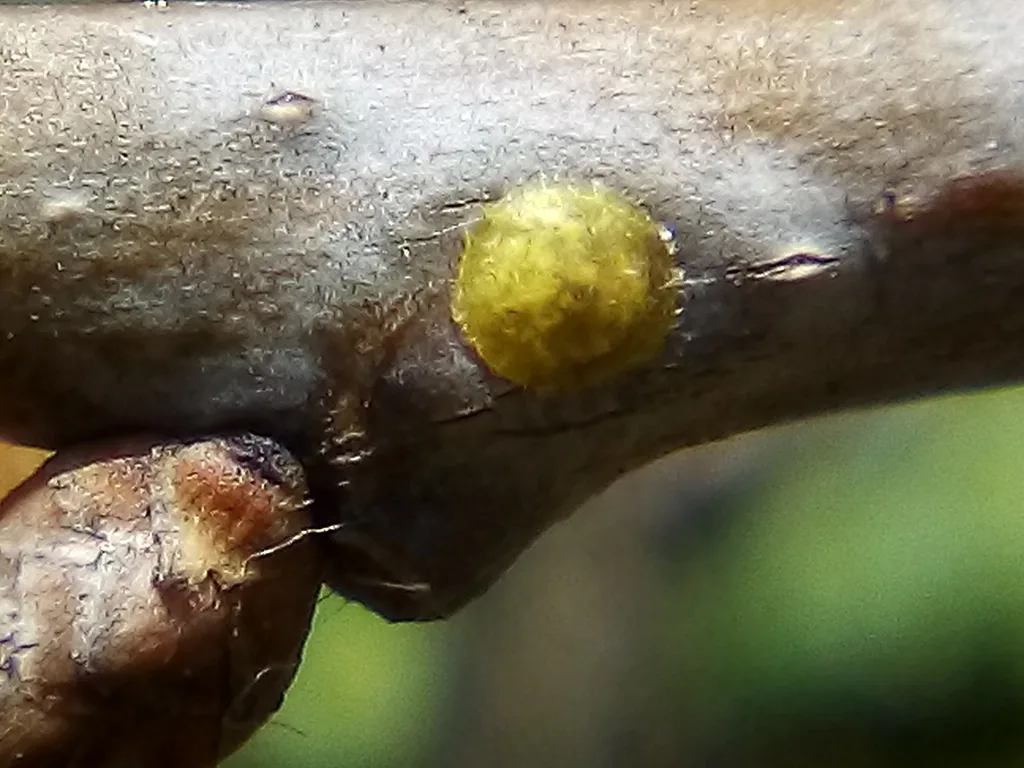
- Adults are round, flat and about the size of a pinhead, brown, dull green or golden, each in a pit ringed by a doughnut-shaped swelling of bark. UMass gives 1 to 2 mm across; the Forest Service field guide gives 1 to 2.25 mm depending on species. A 1972 Forest Service guide to eastern forest insects describes pit scale females as smooth and shiny, light yellowish to brownish, with vestigial or no legs and short antennae.[1][2][4][7]
- Heavy infestations make young twigs look rough and dimpled. The Forest Service guide says pit scales don't produce honeydew.[1][2]
- Names vary: UC IPM uses Asterodiaspis, while older literature, including the Forest Service guide, uses Asterolecanium (A. minus and A. quercicola, the oak pit scales, and A. variolosum, the golden oak scale). UMass notes the related species are so alike that exact identification may not be needed for management.[1][2][4]
Where it lives
In California, UC IPM says damage can be serious on the Central Coast and in the Central Valley; the Forest Service guide says the oak pit scales are widespread there and prefer white oaks such as valley, blue and Engelmann oak, while the golden oak scale is rare. The golden oak scale was introduced from Europe and occurs on many oaks across North America; Washington DNR's 2013 survey found it in 92% of 37 Oregon white oak plots from the San Juan Islands to Klickitat County.[1][2][3][4]
Biology and life cycle
Only females are known, and there's one generation a year. Females overwinter in their pits and can produce young for up to five months; UC IPM says live young appear from April through October in Northern California, peaking in May and June.[1][2][4]
Crawlers move about for a few days, then settle near the parent on twigs no more than a year old, where they stay for life. That guide says the young move rapidly over twigs and branches, but once they settle and begin to feed they never move again; the pits remain after the scale dies, so heavily infested twigs and small branches become quite rough.[1][2][4][7]
In the East, the 1972 Forest Service guide says Asterolecanium quercicola feeds in pits on the twigs, branches and trunks of white, swamp white, red, chestnut and English oaks from New York to Ohio and North Carolina, while the yellow oak scale and A. minus attack several oaks in Pennsylvania and Ohio.[7]
The 1972 Forest Service guide calls the golden oak scale one of the most important pit scale species in the country: it feeds almost exclusively on white oaks, favors English oak above all others and, in its absence, chestnut oak, with one generation a year in the Northeastern States.[7]
Damage and signs
- Dead leaves and twigs can hang on all winter; UC IPM says not to confuse this with oaks such as pin oak and Turkish oak that naturally keep dead leaves. Severe infestations can delay leaf-out by up to three weeks.[1][4]
- Heavy attacks year after year can kill young trees. In Washington, DNR found crown dieback mostly east of the Cascades, where drought may predispose oaks to more damage, and whole-tree death was rare outside Klickitat County. The 1972 Forest Service guide adds that heavy infestations may kill young trees and the branches of larger trees, and heavily infested mature trees are killed during periods of dry weather.[1][4][3][7]
- The Forest Service guide says damage comes from sap removal and perhaps toxins injected into twigs. UMass says the golden oak scale often occurs with anthracnose on oaks in the eastern U.S., a combination that is particularly stressful for trees.[2][4]
Health risk
It feeds on oak twigs. UC IPM, UMass, the USDA Forest Service and Washington DNR describe tree damage only and don't mention any risk to people or pets.[1][4][2][3]
Control
Traps and physical control
Prune out isolated infestations if they're caught very early.[1]
Biological control
UMass says the parasitic wasps Habrolepis dalmanni and Metaphycus asterolecanii have been found in golden oak scale populations, though how well they control it isn't fully understood.[4]
Pesticides
UC IPM says narrow-range oil sprayed in spring just before buds open, covering all branch tips and bark, can manage small to medium trees if repeated each spring for several years. Once leaves are out, good coverage is too hard, and very large trees are hard to cover without high-pressure equipment.[1]
UC IPM says oil mixed with persistent insecticides such as pyrethroids can kill crawlers but isn't generally recommended for large trees in residential areas, because of environmental hazards and poor coverage.[1]
Where the sources disagree
Natural enemies: UC IPM says they're uncommon in California, though parasite exit holes are sometimes seen. Washington DNR found signs of parasitoid emergence in 79% of infested plots, and UMass reports two parasitic wasps.[1][3][4]
Where it's worst in California: UC IPM points to the Central Coast and Central Valley; the Forest Service guide says pit scales are serious pests especially in southern California, more common on deciduous oaks than live oaks and in landscapes than wildlands.[1][2]
Males: UC IPM and the Forest Service guide say all adults are female; UMass says males are either rare or not described. The 1972 Forest Service guide says males are unknown in most of the pit scale species in this country.[1][2][4][7]
Size: UMass gives 1 to 2 mm across and the Forest Service field guide 1 to 2.25 mm, while the 1972 Forest Service guide says pit scale females are about 1 to 3 mm wide.[4][2][7]
Common questions
- Why do my valley oak's twig tips die in late summer?
- Possibly oak pit scales, whose twig dieback shows from mid- to late summer; look for pinhead-sized scales sitting in pits on young twigs.[1][2]
- When should I treat oak pit scale?
- UC IPM says oil works in spring just before buds open; once leaves are out, coverage is too hard.[1]
Sources
- University of California Statewide IPM Program, “Oak Pit Scales (Pest Notes).” ipm.ucanr.edu/home-and-landscape/oak-pit-scales/ (accessed 2026-11-13)
- USDA Forest Service, Pacific Southwest Research Station, “A Field Guide to Insects and Diseases of California Oaks (Gen. Tech. Rep. PSW-GTR-197; T. J. Swiecki and E. A. Bernhardt, 2006).” www.fs.usda.gov/psw/publications/documents/psw_gtr197/psw_gtr197.pdf (accessed 2026-11-13)
- Washington State Department of Natural Resources, “Distribution of oak pit scale and associated crown dieback of Oregon white oak in Washington (G. R. Kohler and A. Dozic; 2013 survey).” dnr.wa.gov/sites/default/files/2025-05/rp_fh_ops_oak_pit_scales.pdf (accessed 2026-11-13)
- UMass Extension, “Asterodiaspis variolosa (Golden Oak Scale).” www.umass.edu/agriculture-food-environment/landscape/publications-resources/insect-mite-guide/asterodiaspis-variolosa (accessed 2026-11-13)
- Global Biodiversity Information Facility (GBIF), “Asterodiaspis Signoret, 1877 (GBIF Backbone Taxonomy).” api.gbif.org/v1/species/4405163 (accessed 2026-11-13)
- iNaturalist, “Asterodiaspis taxon page (order and family).” www.inaturalist.org/taxa/375004 (accessed 2026-10-06)
- USDA Forest Service, via Internet Archive scan (USDA National Agricultural Library), “Eastern Forest Insects, USDA Miscellaneous Publication 1175 (W. L. Baker, 1972).” archive.org/details/easternforestins1175bake (accessed 2026-11-14). Read from the Internet Archive full-text (djvu.txt) of the National Agricultural Library scan.