On this page
How to identify it
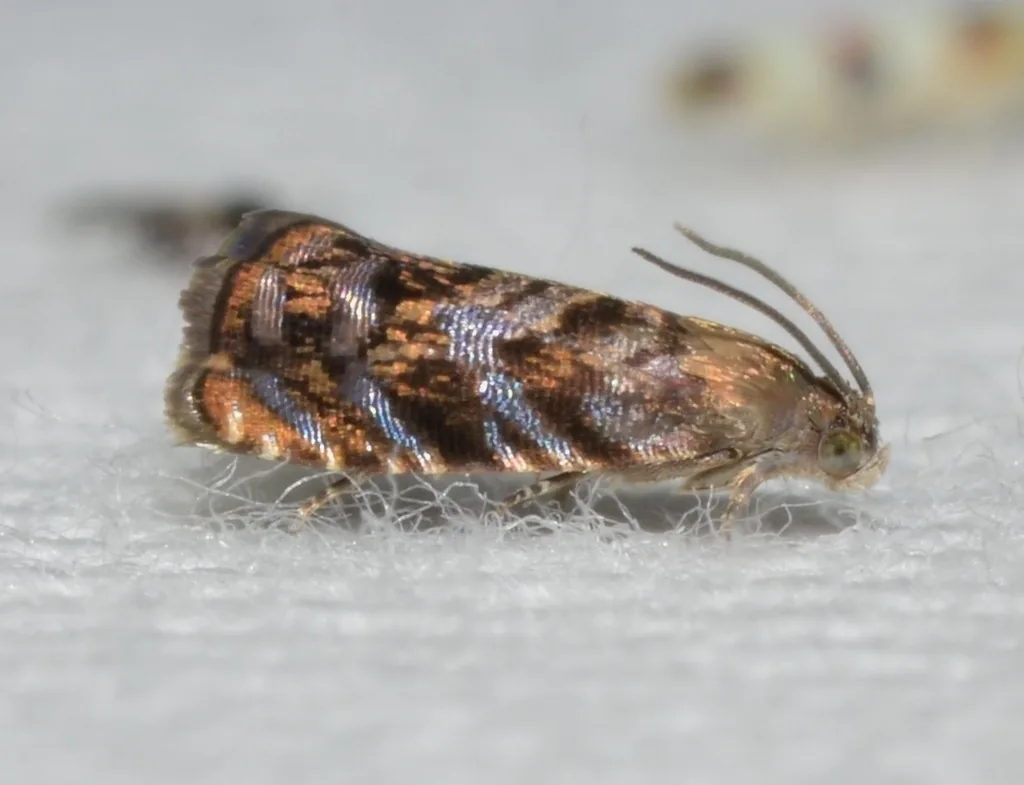
- Moths are small and brownish with yellowish markings, and a gold band shows across the back at rest. Penn State gives about 1/4 inch, Virginia Tech 7 mm with an 11 mm wingspan, and NC State about 1/3 inch (8 mm). Virginia Tech describes dark brown forewings with grayish orange patches and thin, shining pale blue bands.[1][3][2]
- Larvae are pinkish white with a dark brown head and an anal comb, and reach about 3/8 inch (9 mm). They are almost identical to oriental fruit moth and cherry fruitworm larvae; Virginia Tech says rearing them to adults or looking at the damage is the only sure way to tell them apart.[1][2][3]
- Eggs are flat ovals about 0.5 to 0.65 mm across, white at first and turning yellowish, laid singly on leaves and fruit. Virginia Tech puts a female's output at 40 to 60 eggs.[1][2][3]
Look-alikes
| Look-alike | How to tell them apart |
|---|---|
| Oriental fruit moth | Adults are larger and slate gray. Its larvae feed much deeper, often enter the side of the fruit and leave conspicuous dark brown frass at the hole; lesser appleworm leaves a small, inconspicuous frass pile at the calyx or stem end.[3][2] |
| Redbanded leafroller | Leaves a similar blotchy mark, but its larvae eat the fruit skin, while lesser appleworm feeds just beneath it.[3] |
| Codling moth | Larvae lack the anal comb that lesser appleworm, oriental fruit moth and cherry fruitworm larvae share, and their feeding goes deep into the fruit.[3][2] |
Where it lives
It is native to eastern North America. NC State says it now occurs throughout the U.S. and much of Canada, and Virginia Tech says most of Canada and the northern U.S. Penn State calls it common but infrequent as a pest in Pennsylvania orchards.[2][3][1]
Biology and life cycle
There are two and sometimes a partial third generation a year.[1][2]
Full-grown larvae overwinter in cocoons in bark cracks, under loose bark scales, in litter on the ground or occasionally in the calyx end of fallen fruit.[1][3][2]
Its season closely tracks codling moth's, with adults of the two emerging within a week of each other. In Virginia Tech's account, first-generation moths peak by mid-June and second-generation moths emerge in early August, peak in mid-August and can fly into October.[1][3]
It attacks only plants in the rose family. Plum, apple and cherry are preferred, with apricot, pear and peach also recorded, and in the wild it is thought to use hawthorn, native plums and wild rose hips.[3][2]
Damage and signs
- Larvae make shallow, blotchy mines under the skin, mostly at the calyx or stem end; Virginia Tech puts the depth at less than 6 mm. Penn State says larvae may burrow deeper as they grow, though not into the core, while Virginia Tech says deep feeding is rare and many such reports are really oriental fruit moth.[1][3][2]
- Fruit hit by the first generation usually falls during June drop. Second-generation larvae are often still in the fruit at harvest, and fall feeding is often limited to the calyx end.[2][3][1]
Health risk
It feeds on fruit. None of the cited extension sources mentions any risk to people.[1][2][3]
Control
Prevention
Oriental fruit moth pheromone lures attract it, and Oriental fruit moth mating disruption also disrupts its mating.[1][3]
Pheromone traps for lesser appleworm also catch many oriental fruit moths, often more than the target, so sort trap catches carefully. Virginia Tech notes that no treatment thresholds exist and trap counts can't predict population size.[2][3]
Pesticides
Codling moth management also controls this pest, except mating disruption aimed only at codling moth.[1]
How serious it is
NC State says it hasn't historically been a major pest in North Carolina, though moths turn up in traps now and then.[2]
Virginia Tech says it is much more susceptible to insecticides than codling moth and of minor importance in commercial apple orchards, but it can be more abundant than codling moth in abandoned ones.[3]
Common questions
- Does spraying for codling moth control lesser appleworm?
- Usually; Penn State says codling moth programs control it, except mating disruption that targets only codling moth.[1]
- How deep do lesser appleworm larvae tunnel?
- Usually just under the skin. Virginia Tech puts mines at less than 6 mm deep and says deep feeding is rare; Penn State says larvae may go deeper as they grow, but not into the core.[3][1]
- How can I tell lesser appleworm damage from oriental fruit moth?
- Lesser appleworm makes shallow mines at the calyx or stem end with a small frass pile. Oriental fruit moth feeds deeper, often enters the side of the fruit and leaves dark brown frass at the hole.[3]
Sources
- Penn State Extension, “Tree Fruit Insect Pest: Lesser Appleworm.” extension.psu.edu/tree-fruit-insect-pest-lesser-appleworm (accessed 2026-11-13)
- NC State Extension, “Lesser Appleworm.” content.ces.ncsu.edu/lesser-appleworm (accessed 2026-11-13)
- Virginia Tech, Virginia Fruit (Department of Entomology), “Lesser Appleworm, Grapholita prunivora (Walsh).” www.virginiafruit.ento.vt.edu/law.html (accessed 2026-11-13)
- Global Biodiversity Information Facility (GBIF), “Grapholita prunivora (Walsh, 1868) (GBIF Backbone Taxonomy).” api.gbif.org/v1/species/10457666 (accessed 2026-11-13)