On this page
How to identify it
- Larvae are orangish, pale yellow, pink or whitish with a brown head. UC IPM says they grow up to 2/3 inch; Kentucky Extension says about 1/2 inch when full grown.[1][2]
- Under a hand lens, a comb of short stiff bristles on the underside of the last segment sets it apart from other fruit-boring larvae.[1]
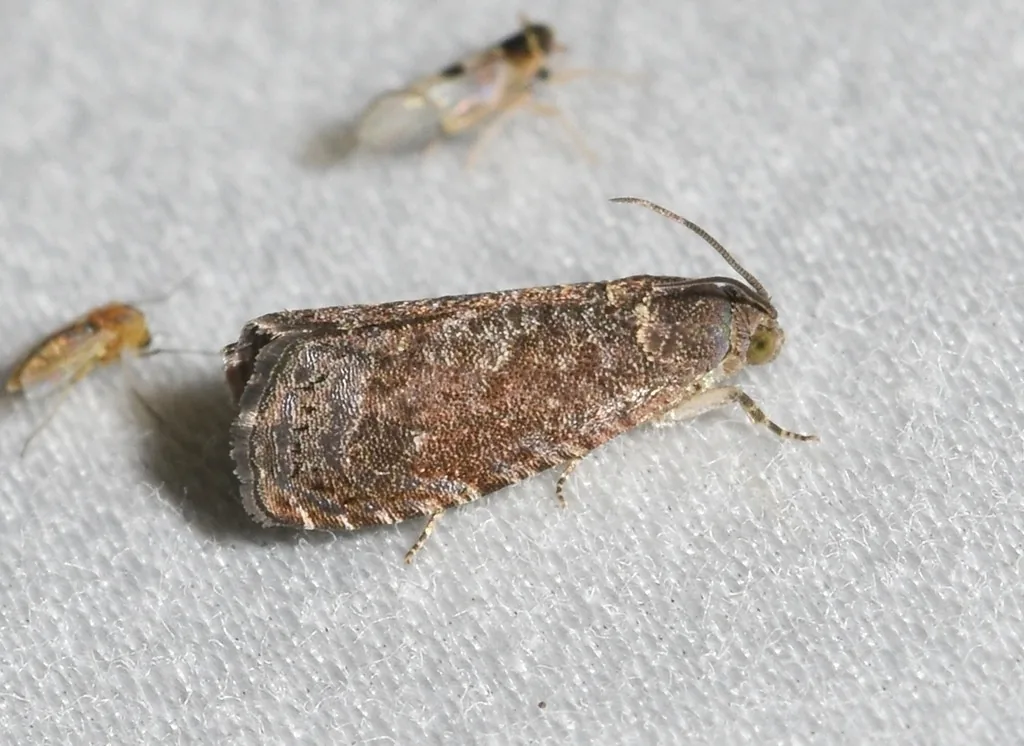
- Adults are small, mottled gray-brown moths that fly around twilight. UC IPM gives a length of about 1/2 inch and Kentucky about 1/4 inch; Kentucky describes fine alternating light and dark bands on the wings.[1][2]
- Eggs are flat, disk-shaped and cream to white, about 1/30 inch across, laid mostly on upper leaf surfaces near young shoot tips.[1][2]
Look-alikes
| Look-alike | How to tell them apart |
|---|---|
| Peach twig borer | Its shoot damage looks identical; check the larva for the anal comb.[1] |
| Codling moth | Damage to fruit and nuts looks the same; only oriental fruit moth larvae have the anal comb.[1] |
Where it lives
UC IPM lists almonds and stone fruits, with nectarines and peaches especially susceptible; Kentucky adds apple, plum, cherry, pear and rose. A 2025 study calls it a significant pest of stone and pome fruits worldwide.[1][2][3]
Biology and life cycle
Mature larvae overwinter in silk cocoons in protected places on the trunk or in litter at the base of the tree, then pupate in early spring.[1][2]
Adults emerge in February or early March in California; Kentucky says emergence usually coincides with peach bloom. First-generation larvae tunnel in shoot tips, and later ones move into fruit and nuts as shoots harden.[1][2]
Generation counts vary with climate: five or six a year in California, and up to six or seven in Kentucky, where the second and third generations do most of the damage.[1][2]
The moths are active at dusk. In a 2025 lab study, females laid more eggs in lit areas than dark ones and preferred ultraviolet light, which is richer in the upper canopy of peach trees; Kentucky notes the moth prefers to feed in the tops of trees.[3][2]
Damage and signs
- A larva may tunnel 2 to 6 inches down a shoot and often damages two or three shoots before it matures; the tips wilt and die back (flagging). Healthy trees tolerate this, though heavy shoot damage on young trees can leave them with poor structure.[2][1]
- The important damage comes when later larvae tunnel to the center of green or ripening fruit and nuts and feed around the pit or seed.[1][2]
Health risk
It feeds on fruit trees, and neither UC IPM nor Kentucky Extension describes a risk to people.[1][2]
Control
Prevention
Avoid persistent broad-spectrum insecticides. Mating disruption works well in large commercial orchards, but UC IPM says it may not work on one or a few trees, and Kentucky recommends it only for orchards of 5 acres or more.[1][2]
Check young, vigorous trees in early spring for wilted shoots and confirm the cause; early shoot damage signals that later generations may attack the fruit.[2][1]
Biological control
The wasp Macrocentrus ancylivorus commonly parasitizes 80 to 90 percent of larvae by late summer on unsprayed trees.[1]
A small, unharvested sunflower patch planted in April and late May gives that wasp an overwintering host.[1]
Pesticides
Sources differ on home sprays. UC IPM says effective products are available only to professional applicators. Kentucky suggests hanging one pheromone trap in a backyard tree just before bloom and treating at petal fall if moths are caught.[1][2]
What fruit damage looks like
Larvae feeding in fruit often make it drop, and the wounds let rots in. Young fruit may ooze gum from entry and exit holes, and damaged fruit left on the tree becomes distorted. A larva that enters through the stem may leave no visible sign by harvest.[2]
Common questions
- Why are my peach shoot tips wilting in spring?
- Oriental fruit moth or peach twig borer larvae tunneling in the tips cause this flagging. To tell them apart, check the larva's last segment with a hand lens for the anal comb.[1][2]
- Can I spray oriental fruit moth myself?
- UC IPM says effective products are available only to professional applicators and points home growers to biological control. Kentucky Extension suggests a petal-fall treatment if a backyard pheromone trap catches moths.[1][2]
Sources
- University of California Statewide IPM Program, “Oriental Fruit Moth (Pests in Gardens and Landscapes).” ipm.ucanr.edu/PMG/GARDEN/FRUIT/PESTS/orientfrmoth.html (accessed 2026-11-13)
- University of Kentucky Entomology, “ENTFACT-212: Oriental Fruit Moth.” entomology.mgcafe.uky.edu/ef212 (accessed 2026-11-13)
- Ecol Evol 2025;15(9):e72096, via PubMed, “Oviposition Response to Light With Different Spectra in the Crepuscular Moth Grapholita molesta (2025).” pubmed.ncbi.nlm.nih.gov/40896093/ (accessed 2026-11-13)
- Global Biodiversity Information Facility (GBIF), “Grapholita molesta (Busck, 1916) (GBIF Backbone Taxonomy).” api.gbif.org/v1/species/1736574 (accessed 2026-11-13)
- iNaturalist, “Aspila molesta taxon page (order and family).” www.inaturalist.org/taxa/1507298 (accessed 2026-10-06)