On this page
How to identify it
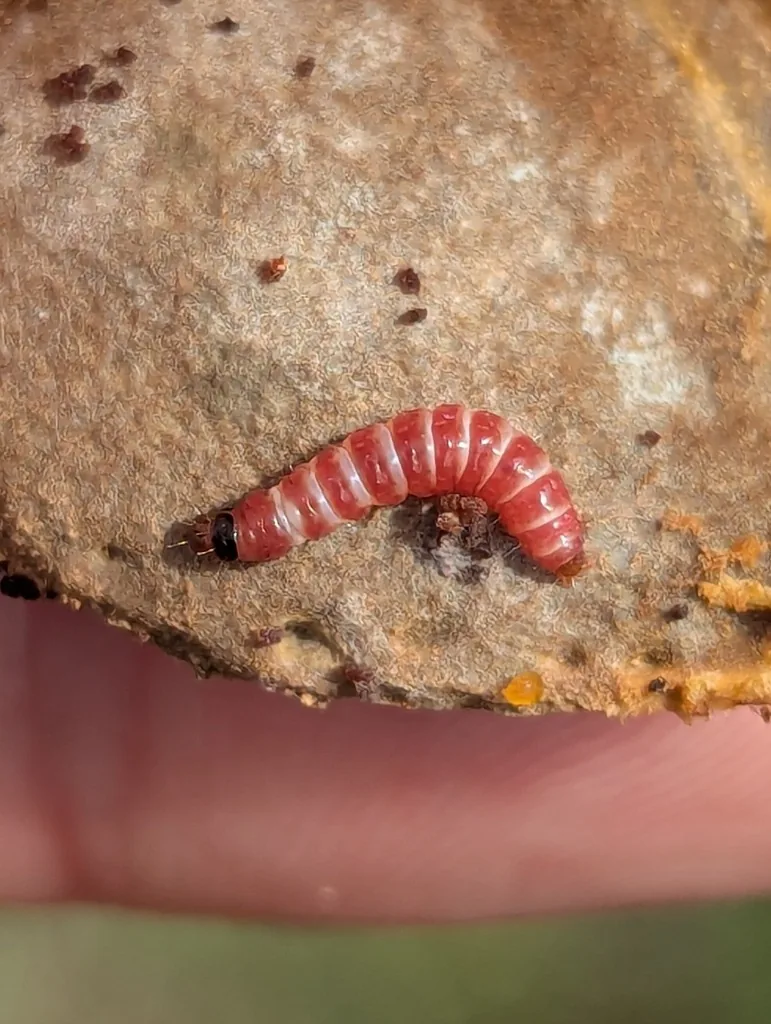
- Young larvae are whitish with thin brown bands and a black head. Mature larvae are chocolate brown with alternating dark and light bands, about 1/2 inch long.[1][2]
- The pale membranes between brown segments set it apart from codling moth and oriental fruit moth larvae.[1]
- Moths are dark gray mottled with whitish, with forward-projecting palpi that look like a snout. UC IPM gives 1/3 to 2/5 inch long and Utah State 0.3 to 0.5 inch.[1][2]
- In fall and winter, small chimneys of reddish-brown frass mark the openings of overwintering cells in branch crotches. Utah State notes they are built of silk with frass and wood chips.[1][2]
- Eggs are oval, orange to yellowish or whitish, about 0.8 mm (1/30 inch) long, and laid singly on fruit, leaves and twigs.[1][2]
Look-alikes
| Look-alike | How to tell them apart |
|---|---|
| Oriental fruit moth | Both cause shoot strikes and can be on the same tree, but oriental fruit moth larvae bore deep into fruit to feed around the pit.[1] |
| Codling moth | Codling moth larvae also bore deep around the pit, unlike the shallow scars of peach twig borer.[1] |
Where it lives
Utah State says it occurs worldwide wherever stone fruits are grown. It attacks almond and stone fruits, and in Utah it is a major pest of apricot, peach and nectarine.[2][1]
Biology and life cycle
It overwinters as a first- or second-instar larva in a tiny cell (hibernaculum) under thin bark in crotches of 1- to 3-year-old wood, in pruning wounds or in bark cracks.[1][2]
Larvae come out just before and during bloom (Utah State says bloom to petal fall) and feed on blossoms and shoots. UC IPM says the first moths emerge from late March through May; Utah State gives April in southern Utah and mid-May in northern Utah.[1][2]
First-generation larvae feed in twigs in May and June. Later generations attack twigs or fruit, and once fruit starts to color they prefer to feed just under the skin.[1]
Northern Utah usually has three generations (May to June, July, and August to September) and southern Utah four or more.[2]
A modeling study for California's Central Valley projects that warming could move peach twig borer's spring flight earlier by up to 28 days and add up to 1.4 generations a year by the end of the century, depending on the scenario.[4]
Damage and signs
- Tunneled shoots wilt and die back one to several inches (flagging or shoot strikes). Scattered strikes matter mostly on very young trees, where repeated dieback stunts growth and leaves poor structure.[1][2]
- Feeding in fruit or nuts lets in decay and makes them unappetizing. UC IPM describes feeding just under the skin; Utah State says larvae enter mainly at the stem end and feed under the skin or next to the pit, especially if the pit splits.[1][2]
- In California almond orchards it often reaches high infestation on many varieties by feeding almost entirely on the hulls rather than the nutmeats.[3]
Health risk
It feeds on fruit trees. None of the cited sources describes any risk to people or pets.[1][2]
Control
Prevention
Utah State times sprays with pheromone traps and a degree-day model. Traps hang in the upper third of the canopy, and the date of consistent moth catches (biofix) starts the degree-day count.[2]
Traps and physical control
Prune out shoot strikes in late spring and early summer as soon as you see them, before the larvae finish developing. Old flagged shoots seen during winter pruning mean early-season control should be planned.[2]
Biological control
About 30 kinds of parasitic wasps and predators attack it, including Trichogramma egg parasites, assassin bugs, minute pirate bugs, lacewing larvae and spiders, but they don't fully prevent damage. UC IPM advises controlling ants, reducing dust and avoiding persistent broad-spectrum sprays to protect them; Utah State notes that in California, Formica ants have themselves destroyed a significant share of larvae in some years.[1][2]
Pheromone mating disruption makes it hard for males to find females. Utah State says larger organic farms use it, often with organic-approved sprays such as Bt or spinosad.[2]
Pesticides
Where damage has been intolerable, UC IPM says Bt or spinosad during bloom is the most effective home timing. Apply spinosad at petal fall in late afternoon, when honey bees aren't active, since it is toxic to bees for several hours.[1]
Alternatively, horticultural oil plus spinosad at the delayed-dormant stage (buds swelling but not yet open) covers shoot tips and also kills overwintering mites and scales. Oil alone doesn't control it, and home-garden sprays after petal fall are unlikely to work well.[1]
Utah State cautions that pyrethroids can set off spider mite outbreaks in hot weather by killing predatory mites, so summer pyrethroid sprays should be avoided, and recommends rotating insecticide classes to slow resistance.[2]
Common questions
- What are the little piles of reddish sawdust in my peach tree crotches?
- They're frass chimneys at the openings of overwintering peach twig borer cells.[1]
- When should I treat peach twig borer?
- UC IPM's home-orchard timings are bloom, with Bt or spinosad, or the delayed-dormant stage, with oil plus spinosad. Sprays after petal fall are unlikely to work well.[1]
- Should I cut off dead shoot tips?
- Yes. Utah State advises pruning out shoot strikes in late spring and early summer as soon as they appear, so the larvae inside don't add to summer generations.[2]
Sources
- University of California Statewide IPM Program, “Peach Twig Borer (Pests in Gardens and Landscapes).” ipm.ucanr.edu/PMG/GARDEN/FRUIT/PESTS/peachtwigbor.html (accessed 2026-11-13)
- Utah State University Extension, “Peach Twig Borer.” extension.usu.edu/planthealth/research/peach-twig-borer.php (accessed 2026-11-13)
- Journal of Economic Entomology (via PubMed), “Ecoinformatics can infer causal effects of crop variety on insect attack: a case study in almonds (Rosenheim et al., 2017) (abstract).” pubmed.ncbi.nlm.nih.gov/29029282/ (accessed 2026-11-13)
- Science of the Total Environment (via PubMed), “Climate change impacts on insect pests for high value specialty crops in California (Jha et al., 2024) (abstract).” pubmed.ncbi.nlm.nih.gov/37802357/ (accessed 2026-11-13)
- Global Biodiversity Information Facility (GBIF), “Anarsia lineatella Zeller, 1839 (GBIF Backbone Taxonomy).” api.gbif.org/v1/species/1847640 (accessed 2026-11-13)