On this page
How to identify it
- The caterpillar is small with a dark, nearly black head. UKY calls it whitish yellow; Agriculture and Agri-Food Canada says white to light reddish brown, about 12 mm (1/2 inch) long when full grown.[1][2]
- Damaged shoots swell into spindle shapes, with waste pellets around a small entry hole.[1][2]
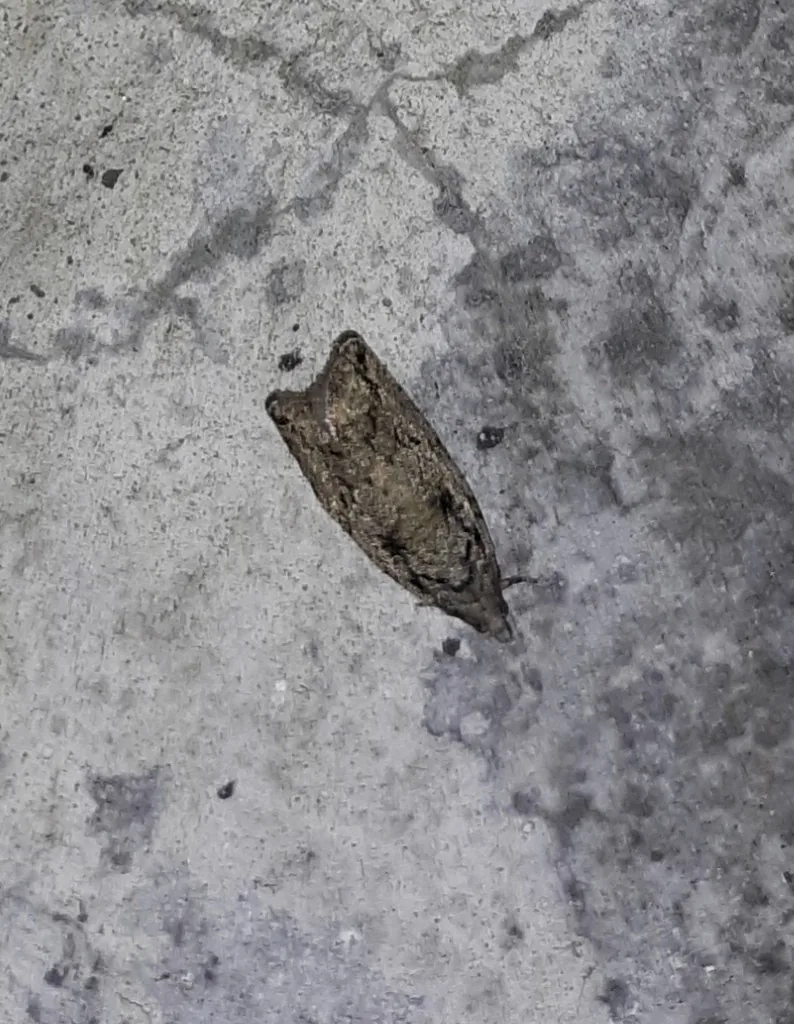
- The adult is a small moth with a 15 to 20 mm wingspan, light brown forewings streaked with gray and black scales, and yellowish-tan hind wings with a dark edge.[2]
Where it lives
UKY describes it on boxelder and red maple in Kentucky, and Agriculture and Agri-Food Canada covers it on Manitoba maple, the Canadian name for boxelder.[1][2]
Biology and life cycle
Moths fly from late June to early July. Eggs are laid singly under the leaves, and young larvae feed on the leaves under silk webbing until late summer, then bore into leaf stalks or dormant buds to spend the winter.[1][2]
In spring each caterpillar bores into a new shoot to finish developing. Agriculture and Agri-Food Canada says full-grown larvae drop to the ground in June and early July and pupate in debris under the tree.[1][2]
Damage and signs
Health risk
It feeds on boxelder and maple. UKY and Agriculture and Agri-Food Canada describe plant damage only and don't mention any risk to people or pets.[1][2]
Control
Traps and physical control
Agriculture and Agri-Food Canada says pruning sucker growth in late fall and swollen twigs in May and June reduces borer numbers the next year.[2]
Pesticides
UKY says control has to target the leaf-feeding larvae in mid-July, before they tunnel into the plant, and names carbaryl (Sevin). Follow the label.[1]
Where the sources disagree
Whether to spray: UKY says any attempt to reduce damage must target the leaf-feeding stage and names carbaryl. Agriculture and Agri-Food Canada says control is rarely needed because parasites, disease and weather keep it in check, and lists pruning first.[1][2]
Egg hatch: UKY says eggs hatch in mid-July; Agriculture and Agri-Food Canada says moths fly late June to early July and eggs hatch 10 to 14 days later.[1][2]
Larva color: UKY says whitish yellow; Agriculture and Agri-Food Canada says white to light reddish brown.[1][2]
Common questions
- Why is my boxelder getting bushy?
- Boxelder twig borers kill buds and shoots, and repeated attacks make trees bushy.[1][2]
- Can I treat damaged twigs?
- Not with sprays; UKY says larvae inside twigs can't be reached and control must target the leaf-feeding stage in midsummer. Agriculture and Agri-Food Canada says pruning swollen twigs in May and June lowers next year's numbers.[1][2]
Sources
- University of Kentucky Entomology (ENTFACT), “Boxelder Twig Borer (ENTFACT-415).” entomology.mgcafe.uky.edu/ef415 (accessed 2026-11-13)
- Agriculture and Agri-Food Canada (Diseases and pests in agroforestry), “Boxelder Twig Borer (Diseases and pests in agroforestry).” agriculture.canada.ca/en/agricultural-production/crop-protection/diseases-and-pests-agroforestry/boxelder-twig-borer (accessed 2026-11-13)
- Global Biodiversity Information Facility (GBIF), “Proteoteras willingana (Kearfott, 1904) (GBIF Backbone Taxonomy).” api.gbif.org/v1/species/1748147 (accessed 2026-11-13)
- iNaturalist, “Proteoteras willingana taxon page (order and family).” www.inaturalist.org/taxa/417016 (accessed 2026-10-06)