On this page
How to identify it
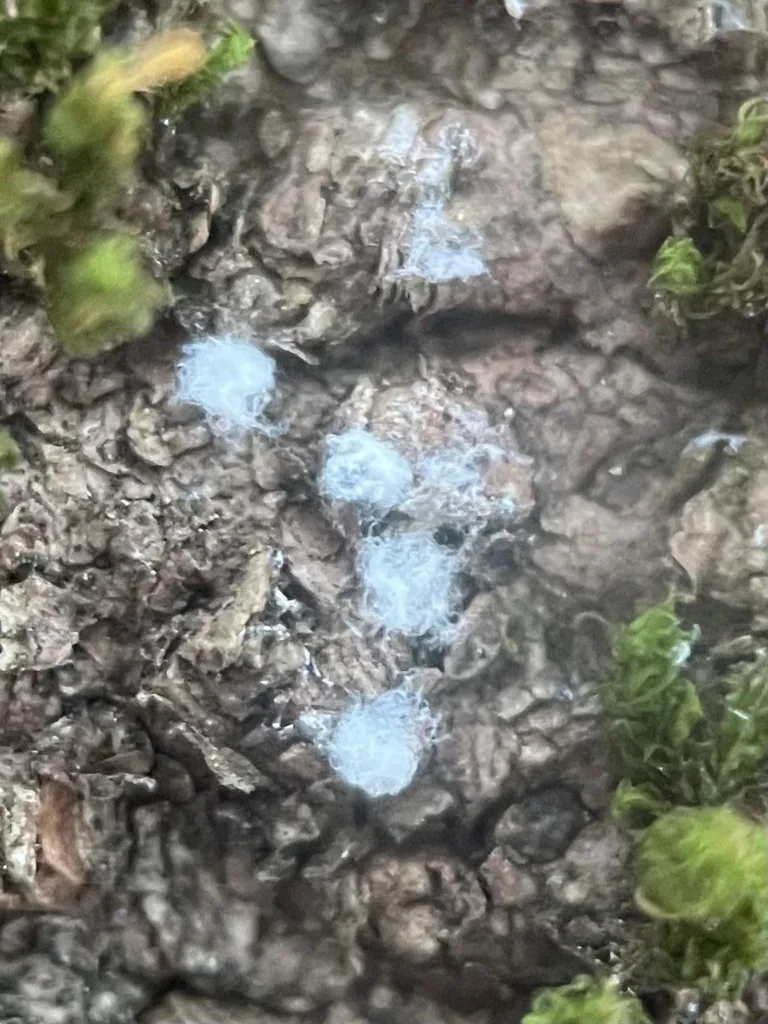
- Adults are about 0.04 inch long and purple-black under a coat of white wool; white or grayish cottony masses of eggs or newly hatched purplish-black young appear on twigs, branches or the trunk.[1][4]
- Feeding makes swollen, knobby areas at nodes and tips of infested branches.[1]
- Overwintering nymphs are small, black and tent-shaped, with a row of short white wax threads down the middle and around the edge; they have no wool yet, so look for them on swollen buds in winter.[3]
- Other signs include a flat top or weak, slanted leader, dead shoots, a stiff trunk, and older needles turning yellow or bronze. The adelgids don't infest the needles themselves.[3][2][4]
- Dried resin and lichens can look like white spots on bark. Under a hand lens they are smooth, while adelgids are covered in wool; a live adelgid leaves a purple smear when rubbed.[3]
Where it lives
The Forest Service says it reached the northeastern U.S. from Europe around 1900, the West Coast by 1929 and the Southeast in the mid-1950s, most likely on nursery stock, and was first found in Alaska (Juneau) in 2019. The PNW handbook calls it a serious forest pest and common in landscapes on balsam, grand, subalpine, Pacific silver and Fraser firs.[2][1]
Biology and life cycle
All are wingless females, immobile except as crawlers, which the wind carries from tree to tree.[1]
Eggs are laid on the bark behind the female. Sources give different generation counts: the PNW handbook says two to four a year, NC State two to three depending on temperature, and UMass about two in the Northeast with up to four in warmer regions.[1][3][4]
Fraser fir is the most seriously affected host, and balsam and subalpine firs are also highly susceptible. UMass says European silver fir resists it, noble fir suffers little damage and Douglas-fir, which is not a true fir, is not a host.[3][1][4]
In North America no males are produced, because the alternate host it uses in Europe isn't here; females reproduce without mating. Crawlers, present from April through October in North Carolina, are the only stage that can reach a new tree.[3]
Damage and signs
- Feeding damages the tissue that carries food and water. Infestations weaken trees, thin the foliage and can kill them; heavy ones may coat the whole trunk.[2][1]
- Fraser fir reacts by forming hard reddish reaction wood that blocks water movement, so the tree slowly declines. NC State notes that even a symptomless infested Christmas tree is more likely to drop needles after harvest.[3]
Health risk
It feeds only on firs, and none of the PNW handbook, NC State or Forest Service pages mention a risk to people.[1][3][2]
Control
Prevention
Don't bring in firs dug from the wild in infested areas. Where the adelgid is a known problem, UMass suggests planting non-hosts or resistant species instead.[4]
Sanitation
Remove trees that are heavily damaged. The Forest Service advises cutting them only from December to February, when the adelgids are inactive, then grinding the stump and chipping the material; NC State likewise says to remove trees only when crawlers aren't present.[2][3]
Traps and physical control
On smaller trees, wipe or brush off minor infestations, or hose trees with a strong stream of water.[1]
Biological control
Small lady beetles and their wax-covered black larvae, plus syrphid fly larvae, feed on it; avoid broad-spectrum insecticides.[1]
Pesticides
The Forest Service says sprays need thorough coverage of the trunk and limbs while crawlers are active, often need repeating and are best kept for individual, high-value trees; little is known about how well systemic products work against it. NC State notes that soap or oil works only in winter, when no eggs are present.[2][3]
More from NC State Extension
Fraser fir suffers most of all the firs and dies after several years of infestation; the adelgid is largely responsible for the decline of native Fraser fir stands in the southern Appalachians.[3]
Common questions
Sources
- Pacific Northwest Pest Management Handbooks (OSU, WSU, University of Idaho), “Fir (Abies): Balsam woolly adelgid (Insect Management Handbook).” pnwhandbooks.org/insect/hort/landscape/hosts-pests-landscape-plants/fir-abies-balsam-woolly-adelgid (accessed 2026-11-13)
- USDA Forest Service, “Balsam Woolly Adelgid (Alaska Region Forest Health).” www.fs.usda.gov/r10/natural-resources/forest-health/balsam-woolly-adelgid (accessed 2026-11-13)
- NC State Extension, “Balsam Woolly Adelgid.” content.ces.ncsu.edu/balsam-woolly-adelgid (accessed 2026-11-13)
- UMass Amherst Extension, Landscape, Nursery and Urban Forestry Program, “Adelges piceae: Balsam Woolly Adelgid (Insect & Mite Guide).” www.umass.edu/agriculture-food-environment/landscape/publications-resources/insect-mite-guide/adelges-piceae (accessed 2026-11-13)
- Global Biodiversity Information Facility (GBIF), “Adelges piceae (Ratzeburg, 1844) (GBIF Backbone Taxonomy).” api.gbif.org/v1/species/2049681 (accessed 2026-11-13)
- iNaturalist, “Adelges piceae taxon page (order and family).” www.inaturalist.org/taxa/199321 (accessed 2026-10-06)