On this page
How to identify it
- Young larvae are pale yellow. Older larvae are yellow to pale green or pink with dark side lines and a gold head; UC IPM's garden page says they grow to about 2 inches, and its avocado guide says 2 to 2.5 inches.[1][2]
- Two pairs of rear prolegs make them travel in the classic looping, inchworm style.[1]
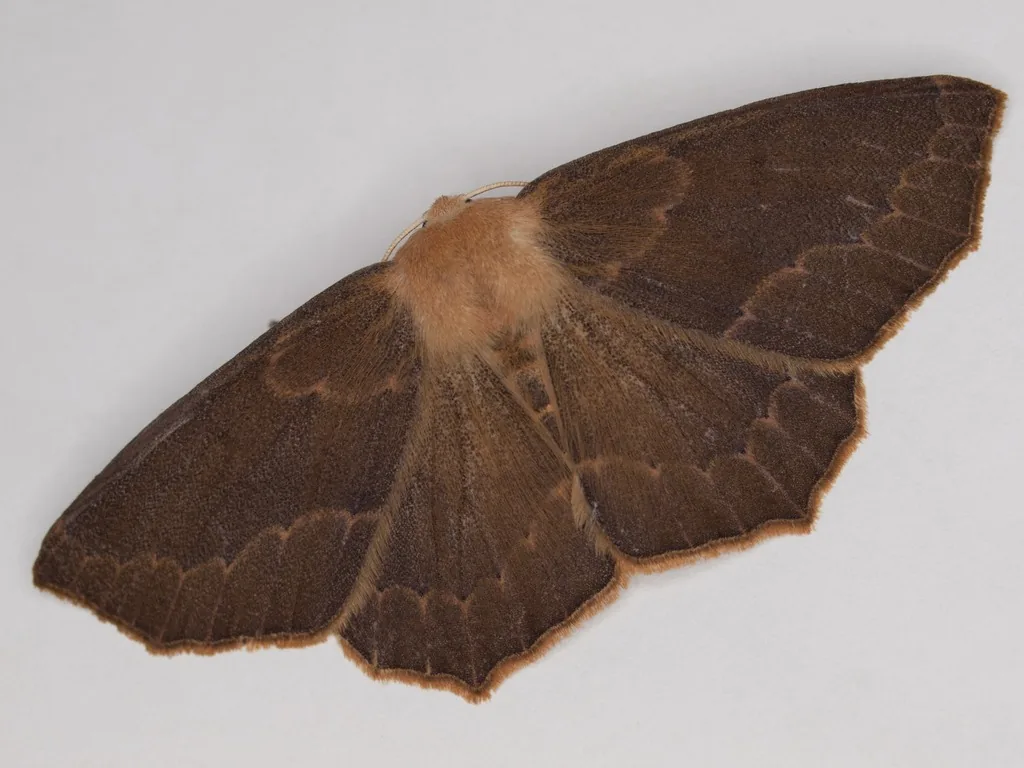
- Adults are tan to orangish moths with a narrow black band across the middle of the wings and a wingspan of about 1.75 to 2 inches.[1][2]
- Eggs are barrel-shaped with a ring of tiny projections, pale green turning reddish brown, laid in clusters of 3 to 80 on leaf undersides.[1][2]
Where it lives
UC IPM lists acacia, box elder, California buckeye, chestnut, elm, eucalyptus, fruit trees, ginkgo, magnolia, maple, pepper tree and willow among several dozen hosts, and it's also an avocado pest in California.[1][2]
Biology and life cycle
Eggs hatch in about 8 or 9 days. Larvae feed for about six weeks, then pupate in webbed or rolled leaves for 1 to 4 weeks; the moths fly at night and are drawn to lights.[1][2]
Egg to adult takes 2 to 5 months depending on temperature, with more generations in warm inland areas than on the coast; see where the sources disagree.[1][2]
Damage and signs
- Young larvae scrape the leaf surface, leaving a brown membrane; older ones chew through, leaving midribs and veins, especially on shoot tips.[1][2]
- Feeding scars fruit and can misshape or drop it.[1]
- In avocado, UC IPM says healthy trees tolerate considerable leaf damage, but extensive feeding can cause sunburn and lower the next year's yield.[2]
Health risk
It feeds on plants. UC IPM's garden and avocado pages describe plant damage only and don't mention any risk to people or pets.[1][2]
Control
Prevention
Prune and thin canopies, since loopers thrive in protected sites.[1]
Avoid broad-spectrum, persistent insecticides that kill its natural enemies; the avocado guide says caterpillar outbreaks commonly follow malathion sprays.[1][2]
Biological control
Parasitic wasps, especially Trichogramma egg parasites and three braconid larval parasites, are its most important natural enemies. The avocado guide adds at least five tachinid fly species, and birds, assassin bugs, lacewing larvae and spiders eat the caterpillars.[1][2]
A granulosis virus often kills larvae when they become abundant, and the avocado guide says an epidemic can make numbers crash within 1 to 2 weeks.[1][2]
Pesticides
UC IPM says thorough sprays of Bacillus thuringiensis (Bt) work and are the least disruptive to natural enemies. Spinosad also works but can harm some natural enemies and is toxic to bees for several hours after it dries, so don't spray it on flowering plants.[1][2]
Where the sources disagree
UC IPM's two pages differ slightly. The garden page gives grown larvae about 2 inches and four to five generations a year inland, three on the coast. The avocado guide gives 2 to 2.5 inches and four, perhaps five, generations from inland Ventura to San Diego counties and three in coastal Santa Barbara County.[1][2]
Common questions
- What are the inchworms on my maple?
- Possibly omnivorous loopers, which move in a looping style and feed on many trees.[1][2]
- Will natural enemies handle them?
- Often. UC IPM says parasitic wasps, predators and a virus usually keep them below damaging levels when broad-spectrum sprays don't disrupt them.[1][2]
Sources
- University of California Statewide IPM Program, “Omnivorous Looper (Pests in Gardens and Landscapes).” ipm.ucanr.edu/PMG/GARDEN/FRUIT/PESTS/omnilooper.html (accessed 2026-11-13)
- University of California Statewide IPM Program, “Omnivorous Looper (Avocado Pest Management Guidelines).” ipm.ucanr.edu/agriculture/avocado/omnivorous-looper/ (accessed 2026-11-13)
- Global Biodiversity Information Facility (GBIF), “Sabulodes aegrotata (Guenée) (GBIF Backbone Taxonomy).” api.gbif.org/v1/species/1954930 (accessed 2026-11-13)
- iNaturalist, “Sabulodes aegrotata taxon page (order and family).” www.inaturalist.org/taxa/55467 (accessed 2026-10-06)