On this page
How to identify it
- The mites are barely visible to the naked eye: NC State says they look like tiny moving specks about the size of a printed period.[1][2]
- On broadleaf evergreens, look on the undersides of leaves; in heavy infestations they may also feed on the upper surface.[1][2]
- Along with the mites, you may find eggs, shed skins and silk webbing.[1][2]
- To check, hold white paper or a paper plate under a branch and strike it with a stick, then watch for moving specks. Clemson suggests wiping or tapping the leaf undersides onto the paper: spider mites leave red streaks.[1][2]
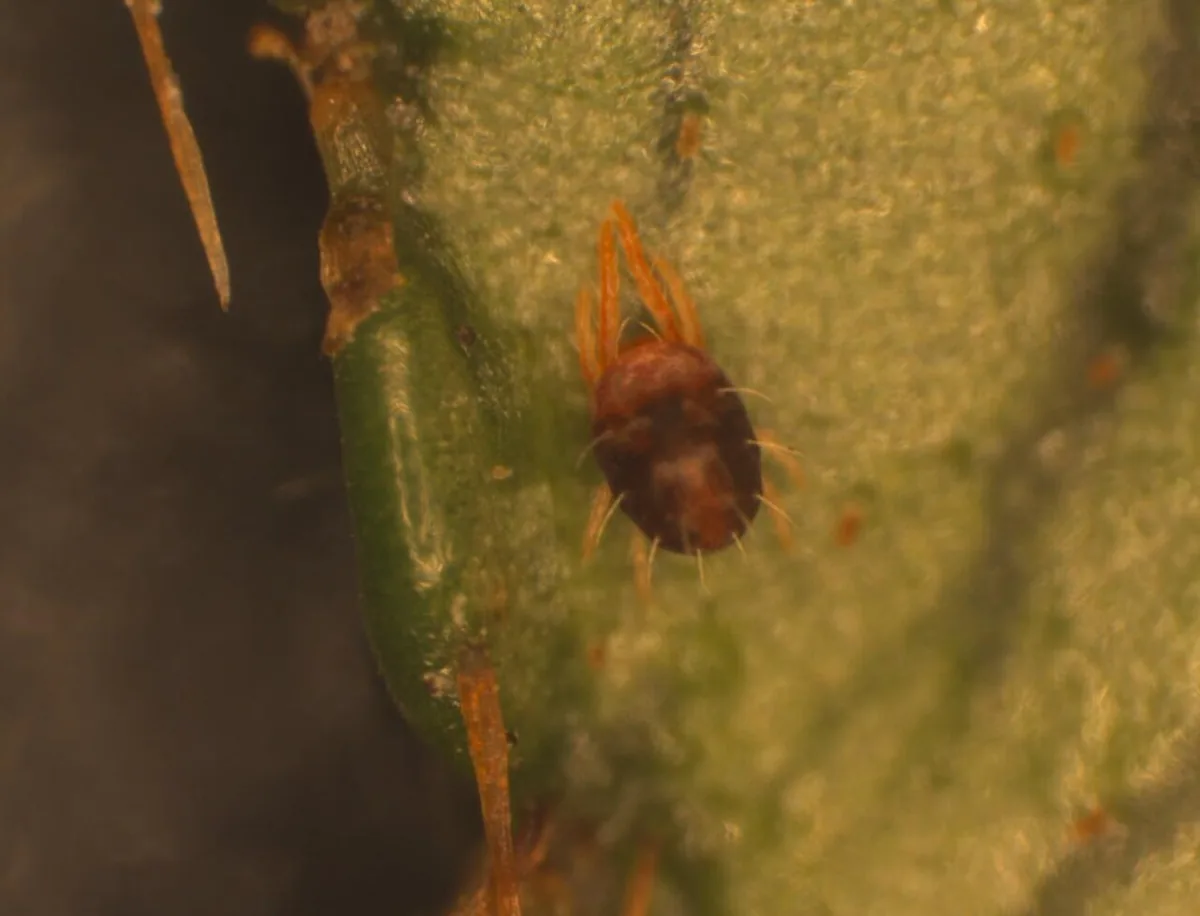
- UF/IFAS gives the adult female as about 1/50 inch (385 µ) long with a rounded oval body, and the male as about 300 µ and narrower toward the rear. Both sexes are reddish brown, darker than most red spider mites on woody ornamentals, and more see-through toward the front.[3]
Look-alikes
| Look-alike | How to tell them apart |
|---|---|
| Other spider mites | Most other spider mites build up fast in dry, warm weather (above 70°F) and peak in midsummer. The southern red mite is a cool-weather mite, active mainly in spring and fall.[2] |
| Spruce spider mite | The other main cool-season mite in North Carolina feeds on conifers such as spruce, juniper, hemlock and arborvitae, while the southern red mite feeds on broadleaf evergreens.[1] |
Where it lives
Extension services report it on landscape azaleas and other broadleaf evergreens in North Carolina and South Carolina, and NC State lists it among the most frequently reported pests of hollies in the southeastern United States. It is also a pest of coffee in Brazil. UF/IFAS lists U.S. records from Alabama, California, Florida, Louisiana, Massachusetts, New Jersey, New York, North Carolina, Ohio, South Carolina and Virginia and says it is probably widespread on broad-leaved evergreens in the eastern United States; abroad it is recorded from Brazil, where it is called the coffee red mite, Italy, Japan, Korea, the Netherlands and Paraguay. The USDA Forest Service's Eastern Forest Insects lists it among the Oligonychus mites, as a mite that damages azalea and camellia. Since 2019 it has also been confirmed in commercial blueberry plantings in Florida and Georgia.[1][2][4][5][3][6][7]
Biology and life cycle
It is a cool-season mite. NC State says it is active in spring and fall and dormant in hot summer months; Clemson says it becomes almost inactive in both summer and winter.[1][2]
It overwinters as eggs, so plants that had mites or mite damage the year before are likely to have them again.[1]
Cool-season mites reproduce very quickly, with overlapping generations, so eggs, juveniles and adults are all present through spring.[1]
NC State lists azalea, camellia, holly and rhododendron as hosts and calls cherry laurel a reliable, favored host. UF/IFAS adds boxwood, coffee, cranberry, elaeagnus, hibiscus, juniper, loquat, photinia, pyracantha, tea and viburnum among other reported hosts, and cites a 1998 catalog that recorded it on 34 plant species in 15 families. Researchers describe it as a polyphagous pest of many ornamentals, coffee and fruit crops.[1][3][8]
It was first described in 1917 from American holly in South Carolina. UF/IFAS says many generations occur each year, with the highest numbers in the cool spring and fall months during long spells of high humidity.[3]
UF/IFAS says it overwinters as red eggs on the undersides of leaves; darker summer eggs can be abundant on favored hosts when infestations aren't controlled, but most of the population is dormant through the summer heat.[3]
Damage and signs
- Feeding stipples the leaves. Leaves turn from normal green to dull green, then gray-green or bronze-green in heavy infestations, and fine webbing can cover leaves when numbers are high. On holly, NC State describes small yellowish (chlorotic) spots, with heavily infested leaves turning bronze. UF/IFAS says that as numbers grow the mites move from the lower to the upper leaf surface and onto small, tender stems, causing graying, stippling, 'firing' and leaf drop; leaves attacked while young and expanding may be distorted.[1][2][4][3]
- On southern highbush blueberries it causes purple or bronzed leaves that turn dry and rough, along with stunting, and it has caused losses of 80 to 100 percent in some plantings.[9][7]
Health risk
NC State and Clemson describe it only as a sap-feeding pest of plants and mention no effect on people or pets.[1][2]
Control
Prevention
Scout in spring and fall, starting with plants that had mites last year, and catch populations early before they explode. UF/IFAS suggests a 10X to 15X magnifier for checking leaf undersides for mites, cast skins and webbing.[1][2][3]
Avoid unnecessary insecticide sprays. Clemson says misused pesticides can make mite problems worse by killing natural enemies. In Brazilian coffee, outbreaks of this mite often follow pyrethroid sprays, and a lab study found that exposure to deltamethrin stimulated the mite's population growth.[2][5]
Biological control
Natural enemies such as lady beetles, thrips and predatory mites usually keep spider mites below damaging levels. UF/IFAS cites a test of three predatory mite species in which adult female predators ate the most, preferring southern red mite larvae to adults. In greenhouse tests on blueberry, the predatory mites Phytoseiulus persimilis and Neoseiulus californicus reduced southern red mite eggs and active stages, and native predatory mites (Amblyseius and Neoseiulus ilicis) have been found with it in blueberry plantings.[2][3][8][7]
Pesticides
Low, early-season infestations can often be managed with insecticidal soap or horticultural oil. Cover both upper and lower leaf surfaces. Clemson advises applying oil when temperatures are between 45°F and 85°F, in the evening, and not when rain is expected within 24 hours or on drought-stressed plants.[2]
Where the sources disagree
Summer and winter: NC State says the mites are dormant in hot summer months; Clemson says they become almost inactive in both summer and winter; NC State's holly guide finds them usually in spring or fall.[1][2][4]
Why sprays cause outbreaks: Clemson says misused pesticides worsen mite problems by eliminating natural enemies; the Brazilian coffee study found the predatory mite was more tolerant of deltamethrin than the southern red mite and pointed instead to insecticide-stimulated mite reproduction.[2][5]
Peak season: UF/IFAS says numbers are highest in the cool months of spring and fall, but also that populations peak in winter under mild, humid conditions and can be found year round in landscapes, especially on elaeagnus and on shaded or stressed pyracantha.[3]
A newer problem on blueberries
Spider mite outbreaks showed up in southern highbush blueberries from 2016, and in 2019 the southern red mite was confirmed as the cause of severe bronzing and stunting in multiple Florida and Georgia commercial plantings.[7]
In field trials, the miticides fenpyroximate and fenazaquin gave the best control and less bronzing, and they were also safe to the predatory mites found in the plantings. The researchers note there are no clear guidelines yet for managing it in blueberries.[9][7]
Common questions
- Why are my azalea leaves gray and speckled?
- Southern red mites feeding on the undersides stipple the leaves and turn them dull, gray-green or bronze-green, mostly in the cool weather of spring and fall.[2][1]
- When are southern red mites worst?
- In spring and fall. They go dormant or nearly inactive in hot summer weather.[1][2]
- Will they come back next year?
- Likely. They overwinter as eggs on the same plants, so check plants that had mites the year before.[1]
- Do southern red mites attack blueberries?
- Yes. Since 2019 they have been confirmed causing severe bronzing and stunting in southern highbush blueberry plantings in Florida and Georgia.[7][9]
Sources
- NC State Extension, “Southern Red Mites Active on Ornamentals - Entomology.” entomology.ces.ncsu.edu/news/southern-red-mites-active-on-ornamentals/ (accessed 2026-11-13)
- Clemson Cooperative Extension, Home & Garden Information Center, “Azalea and Rhododendron Insect Pests in South Carolina.” hgic.clemson.edu/factsheet/azalea-rhododendron-insect-pests/ (accessed 2026-11-13)
- University of Florida IFAS Extension (EDIS), “Southern Red Mite, Oligonychus ilicis (McGregor), EENY376/IN680 (H. A. Denmark, W. C. Welbourn and T. R. Fasulo; Featured Creatures).” ask.ifas.ufl.edu/publication/IN680 (accessed 2026-11-14)
- NC State Extension, “Pests of Holly.” content.ces.ncsu.edu/pests-of-holly (accessed 2026-11-13)
- Chemosphere, via PubMed, “Cordeiro EM et al. (2013), Beyond selectivity: are behavioral avoidance and hormesis likely causes of pyrethroid-induced outbreaks of the southern red mite Oligonychus ilicis?, Chemosphere 93(6):1111-1116.” pubmed.ncbi.nlm.nih.gov/23830118/ (accessed 2026-11-13). Cited from the PubMed abstract.
- USDA Forest Service, “Eastern Forest Insects, Miscellaneous Publication 1175 (W. L. Baker, 1972; scanned copy).” archive.org/details/easternforestins1175bake (accessed 2026-11-14). Scanned copy at archive.org; full text read from archive.org's djvu.txt.
- Insects, via PubMed, “Lopez L, Liburd OE (2023), Miticidal Tools for Management of Southern Red Mites Infesting Southern Highbush Blueberries, Insects 14(7):573.” pubmed.ncbi.nlm.nih.gov/37504580/ (accessed 2026-11-14). Cited from the PubMed abstract (read via E-utilities).
- Journal of Economic Entomology, via PubMed, “Marucci RC et al. (2024), Are predatory mites effective as biological control agents to suppress Oligonychus ilicis in blueberry plantings?, Journal of Economic Entomology 117(3):834-842.” pubmed.ncbi.nlm.nih.gov/38687636/ (accessed 2026-11-14). Cited from the PubMed abstract (read via E-utilities).
- Insects, via PubMed, “Lopez L, Liburd OE (2020), Injury to Southern Highbush Blueberries by Southern Red Mites and Management Using Various Miticides, Insects 11(4):233.” pubmed.ncbi.nlm.nih.gov/32276313/ (accessed 2026-11-14). Cited from the PubMed abstract (read via E-utilities).
- Global Biodiversity Information Facility (GBIF), “Oligonychus ilicis (McGregor, 1917) (GBIF Backbone Taxonomy).” api.gbif.org/v1/species/2130691 (accessed 2026-11-13)
- iNaturalist, “Oligonychus ilicis taxon page (order and family).” www.inaturalist.org/taxa/825269 (accessed 2026-11-11)