On this page
How to identify it
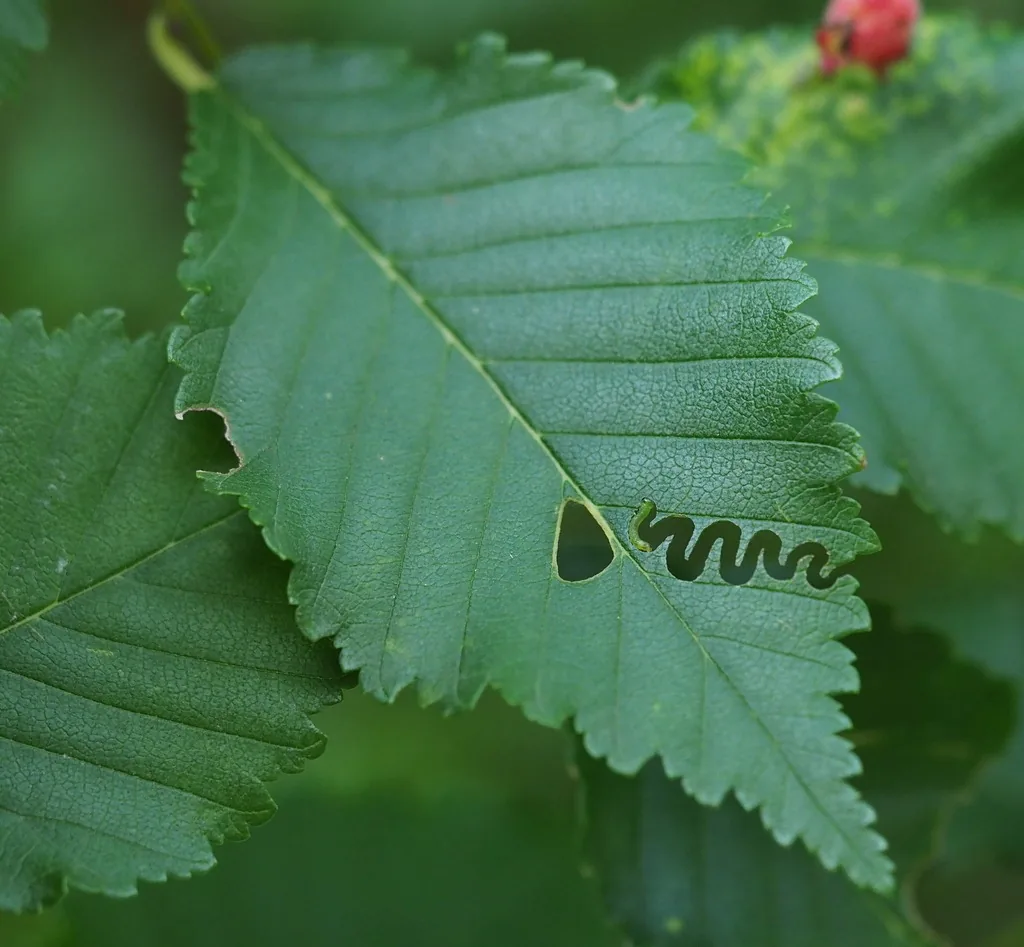
- Young larvae chew a zigzag track from the leaf edge toward the midvein. Older larvae eat whole sections and can leave only the thick veins, which hides the zigzag.[1][2][3]
- Grown larvae are green, 10 to 11 mm long, with a dark band on the head and T-shaped dark marks over the second and third pairs of legs. Like other sawfly larvae they have six or more pairs of fleshy prolegs; caterpillars have five or fewer.[1][2][3]
- Adults are shiny black, 7 to 8 mm long, with smoky wings, pale yellow to white legs and short three-segmented antennae. They don't sting.[1][2][3][8]
- Summer cocoons are loose, net-like mesh on leaves, twigs, fence posts and even vehicles. Cocoons for winter are dense and sit in leaf litter or soil.[1][2][3]
Where it lives
Native to Japan, eastern Russia, eastern China and Korea, it has been in Europe since 2003. NC State tracked it from Virginia in 2021 to North Carolina, Maryland, Pennsylvania and New York in 2022, then Ohio, Vermont and Massachusetts in 2023. Minnesota and Wisconsin followed in July 2024.[2][1][9][6]
Biology and life cycle
No males are known; females lay fertile eggs without mating. Each lives only one to six days. Clemson says a female lays up to 60 eggs, and the Forest Service gives a range of 7 to 60, placed singly along leaf edges.[1][3][8][2]
Eggs hatch in four to eight days, larvae feed for about 10 to 18 days through six instars, and pupation takes about a week. Summer adults emerge within 10 days of spinning a cocoon.[1][3]
Sources give different numbers of generations. Clemson reports two to five in the U.S., the Forest Service one to six, and Wisconsin DNR one to four in eastern states. NC State saw two in Virginia in 2021, one in 2022, and at least four in North Carolina in 2023.[1][3][5][2]
In Illinois, traps in 2025 showed two generations and possibly a third. In northeastern Italy, field generations ranged from one to six, with five adult peaks in 2012.[4][11]
Sources describe the winter stage differently. Minnesota's MDA says it overwinters as a pupa, while Clemson and the Forest Service describe a larva resting inside a thick winter cocoon in the litter or soil.[8][1][3]
Damage and signs
- Heavy feeding can strip whole trees. Most trees recover from a single defoliation, but Vermont's forest health program and NC State warn that years of repeated loss can bring crown dieback or death.[1][2][7]
- Hosts include American, winged, slippery, Siberian, Chinese and English elms, along with hybrids such as 'Cathedral'. Whether zelkova is at risk is still unknown.[1][3][8]
- Accounts of host preference differ. Clemson says, anecdotally, that it favors non-native elms, while the Illinois Forest Health report cites research showing a preference for Siberian and American elm.[1][4]
- Accounts of how serious it is also differ. Wisconsin DNR says feeding often causes only minor cosmetic damage, and Illinois larval populations never really built up in 2025. NC State notes that outbreaks in Europe regularly defoliate urban trees and large tracts of forest.[5][4][2]
Health risk
Adults don't sting, and none of the extension or agency sources lists any risk to people.[8][1][3]
Control
Prevention
Look up into elm canopies for zigzag feeding from spring through late summer. Photograph or collect suspect larvae and report them to your state agriculture department or extension office; in South Carolina that's Clemson Extension or DPI.[1][3][8]
Cocoons hitchhike, so check vehicles, outdoor furniture, nursery stock and leaf litter before moving them out of an infested area. Wisconsin reports no federal or state quarantine.[3][5][6]
Traps and physical control
On small trees you can hand-pick or squash larvae, knock them off with a strong stream from a hose, or scrape them into soapy water. Wisconsin DNR and NC State both say doing nothing is often reasonable, since most trees recover.[5][2][7]
Biological control
The Forest Service reports that the soil fungus Beauveria bassiana was effective in testing. In Italy, sawfly numbers have fallen steadily since 2013, and researchers recorded several natural enemies.[3][11]
Pesticides
No insecticide is labeled specifically for elm zigzag sawfly. Sprays used in Europe aren't specific to it and will likely hit other insects on elms, and research on systemic products is ongoing in the U.S.[3][7][1]
How far it has spread
Wisconsin's first find was in Portage County on July 4, 2024, confirmed by USDA-APHIS on July 30. By August 12 it was known from 17 counties, and DATCP later called it likely established and widely distributed in the state.[5][6]
Minnesota's first find came from a citizen report in Ramsey County in summer 2024. By July 2026 MDA had found it at multiple sites across the Twin Cities metro. The same MDA bulletin relayed a news report that Michigan had confirmed its first case, in St. Clair County.[9][8][10]
The 2025 Illinois Forest Health report counts it in 12 eastern and central states, including Minnesota and Wisconsin, plus several Cook County, Illinois sites found in 2024.[4]
The Forest Service says it is probably more widespread than known. Adults can fly about 27 to 55 miles a year; Wisconsin DNR puts it at up to 56 miles.[3][5]
Common questions
- What's making zigzag holes in my elm leaves?
- Zigzag tracks running from the leaf edge in toward the midvein are typical of young elm zigzag sawfly larvae.[1][2][3]
- Should I report elm zigzag sawfly?
- Yes, especially outside areas where it's already known. Minnesota's MDA and Clemson in South Carolina both ask people to report suspected sightings.[1][8]
- Will elm zigzag sawfly kill my elm?
- Usually not after one season; most trees grow new leaves. Repeated heavy defoliation over several years can cause dieback or death, and the Forest Service says its effect on elms already hit by Dutch elm disease is unknown.[2][7][3]
Sources
- Clemson Cooperative Extension, Home & Garden Information Center, “Elm Zigzag Sawfly (HGIC 2026).” hgic.clemson.edu/factsheet/elm-zigzag-sawfly/ (accessed 2026-11-13)
- NC State Extension, “Elm Zigzag Sawfly.” content.ces.ncsu.edu/elm-zigzag-sawfly (accessed 2026-11-13)
- USDA Forest Service, Eastern Region State, Private, and Tribal Forestry, “Pest Alert: Elm Zigzag Sawfly (R9-PR-016-24, November 2024).” agriculture.delaware.gov/wp-content/uploads/sites/108/2025/01/Elm-Zigzag-Sawfly-Pest-Alert-November-2024-FINAL-508.pdf (accessed 2026-11-13)
- USDA Forest Service, Forest Health Protection, “Illinois Forest Health Highlights 2025.” www.fs.usda.gov/foresthealth/docs/fhh/IL_FHH_2025.pdf (accessed 2026-11-13)
- Wisconsin Department of Natural Resources, “New Invasive Pest Discovered In Wisconsin (Forestry News, 2024).” forestrynews.blogs.govdelivery.com/?p=10373 (accessed 2026-11-13)
- Wisconsin Department of Agriculture, Trade and Consumer Protection, “Field Notes 10-31-24.” content.govdelivery.com/accounts/WIDATCP/bulletins/3bf4bb6 (accessed 2026-11-13)
- Vermont Department of Forests, Parks and Recreation (via Vermont Invasives), “Invasive Insect Elm Zigzag Sawfly Confirmed in Vermont.” vtinvasives.org/node/849 (accessed 2026-11-13)
- Minnesota Department of Agriculture, “Elm Zigzag Sawfly.” mda.state.mn.us/plants-insects/elm-zigzag-sawfly (accessed 2026-11-13)
- Minnesota Department of Agriculture, “Invasive Insect Elm Zigzag Sawfly Found for First Time in Minnesota (August 6, 2024).” www.mda.state.mn.us/invasive-insect-elm-zigzag-sawfly-found-first-time-minnesota (accessed 2026-11-13)
- Minnesota Department of Agriculture, “Plant Pest Insider (July 21, 2026).” content.govdelivery.com/accounts/MNMDA/bulletins/41ec47b (accessed 2026-11-13)
- Insects, 2026 (via PubMed), “Bionomics of the Non-Native Elm Defoliator Aproceros leucopoda (Hymenoptera, Argidae) in North-Eastern Italy (abstract).” pubmed.ncbi.nlm.nih.gov/42042431/ (accessed 2026-11-13)
- Global Biodiversity Information Facility (GBIF), “Aproceros leucopoda Takeuchi, 1939 (GBIF Backbone Taxonomy).” api.gbif.org/v1/species/8599762 (accessed 2026-11-13)