On this page
How to identify it
- Larvae are 0.33 to 0.4 inch (8 to 11 mm) long, pale gray to flesh-colored with small pale spines and a yellowish-brown head.[1][2]
- The first sign is reddish-brown, gum-like resin oozing from the bark, often mixed with droppings and silk.[1]
- Soft, sawdust-like frass tubes about 1/4 inch long cluster at the trunk base, where branches meet the trunk and at graft unions.[1]
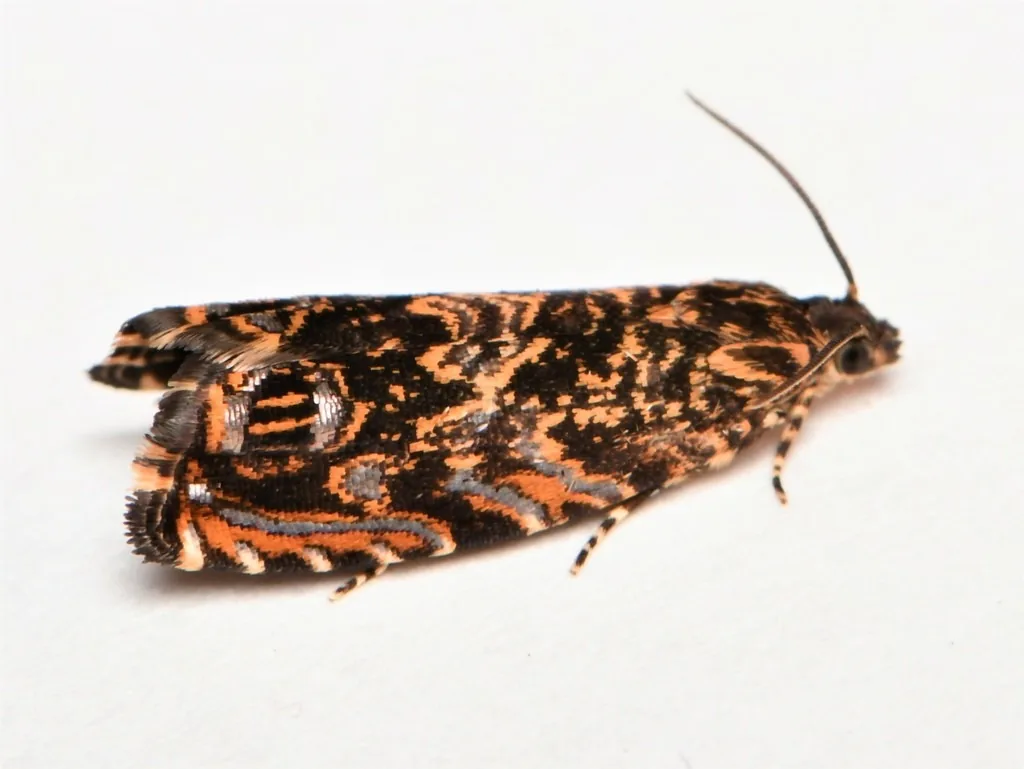
- Adults are small moths mottled in brown, orange-yellow and cream. Sources disagree on size: the PNW handbook gives a wingspan of about 0.33 inch, while Oregon State Extension and Rhode Island DEM give 15 to 18 mm (0.6 to 0.7 inch). Oregon State says the forewings carry five evenly spaced whitish spots along the outer edge and the moth looks like a more ornate codling moth.[1][2][3]
- Eggs are tiny (0.7 mm), round and flattened, milky white when laid and turning red within two or three days.[2][3]
Where it lives
Native to Eurasia, from Denmark to Siberia and from France to Algeria. The PNW handbook says it was first found in North America in British Columbia in 1989, while Oregon State Extension gives 1990, with the first U.S. record in far northwestern Washington in February 1991. By 1998 it had reached Centralia, Washington; it is slowly moving south and hasn't been seen spreading east, possibly because of the Cascades.[2][1]
Biology and life cycle
Larvae overwinter under bark, feed again in spring and pupate in silk tubes that stick out from the bark.[1]
Moths fly from late April to September, mostly in early morning, and some come to lights at night. Eggs are laid singly or in twos and threes on bark, in crevices or under loose bark, mainly at wounds, and hatch in two to three weeks.[1][2]
Hatching larvae enter through natural or mechanical wounds and feed on the living bark tissue, never the hardwood.[1]
It attacks most woody ornamental trees and shrubs in the rose family. Oregon State says larvae prefer cherry and plum but also attack apple, apricot, firethorn, mountain-ash, nectarine, peach, pear and quince.[1][2]
Oregon State Extension notes that cold is unlikely to limit it in Oregon, but warm, dry areas may slow its spread, since eggs appear to die above about 90°F. Rhode Island DEM rates New England at medium to high risk of establishment if it spreads there.[2][3]
Damage and signs
- Feeding on the cambium cuts the tree's nutrient supply and leaves it open to disease, other insects, cold injury and stress. Heavy infestations cause swellings and cankers and can kill limbs or the whole tree.[1][2][3]
- It mostly attacks older trees, but Rhode Island DEM says it has also been found on younger plants in the U.S. On cherry, damage is usually near the base of the trunk; on apple, on the main branches close to the trunk. Nursery stock can be hit at graft sites and where repeated clipping builds up extra bark.[2][3]
Health risk
It feeds on trees; none of the PNW handbook, Oregon State or Rhode Island DEM sheets mention a risk to people.[1][2][3]
Control
Prevention
Check susceptible trees regularly for frass tubes. Several native insects cause similar damage, so larvae must be collected and examined to confirm it. Pheromone traps hung from May to September catch the moths.[1][2]
Avoid unneeded pruning cuts and injuries, and keep trees healthy with proper watering, fertilizing and pruning; stressed trees attract it.[1]
Sanitation
Remove loose bark and pupation chambers in spring where you can, and remove heavily infested branches or trees.[2][1]
Biological control
Some wasps parasitize the larvae but don't control it well yet; avoid sprays that would disrupt them.[1]
How it was found and spread in the Northwest
Trapping in western Washington in 1991 and 1992 found it as far south as Pierce County, with moths caught from mid-April to September; it was not found in eastern Washington. In Washington it was then known only from mature cherry and apple.[2]
Common questions
- What are the sawdust-like tubes at the base of my flowering cherry?
- Probably cherry bark tortrix frass tubes, made of droppings and webbing by larvae feeding under the bark.[1]
- Can cherry bark tortrix kill a tree?
- Yes. Larvae feed on the living tissue under the bark, and heavy infestations can kill limbs or the entire tree.[1][2]
Sources
- Pacific Northwest Pest Management Handbooks (OSU, WSU, University of Idaho), “Cherry, flowering (Prunus): Cherry bark tortrix (Insect Management Handbook).” pnwhandbooks.org/insect/hort/landscape/hosts-pests-landscape-plants/cherry-flowering-prunus-cherry-bark-tortrix (accessed 2026-11-13)
- Oregon State University Extension Service and Oregon Department of Agriculture, “Cherry Bark Tortrix Moth (New Pest Alert, EC 1409).” extension.oregonstate.edu/sites/extd8/files/documents/ec1409.pdf (accessed 2026-11-13)
- Rhode Island Department of Environmental Management, Division of Agriculture, “Cherry Bark Tortrix, Enarmonia formosana (CAPS pest sheet).” dem.ri.gov/sites/g/files/xkgbur861/files/programs/agriculture/documents/pests_cherrybarktortrix.pdf (accessed 2026-11-13)
- Global Biodiversity Information Facility (GBIF), “Enarmonia formosana (Scopoli, 1763) (GBIF Backbone Taxonomy).” api.gbif.org/v1/species/1744416 (accessed 2026-11-13)
- iNaturalist, “Enarmonia formosana taxon page (order and family).” www.inaturalist.org/taxa/320540 (accessed 2026-10-06)