On this page
How to identify it
- Adults are small black flies about 0.2 inch long, and mature larvae are about 0.2 inch long.[1]
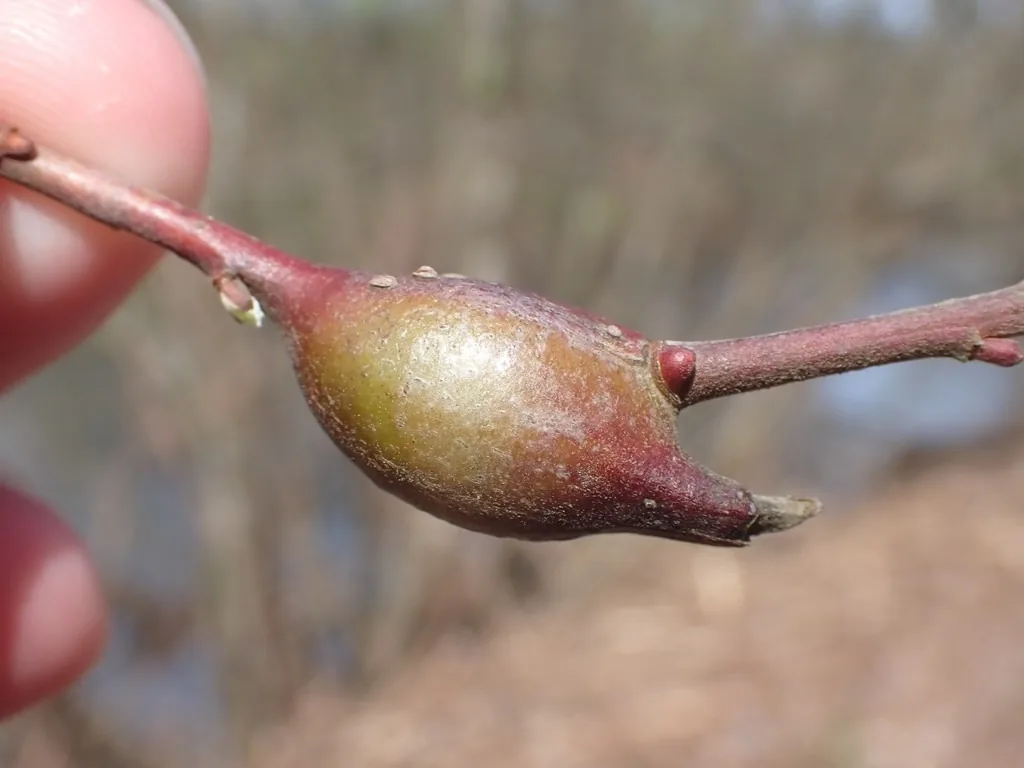
- Infested buds swell and harden into galls with a characteristic beak shape, red and hard by September.[1]
- The beaked gall is one of several willow galls. The PNW handbook notes that other flies and midges make willow pine cone galls, and sawflies make pea- and bean-shaped galls on willow leaves.[3]
Where it lives
The PNW Insect Management Handbook covers it on willows in Pacific Northwest landscapes, where pussy willow is reportedly a favorite host. Its genus is widespread: the Forest Service's Alaska guide lists Rabdophaga gall midges on willows throughout Alaska.[1][4]
Biology and life cycle
It overwinters as a partly grown larva in the gall; adults emerge in spring and lay eggs on swollen willow buds.[1]
Each larva tunnels into a bud and develops in a hollow cavity inside the gall; there's one generation a year.[1]
Gall makers like this one trigger the plant to grow extra tissue around the developing insect. Beaked galls are closed galls, so the insect inside has to chew its way out.[3]
Damage and signs
Health risk
It lives inside willow buds. None of the Extension or Forest Service sources cited here describes any risk to people or pets.[1][3][4]
Control
Prevention
Control is rarely needed. The Forest Service calls it seldom necessary, and the PNW handbook says most people can live with galls once they know the plant won't die.[4][3]
Traps and physical control
Prune out galls as you notice them. If you prune in fall or winter, crush or bury the galls, since adults can still emerge from galls tossed on the ground.[1]
Biological control
Gall insects are often heavily parasitized. To check, the PNW handbook suggests sealing a few galls in a plastic bag with a bit of tissue and seeing what comes out; parasitoid wasps are worth keeping.[3]
Galls that can help the shoot
A 2007 Environmental Entomology study on the willow Salix eriocarpa in Japan found that the midge starts its stem galls at shoot tips in mid-May. The next spring, galled shoots were thicker at the base and had more side shoots than ungalled ones.[2]
Galled shoots also survived better, so they ended up with about twice as many buds as ungalled shoots. The authors suggest the regrowth set off by galling can increase bud production.[2]
Common questions
- What are the red, pointed swellings on my willow's twig tips?
- Likely willow beaked-gall midge galls, which harden and turn red by September.[1]
- Do I need to do anything about willow beaked galls?
- Usually not. The galls rarely injure trees seriously, but you can prune them out and destroy them if they bother you.[1][3]
- Are other insects in the galls a problem?
- Not necessarily. Many gall insects are attacked by tiny parasitic wasps, and the PNW handbook says some insects coming out of galls may be parasitoids worth protecting.[3]
Sources
- Pacific Northwest Pest Management Handbooks (OSU, WSU, University of Idaho), “Willow (Salix): Willow beaked-gall midge (Insect Management Handbook).” pnwhandbooks.org/insect/hort/landscape/hosts-pests-landscape-plants/willow-salix-willow-beaked-gall-midge (accessed 2026-11-13)
- Peer-reviewed literature (PubMed), “Willow regrowth after galling increases bud production through increased shoot survival (Nakamura M et al., Environmental entomology, 2007).” pubmed.ncbi.nlm.nih.gov/17540073/ (accessed 2026-11-13)
- Pacific Northwest Pest Management Handbooks (OSU, WSU, University of Idaho), “Gallmakers (Common Landscape Pests, Insect Management Handbook).” pnwhandbooks.org/insect/hort/landscape/common/landscape-gallmakers (accessed 2026-11-13)
- USDA Forest Service, Alaska Region, “Insects and Diseases of Alaskan Forests (R10-TP-140): Hardwood Gall Insects.” www.fs.usda.gov/media/38205 (accessed 2026-11-13)
- Global Biodiversity Information Facility (GBIF), “Rabdophaga rigidae (Osten Sacken, 1862) (GBIF Backbone Taxonomy).” api.gbif.org/v1/species/1601149 (accessed 2026-11-13)