On this page
How to identify it
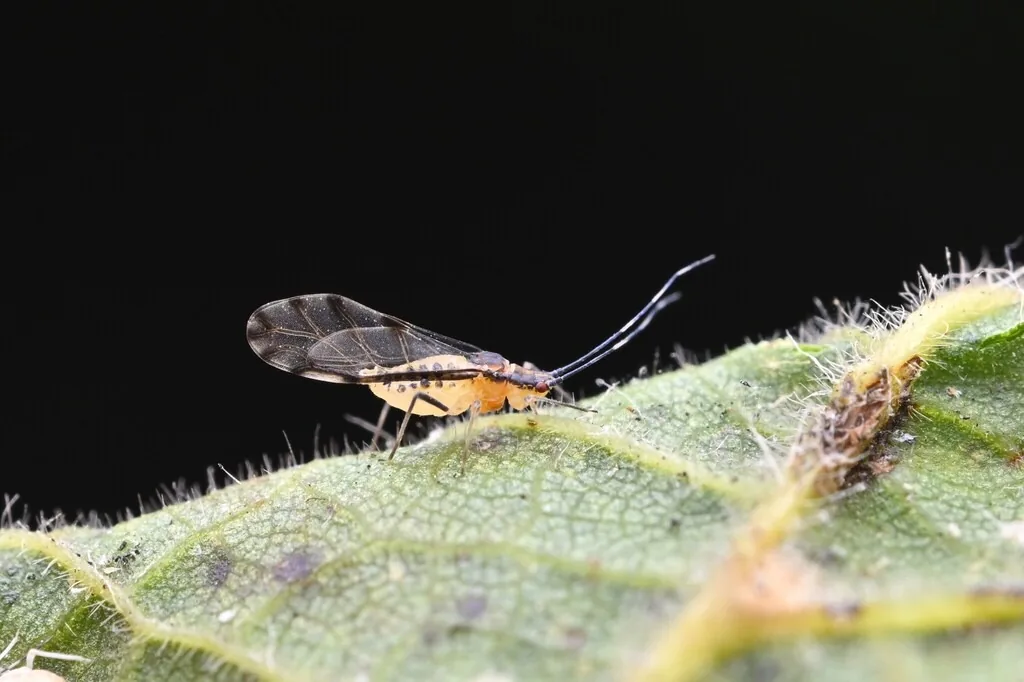
- Aphids are green with black stripes along the sides, about 0.07 to 0.12 inch (1.9 to 3 mm) long; winged forms have clouded wings.[1][2]
- Colonies feed on the undersides of leaves, and surfaces below infested trees turn shiny with honeydew and then black with sooty mold.[1][2]
- Brown to bronze aphid mummies on leaves show where parasitoid wasps have struck.[1]
- Ants, bees, wasps and other insects that like sugary liquids may be drawn to an infested tree; to confirm, flip leaves over and look for aphid groups or their cast skins.[1]
Where it lives
Native to Europe and first reported in North America in 1886. UMass says it commonly infests urban street trees, with established European parasitoids in eastern North America and northern California; the Pacific Northwest handbook covers it on landscape lindens.[1][2]
Biology and life cycle
There are many generations a year, all on linden (it uses no alternate host); winged males and wingless egg-laying females appear in mid to late summer and lay the overwintering eggs.[1]
Damage and signs
- Little-leaf linden (Tilia cordata) and European linden (T. x europaea) are favored hosts. UMass says resistance depends on how hairy and glandular the leaf undersides are.[1]
- Feeding rarely harms large, established trees: UMass says it can interrupt normal growth of saplings, and the PNW handbook says feeding damage is usually minor, with some leaf and shoot distortion when populations are high.[1][2]
- Its honeydew is mainly a nuisance on cars, sidewalks and anything else below the tree.[1][2]
Health risk
It feeds on linden sap, and no cited source describes any risk to people or pets.[1][2]
Control
Prevention
Where it is a known problem, UMass suggests planting hairier, more resistant lindens such as Tilia platyphyllos, T. mongolica, T. petiolaris, T. maximowicziana or T. euchlora; it notes these are not native to Massachusetts.[1]
Biological control
European parasitoid wasps (Trioxys and Aphelinus species) are established in North America, and the PNW handbook says the aphid is controlled by releasing parasitoids. UMass adds that lady beetles and the aphid midge Aphidoletes aphidimyza, which is sold commercially, feed on it; it says lady beetles can quickly fill up on the available aphids, though their feeding may help reduce numbers the next year.[1][2]
Pesticides
If treatment is needed, UMass lists insecticidal soap, horticultural oil and other active ingredients, and says to apply after bloom and at times of day when pollinators are less active; neonicotinoids have been state restricted use on trees and shrubs in Massachusetts since July 2022. The PNW handbook refers readers to its chemical control table. Follow the label.[1][2]
Common questions
- Why is everything under my linden tree sticky?
- Linden aphids feeding under the leaves drip honeydew onto whatever is below.[1][2]
- Do linden aphids hurt the tree?
- Rarely on established trees: both UMass and the PNW handbook call the honeydew the main problem, though heavy populations can distort leaves and set back young trees.[1][2]
Sources
- UMass Extension Landscape, Nursery and Urban Forestry Program (Landscape Insect & Mite Guide), “Eucallipterus tiliae (Linden Aphid).” www.umass.edu/agriculture-food-environment/landscape/publications-resources/insect-mite-guide/eucallipterus-tiliae (accessed 2026-11-13)
- Pacific Northwest Insect Management Handbook (Oregon State, Washington State, University of Idaho), “Linden (Tilia)-Aphid (Hosts and Pests of Landscape Plants).” pnwhandbooks.org/insect/hort/landscape/hosts-pests-landscape-plants/linden-tilia-aphid (accessed 2026-11-13)
- Global Biodiversity Information Facility (GBIF), “Eucallipterus tiliae (Linnaeus, 1758) (GBIF Backbone Taxonomy).” api.gbif.org/v1/species/2076990 (accessed 2026-11-13)