On this page
How to identify it
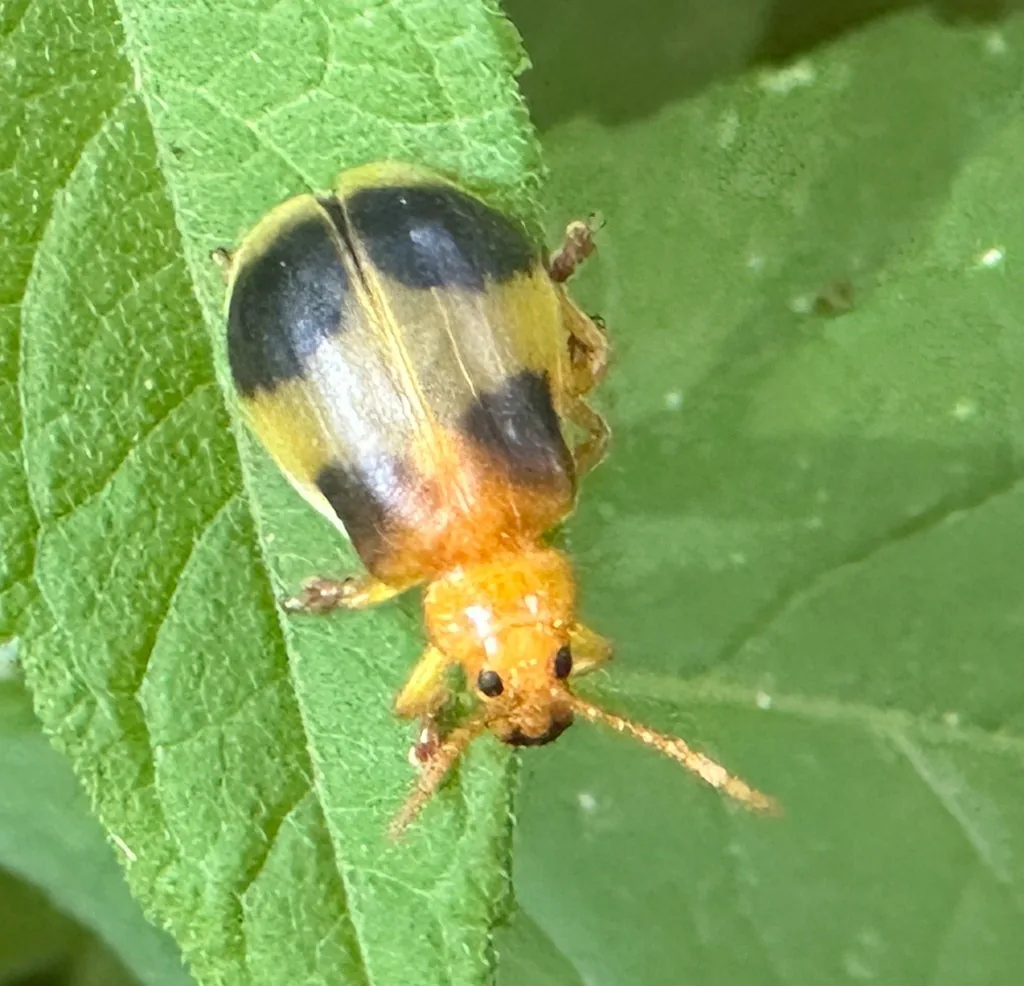
- NC State describes adults as 3/8 to 5/8 inch long and orange with four dark to metallic blue spots; on some beetles the spots run together into two broad bands across the wing covers. UF/IFAS gives adults as 10 to 16 mm (about 3/8 to 2/3 inch), one of the largest leaf beetles in the United States.[1][2]
- NC State calls the larvae orange, conspicuous and up to 3/4 inch long; newly hatched larvae are about 1/8 inch and greenish yellow. UF/IFAS gives full-grown larvae as up to 20 mm (3/4 inch) and newly hatched larvae as about 3 mm.[1][3][2]
- Adults and larvae give off an orange fluid when disturbed. UF/IFAS calls the fluid presumably defensive.[1][2]
Look-alikes
| Look-alike | How to tell them apart |
|---|---|
| Elm leaf beetle | The common elm leaf beetle is much smaller, about 1/4 inch (6 to 8 mm), and is yellow with black stripes on the wing covers rather than blue spots. Its mature larvae reach only about 1/2 inch and are yellow-green with black spots. UF/IFAS adds that it has lengthwise stripes on the wing covers instead of crosswise markings and does not seem to be a serious pest in Florida.[4][2] |
Where it lives
University of Maryland entomologist Michael Raupp calls it a native beetle that often frequents elms in riparian forests in the eastern United States. Of 3,185 U.S. GBIF records since 1990, most come from Virginia, North Carolina, Pennsylvania, Georgia and West Virginia, with smaller numbers from Ohio, Kentucky, Tennessee, Maryland, South Carolina, Alabama, Mississippi, Indiana, Florida and Louisiana. UF/IFAS cites a range from Pennsylvania south to Florida and west to Kansas but says it is unevenly distributed and was reported as new to Ohio in 1986; in Florida it occurs from the Panhandle south to the middle of the peninsula.[5][6][2]
Biology and life cycle
The grubs spend the winter in the soil and pupate in spring. The USDA Forest Service says they spend the winter as full-grown larvae in a cell a few inches below the soil surface, and UF/IFAS says pupation takes about a month in late winter or early spring.[1][5][7][2]
New adults begin emerging from the soil in May; NC State's entomology blog says adults are active in spring and early summer, laying clusters of eggs. UF/IFAS, drawing on a Florida study, says adults begin emerging in April and are active until early August, with most records from June to July. The Forest Service says new adults fly to the tops of their host trees and feed on the leaves for several days.[1][3][2][7]
Females lay masses of 24 to 58 eggs in yellow, crusty clusters on the undersides of leaves. The eggs hatch in about two weeks, and the young larvae feed in groups for three or four days before spreading out.[1]
Mature larvae crawl down the tree and wander for a few days before digging into the soil, which is why groups of larvae sometimes turn up on the ground under a tree. There is one generation a year.[1][3]
Damage and signs
- Elm is the main host; it also feeds on dogwood, hazelnut, pecan, river birch, plum and hawthorn. UF/IFAS lists elms, hazel, hawthorn, river birch and pecan and treats other Florida plant records as resting or incidental; the Forest Service lists native and Japanese elms and says slippery elm is especially favored.[1][2][7]
- Adults chew holes in the leaves and larvae skeletonize them. Defoliation in spring does an elm more harm than the same loss later in summer or fall.[1]
- Damage can be severe. A 1957 Florida record from Bradenton estimated 1,000 beetles per tree, with elms brown and dropping leaves, and larvae completely skeletonized elms at Quincy in 1940. The Forest Service recorded outbreaks in river bottoms of the Piedmont in the Carolinas and Alabama in 1964.[2][7]
Health risk
It feeds on elm and other tree leaves, and no cited source describes any risk to people or pets.[1][5]
Control
Biological control
A tachinid fly, Icelia triquetra, and other parasites usually keep the beetle below noticeable levels. Outbreaks happen when it escapes its parasites, predators and diseases for a year or two, and then die away; Raupp also says parasitic tachinid flies attack the beetles when their numbers rise. UF/IFAS cites a Florida study that saw numbers drop sharply the year after an outbreak, with a very high rate of parasitism, and notes that the larvae's crawl down the tree is a vulnerable stage.[1][5][2]
Pesticides
Treatment is only worth considering if severe defoliation hits early in the growing season, the tree is small enough to treat and it matters in the landscape. The beetle is not reported to be resistant, so most garden-center pyrethroids labeled for residential landscapes should control it; keep pyrethroids away from pools, ponds and streams because they are very toxic to fish.[1]
For an isolated elm, NC State's entomology blog suggests spraying the base of the trunk with a contact insecticide so larvae die on the way down, but says this will not help much if other elms are nearby, because the beetles move around a lot.[3]
Where the sources disagree
Larval season: NC State's entomology blog says larvae feed all summer and are full-sized, about 3/4 inch, by late summer, while Raupp says they develop through the summer and autumn before moving to the soil.[3][5]
How serious: NC State says it periodically appears in great numbers and does tremendous defoliation for a year or two, and its blog reported severe defoliation of even large elms around Raleigh, while Raupp calls it only an occasional pest of elms in landscapes.[1][3][5]
Adult size and color: NC State gives 3/8 to 5/8 inch and UF/IFAS 10 to 16 mm, orange with metallic blue, while the USDA Forest Service gives about 12 mm, dull yellow to dark brown with large greenish patches at the ends of the wing covers.[1][2][7]
Larval color: NC State and UF/IFAS call the larvae orange, while the Forest Service describes full-grown larvae as reddish-brown with a metallic luster, about 20 mm long.[1][2][7]
Adult emergence: UF/IFAS says April in Florida, NC State says May, and the Forest Service says late May.[2][1][7]
Range: UF/IFAS cites Pennsylvania to Florida and west to Kansas, and the Forest Service Georgia and Alabama north to Pennsylvania, Ohio, Indiana and Illinois and west to the Plains States; GBIF records since 1990 are concentrated farther east.[2][7][6]
Common questions
- What are the big orange beetles with blue bands on my elm?
- Most likely larger elm leaf beetles: large orange leaf beetles with four dark to metallic blue spots that may merge into bands.[1]
- Will they come back every year?
- Usually not. Outbreaks tend to last a year or two, and then the beetle disappears for years as its natural enemies catch up.[1]
- Why are orange grubs crawling on the ground under my elm?
- Those are mature larvae. They crawl down the trunk and wander for a few days before burrowing into the soil to spend the winter.[1][3]
- Is the larger elm leaf beetle found in Florida?
- Yes, though it is usually uncommon. UF/IFAS says it occurs from the Panhandle south to the middle of the peninsula and occasionally defoliates elms there.[2]
Sources
- NC State Extension, “Larger Elm Leaf Beetle (PDIC Factsheet).” content.ces.ncsu.edu/larger-elm-leaf-beetle (accessed 2026-11-14)
- University of Florida/IFAS Extension (Featured Creatures), “Larger Elm Leaf Beetle, Monocesta coryli (Say), EENY-180/IN337.” ask.ifas.ufl.edu/publication/IN337 (accessed 2026-11-14)
- NC State Extension, Entomology, “Larger Elm Leaf Beetle (Steven Frank, August 29, 2018).” entomology.ces.ncsu.edu/news/larger-elm-leaf-beetle/ (accessed 2026-11-14)
- Penn State Extension, “Elm Leaf Beetle.” extension.psu.edu/elm-leaf-beetle (accessed 2026-11-14)
- Bug of the Week (Michael J. Raupp, Professor of Entomology, University of Maryland), “Beautiful beetles and gnarly elm leaves: Larger elm leaf beetle, Monocesta coryli, and elm leaf beetle, Xanthogaleruca luteola (July 17, 2023).” bugoftheweek.com/blog/2023/7/17/beautiful-beetles-and-gnarly-elm-leaves-larger-elm-leaf-beetle-monocesta-coryli-and-elm-leaf-beetle-xanthogaleruca-luteola (accessed 2026-11-14). Bug of the Week is written by Michael J. Raupp, Professor of Entomology at the University of Maryland.
- Global Biodiversity Information Facility (GBIF), “Monocesta coryli: U.S. occurrence records since 1990 by state (GBIF occurrence search).” api.gbif.org/v1/occurrence/search?taxonKey=1048375&country=US&hasGeospatialIssue=false&occurrenceStatus=PRESENT&year=1990%2C2026&facet=stateProvince&facetLimit=400&limit=0 (accessed 2026-11-14). Fetched 2026-11-13: 3,185 U.S. records since 1990; Virginia 648, North Carolina 624, Pennsylvania 499, Georgia 321, West Virginia 249, Ohio 171, Kentucky 153, Tennessee 138, Maryland 135, South Carolina 113, Alabama 76, Mississippi 26, Indiana 19, Florida 12, Louisiana 1.
- USDA Forest Service, “Eastern Forest Insects, Miscellaneous Publication 1175 (W. L. Baker, 1972; scanned copy).” archive.org/details/easternforestins1175bake (accessed 2026-11-14). Read via archive.org's full-text (djvu.txt) copy of the scanned USDA publication; a historic document.
- Global Biodiversity Information Facility (GBIF), “Monocesta coryli (Say, 1824) (GBIF Backbone Taxonomy).” api.gbif.org/v1/species/1048375 (accessed 2026-11-14)