On this page
How to identify it
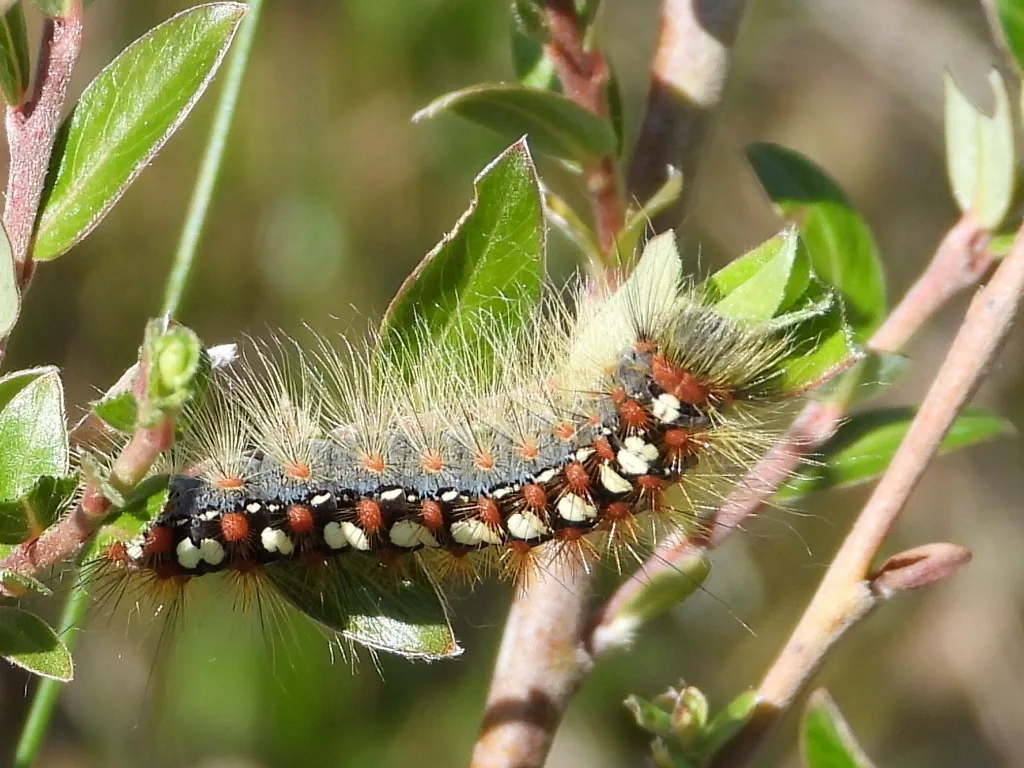
- Grown caterpillars are dark and hairy, with a row of large white or pale-yellow patches down the back and reddish-orange warts. Sources differ on size: UMass and WSU say about 2 inches, Nevada about 1.75 inches and NRCan 35 to 45 mm (about 1.4 to 1.8 inches).[1][4][3][2]
- Moths are satiny white, and the black body shows through the white hairs. NRCan gives a wingspan of 24 to 47 mm (about 1 to 1.9 inches); Nevada and WSU say 1.5 to 2 inches.[2][3][4]
- Eggs are laid in masses of up to 400 covered with frothy white material; NRCan and Nevada say a mass usually holds 150 to 200.[1][2][3]
- Pupae are shiny black and 15 to 22 mm long; the stage lasts about 10 days.[2][1]
Where it lives
Introduced from Europe or Asia, it was first reported between Boston and Hampton, New Hampshire, in 1920, and NRCan says it was also found in British Columbia that year. It now ranges from Newfoundland through eastern Canada and the northeastern U.S. to Ontario, and from British Columbia to northern California. Nevada says it is established in most Western states and has been in Nevada since 1981.[1][2][3]
Biology and life cycle
Moths fly in July and August. Eggs hatch in about two weeks, and the small caterpillars feed briefly before spinning silk shelters on trunks and branches for the winter. Sources differ on the overwintering stage: UMass says third instar, NRCan second instar.[1][2]
Caterpillars resume feeding in spring. NRCan says damage shows from mid to late May and is most conspicuous after mid-June, and Nevada puts most damage from mid-May through June. Pupation starts at the end of June.[2][3][1]
There is one generation a year. UMass counts seven larval stages, NRCan seven or eight.[1][2][3]
Damage and signs
- It feeds on poplars, cottonwoods, aspens and willows, and occasionally oak. NRCan says it prefers ornamental poplars and Nevada says aspen. NRCan and Nevada also mention crabapple.[1][2][3][4]
- Nevada reports repeated cycles of outbreaks, some of the worst in Lake Tahoe Nevada State Park, and moths turning up in towns. UMass says outbreaks haven't been frequent in Massachusetts recently, though a population was found in Beartown State Forest from 2020 to 2022.[3][1]
- Severe defoliation can weaken trees, but they often survive. NRCan says repeated severe defoliation has caused top-kill and some tree deaths, and calls the wandering caterpillars a public nuisance.[1][2]
Health risk
MedlinePlus says most caterpillars are harmless, but the hairs of some cause allergic reactions in the skin, eyes or lungs, and fuzzy caterpillars should not be touched. It advises pulling hairs off skin with sticky tape and washing, flushing eyes with water and getting medical help, and calling Poison Help at 1-800-222-1222.[5]
Control
Prevention
Scout for it. Nevada says moths gathering at lights are a cue to check nearby trees for egg masses and young caterpillars, and UMass mentions pheromone and black-light traps for monitoring.[3][1]
Traps and physical control
Scrape off egg masses, or knock egg masses and caterpillars off with a strong spray of water. Sticky bands may catch caterpillars moving on the trunk, though UMass says how well they protect a tree is uncertain. WSU suggests hand-picking caterpillars while wearing gloves.[1][3][4]
Biological control
Parasites of the spongy moth, such as the fly Compsilura concinnata and the wasp Eupteromalus peregrinus, also attack satin moth, along with a virus, fungi and birds.[1][4][3]
Pesticides
Bacillus thuringiensis var. kurstaki (Btk) works only on feeding caterpillars and may need reapplying. Timing advice differs: Nevada says it works best on young caterpillars on new leaves in spring, while WSU says to apply when larvae are seen in late summer. Nevada says imidacloprid doesn't work on the caterpillars, and that the contact insecticides it lists are toxic to pollinators and shouldn't be used while trees bloom.[3][4]
Common questions
- What are the white moths covering my porch light in July?
- Near poplars, aspens or willows in July or August, often satin moths. Nevada says the adults gather at porch lights and streetlights in the evening.[3][2]
- Are satin moth caterpillars safe to touch?
- It's best not to. MedlinePlus says fuzzy caterpillars should not be touched because the hairs of some kinds cause allergic reactions.[5]
Sources
- UMass Extension Landscape, Nursery and Urban Forestry Program (Landscape Insect & Mite Guide), “Leucoma salicis (Satin Moth).” www.umass.edu/agriculture-food-environment/landscape/publications-resources/insect-mite-guide/leucoma-salicis (accessed 2026-11-13)
- Natural Resources Canada, Canadian Forest Service, “Satin moth, Leucoma salicis (Forest Invasive Alien Species).” www.exoticpests.gc.ca/es-details/insect/9504 (accessed 2026-11-13)
- University of Nevada Cooperative Extension, Nevada Division of Forestry and Nevada Department of Agriculture, “White Satin Moth (Fact Sheet 18-05; Kratsch, Fisher, Hanson Mazet, Phillips & Knight).” forestry.nv.gov/uploads/missions/20210302_AMT_2019_White_Satin_Moth_Fact_Sheet.pdf (accessed 2026-11-13)
- Washington State University Extension, “Poplar: Satin moth (Hortsense).” hortsense.cahnrs.wsu.edu/fact-sheet/poplar-satin-moth/ (accessed 2026-11-13)
- NIH National Library of Medicine, MedlinePlus, “Caterpillars (Medical Encyclopedia).” medlineplus.gov/ency/article/002860.htm (accessed 2026-11-13)
- Global Biodiversity Information Facility (GBIF), “Leucoma salicis Linnaeus, 1758 (GBIF Backbone Taxonomy).” api.gbif.org/v1/species/1820039 (accessed 2026-11-13)
- iNaturalist, “Leucoma salicis taxon page (order and family).” www.inaturalist.org/taxa/209787 (accessed 2026-10-06)