On this page
How to identify it
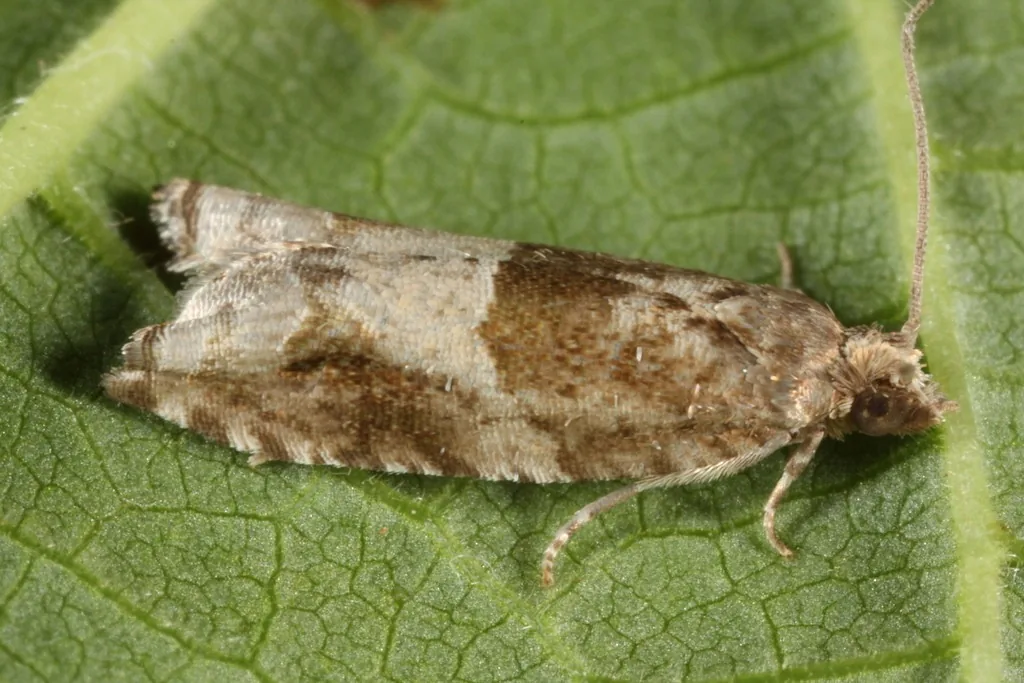
- Adults are small mottled moths. The PNW handbook describes them as brown and silver with a wingspan of about 1/2 inch; UMass gives about 3/8 inch (9 to 10 mm), with gray-brown and silver-gray bands on the forewings. UMass says they fly from daytime through dusk.[1][2]
- Larvae have dark heads. The PNW handbook calls them greenish brown and about 1/2 inch long; UMass describes a shiny black head on a greenish, yellowish or grayish body, with mature larvae only 7 to 9 mm (1/3 to 1/2 inch) long.[1][2]
- Eggs are flat yellow disks about 1/32 inch across, laid singly on the undersides of leaves; UMass says they darken just before hatching.[2]
Where it lives
The PNW handbook covers it on landscape holly and in commercial holly orchards. As the blackheaded fireworm, UMass cites work on it as a cranberry pest in British Columbia, Wisconsin and Massachusetts, and a 2026 study treats it as a major pest of cranberries in Quebec.[1][2][3]
Biology and life cycle
Overwintering eggs hatch in spring. Larvae feed first on buds, then roll leaves and hold them with webbing; UMass says on cranberry they strongly prefer new growth over old leaves.[1][2]
Mature larvae drop to pupate in the duff; second-generation females lay single eggs under leaves, and those larvae appear by late July.[1]
There are two generations a year. On cranberry in British Columbia and Wisconsin, UMass reports that first-generation eggs began hatching 2 to 7 days after being laid, but 5 to 10% wait until the next spring; females of both generations lay about 70 to 80 eggs.[1][2]
Damage and signs
Health risk
It feeds on holly, cranberry and other plants, and no cited source describes any risk to people or pets.[1][2]
Control
Prevention
Watch new growth as it starts, when larvae begin tying leaves together.[1]
Traps and physical control
Hand-pick larvae in rolled leaves; once larvae are established and before they pupate, shear trees and hedges and destroy the clippings.[1]
Biological control
Little is known about its natural enemies, but the PNW handbook says the low number of infested leaves in most years suggests they exist.[1]
Pesticides
Don't spray holly in bloom; the handbook times any insecticide for when new growth is about 1/4 inch long, before blossoms open.[1]
What cranberry research shows
A 1987 study identified the female sex pheromone, and UMass says pheromone traps are used on cranberry beds to follow the summer moth flight and time treatments.[4][2]
A Wisconsin study of trap catches from 2003 to 2011 found that spring flight of this moth began at nearly the same time as two other cranberry moth pests, though peak flights differed.[5]
In a 2026 trial on four organic cranberry farms in Quebec, a sprayable mating-disruption pheromone cut the share of mated females by 16% and reduced fireworm damage by 59%, even though male trap catches did not drop.[3]
Where the sources disagree
Wingspan: the PNW handbook gives about 1/2 inch, UMass 9 to 10 mm (about 3/8 inch).[1][2]
Larvae: the PNW handbook calls them greenish brown and about 1/2 inch long, while UMass describes a greenish, yellowish or grayish body only 7 to 9 mm long when mature.[1][2]
Where it pupates: the PNW handbook says mature larvae drop from the plant to pupate in the duff, while UMass finds pupae silked in the tent of uprights or in the trash layer below the vines.[1][2]
How serious: on landscape holly the PNW handbook says natural enemies keep damage minimal and leaf distortion is hardly noticed, while UMass calls it a key pest throughout North American cranberry regions.[1][2]
Name: the PNW handbook labels its photos Rhopobota naevena Kraft, while GBIF and UMass use Rhopobota naevana (Hübner).[1][6][2]
Common questions
- What is rolling and webbing the new leaves on my holly?
- Likely holly bud moth larvae, small dark-headed caterpillars that roll new leaves and tie them with webbing.[1][2]
- When should I deal with holly bud moth?
- At the first sign of new growth, when larvae start tying leaves; never spray holly in bloom.[1]
Sources
- Pacific Northwest Pest Management Handbooks (OSU, WSU, University of Idaho), “Holly (Ilex): Holly bud moth (Insect Management Handbook).” pnwhandbooks.org/insect/hort/landscape/hosts-pests-landscape-plants/holly-ilex-holly-bud-moth (accessed 2026-11-13)
- University of Massachusetts Amherst, Cranberry Station (Center for Agriculture, Food, and the Environment), “Black-headed Fireworm (2005).” www.umass.edu/agriculture-food-environment/cranberry/fact-sheets/black-headed-fireworm-2005 (accessed 2026-11-13)
- J Econ Entomol 2026;119(5):3455-3463, via PubMed, “Mating disruption to control the blackheaded fireworm (Lepidoptera: Tortricidae) in organic cranberries using microencapsulated sprayable formulation (2026).” pubmed.ncbi.nlm.nih.gov/42555819/ (accessed 2026-11-13)
- J Chem Ecol 1987;13(5):1163-70, via PubMed, “Sex pheromone of blackheaded fireworm, Rhopobota naevana (Lepidoptera: Tortricidae), a pest of cranberry (1987).” pubmed.ncbi.nlm.nih.gov/24302140/ (accessed 2026-11-13)
- Insects 2017;8(1), via PubMed, “Flight Synchrony among the Major Moth Pests of Cranberries in the Upper Midwest, USA (2017).” pubmed.ncbi.nlm.nih.gov/28245642/ (accessed 2026-11-13)
- Global Biodiversity Information Facility (GBIF), “Rhopobota naevana (Hübner, 1817) (GBIF Backbone Taxonomy).” api.gbif.org/v1/species/8086347 (accessed 2026-11-13)