On this page
How to identify it
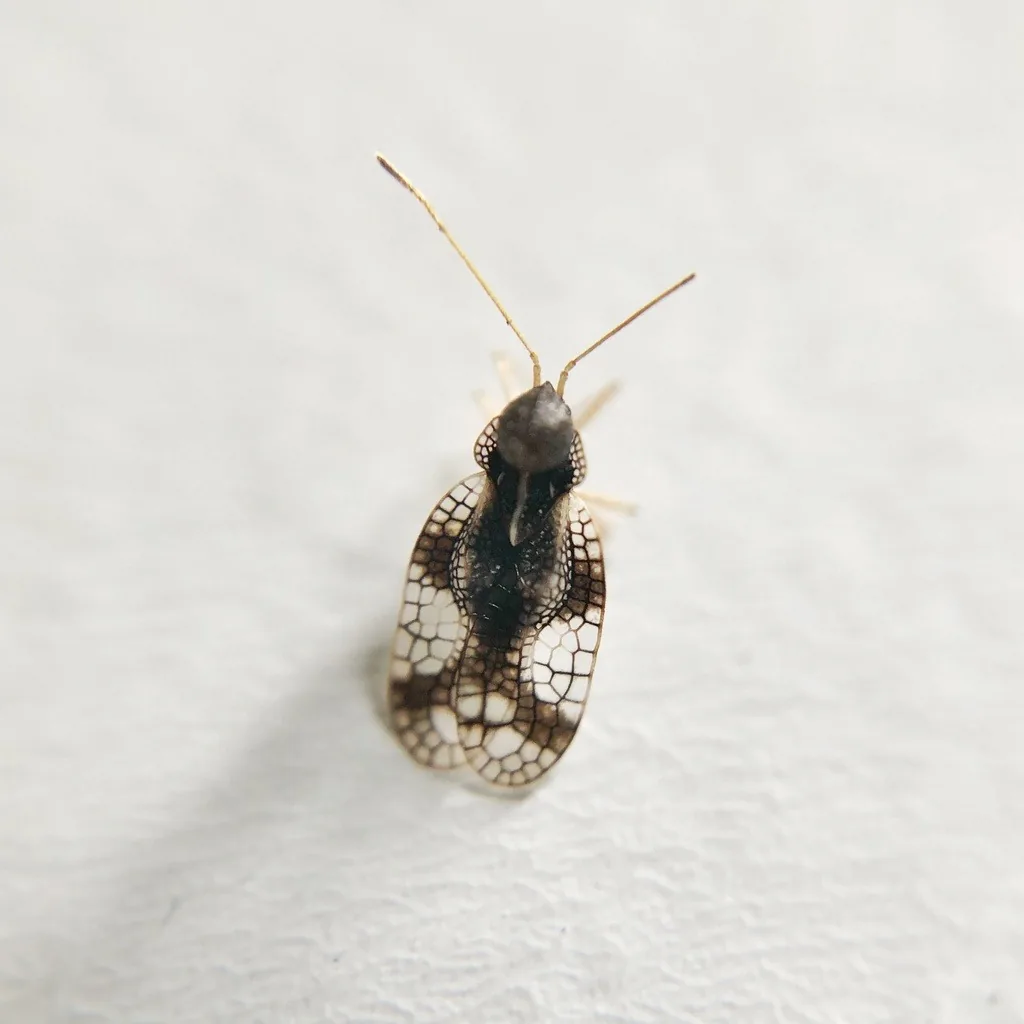
- Adults are about 1/8 inch long, with delicate lacy wings and an inflated hood over the head, marked contrastingly in black and clear. A dark X-shaped band across the wing tips is typical.[1][2][4]
- Nymphs are almost colorless at first, then dark and spiny; they and the adults feed on leaf undersides.[1][2]
- Eggs are pushed into the leaf, along the midvein on the underside, and capped with a shiny, dark, varnish-like covering.[1][2]
- Shiny black, tar-like spots and shed nymph skins under the leaves separate lace bug damage from mite or leafhopper stippling.[2][3]
Look-alikes
| Look-alike | How to tell them apart |
|---|---|
| Azalea lace bug | Azalea lace bug feeds mainly on azaleas; NC State says andromeda lace bug is rarely found on azalea. In lab tests on more than 60 Pieris types, no azalea lace bug nymphs emerged on any of them.[1][5] |
| Rhododendron lace bug | It looks similar but is generally paler, and the X mark on the wings is faint or missing. Its hood is pinched in along its whole length, while the andromeda lace bug's is bulbous at the back.[4] |
Where it lives
It's native to Japan and reached Connecticut by 1945. Sources differ on how common it is: UMass calls it a common pest of Japanese andromeda in New England, while NC State says it's relatively uncommon in North Carolina but damaging where it occurs. In Europe it was first found in the Netherlands in 1994 and has since been reported from at least ten more countries, including Britain, Germany and France.[2][3][1][4]
Biology and life cycle
It usually overwinters as eggs inside the leaf; most adults and nymphs die by late winter.[1]
Nymphs go through five stages. NC State counts at least four generations a year in North Carolina, active from May to September; UMass reports three to four in New England, active from late May into September.[1][2]
The first generation causes the most damage.[1]
In Japan it moves between Japanese andromeda in winter and a deciduous shrub, lyonia, in summer, but it can stay on andromeda all year when lyonia is scarce.[4]
Damage and signs
- Japanese andromeda is the main host in the U.S. NC State says it's rarely found on azalea, leucothoe and rhododendron; UMass also lists mountain laurel, fetterbush, snowbell and willow among recorded hosts.[1][2][3]
- Feeding under the leaves causes severe yellow to gray stippling on the upper surface. Plants in full sun are hit hardest, and heavy infestations can strip them of leaves.[1][2][3]
Health risk
It feeds on plant sap; neither NC State nor UMass mentions any risk to people or pets.[1][2]
Control
Prevention
Plant mountain andromeda (Pieris floribunda), which is highly resistant, or its hybrids with Japanese andromeda. If you grow Japanese andromeda, keep it out of full sun.[1][2][3]
Cultivars differ. UMass lists 'Select', 'Debutante' and 'Cupido' as highly susceptible and 'Flaming Silver', 'Variegata' and 'Redmill' as less so. In University of Georgia tests, 'Variegata' and P. phillyreifolia resisted lace bugs, while 'Temple Bells' and 'Cavatine' were susceptible.[2][5]
Pesticides
Horticultural oil labeled for summer use or insecticidal soap works well when sprayed on leaf undersides, and may need repeating as new eggs hatch. Apply any insecticide, including soil-applied systemics, after bloom to protect pollinators.[1][2][3]
Why some Pieris resist it
Resistant P. phillyreifolia leaves took more force to puncture and had more fiber and less moisture than susceptible 'Temple Bells'. Leaf wax made no difference.[6]
On resistant plants, fewer adults survived and fewer young were produced.[6]
Common questions
- Why are my Pieris leaves yellow and speckled?
- Andromeda lace bugs feeding underneath cause yellow to gray stippling on top.[1][2]
- Is there a resistant andromeda?
- Yes. Mountain andromeda (Pieris floribunda) is highly resistant, and Japanese andromeda cultivars vary; 'Variegata' held up in both UMass's list and University of Georgia tests.[1][2][5]
- Where should sprays go?
- On the leaf undersides, where the bugs, nymphs and eggs are.[1]
Sources
- NC State Extension, “Andromeda Lace Bug (PDIC Factsheet).” content.ces.ncsu.edu/andromeda-lace-bug (accessed 2026-11-13)
- UMass Extension Landscape, Nursery and Urban Forestry Program (Landscape Insect & Mite Guide), “Stephanitis takeyai (Andromeda Lace Bug).” www.umass.edu/agriculture-food-environment/landscape/publications-resources/insect-mite-guide/stephanitis-takeyai (accessed 2026-11-13)
- UMass Amherst Extension, Landscape, Nursery and Urban Forestry Program, “Andromeda Lace Bug (fact sheet).” www.umass.edu/agriculture-food-environment/landscape/fact-sheets/andromeda-lace-bug (accessed 2026-11-13)
- Journal of Plant Protection Research (Polish Academy of Sciences), “Stephanitis takeyai and S. rhododendri (Heteroptera: Tingidae) in Slovakia: first record and economic importance (Barta & Biben, Journal of Plant Protection Research 56(2), 2016).” www.plantprotection.pl/pdf-94235-28614?filename=Stephanitis+takeyai+and.pdf (accessed 2026-11-13)
- Environmental Entomology, 2012 (via PubMed), “Relative differences in susceptibility of Pieris taxa (Ericaceae) to Stephanitis spp. lace bugs (Hemiptera: Tingidae) (abstract).” pubmed.ncbi.nlm.nih.gov/23068171/ (accessed 2026-11-13)
- Environmental Entomology, 2012 (via PubMed), “Resistance mechanisms in Pieris taxa (Ericaceae) to Stephanitis takeyai (Hemiptera: Tingidae) (abstract).” pubmed.ncbi.nlm.nih.gov/23068172/ (accessed 2026-11-13)
- Global Biodiversity Information Facility (GBIF), “Stephanitis takeyai Drake & Maa, 1955 (GBIF Backbone Taxonomy).” api.gbif.org/v1/species/2020686 (accessed 2026-11-13)