On this page
How to identify it
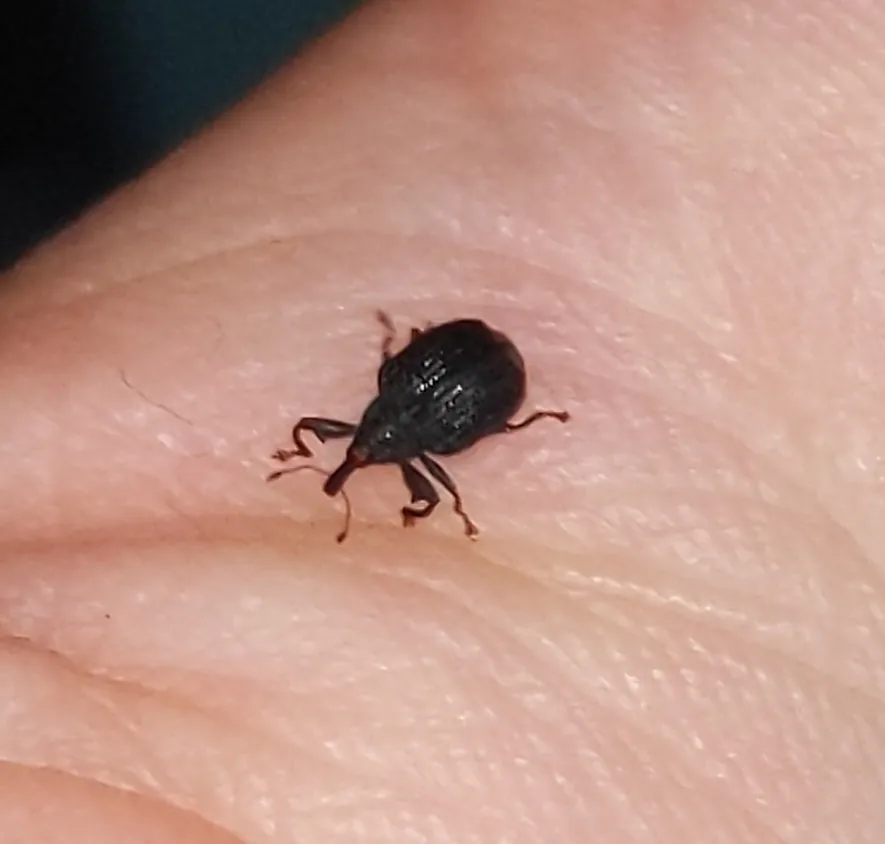
- Adults are chunky black snout beetles about 1/8 inch long. Other names include sassafras weevil, magnolia weevil, tuliptree leafminer and magnolia leafminer.[1][2]
- Larvae are white, legless, somewhat flat grubs that feed inside the leaves.[1][2]
- Adult feeding leaves holes about 1/8 inch across. Larval mines usually start near the leaf tip, turn brown, and often kill the tip of the leaf.[1][2]
Where it lives
University of Kentucky and NC State Extension both cover it as a pest of yellow poplar (tuliptree), sassafras and magnolia; NC State adds sweet bay as a host.[1][2]
Biology and life cycle
Adults spend the winter in leaf litter under host trees. On warm days in late April and early May they fly up and feed on swelling buds, then on the new leaves.[1][2]
Females lay eggs in a row inside the leaf midrib in May and early June. The grubs mine the leaf, then spin a round silk cocoon in a puffed-up part of the mine to pupate.[1][2]
New adults come out of the leaves in mid-June and feed for a few weeks. By mid-July they drop back to the leaf litter and stay inactive until spring. There is one generation a year.[1][2]
NC State says a single tuliptree leaf can hold up to 19 grubs. Outbreaks come and go at irregular intervals and probably won't show up more than two years running, because parasites build up and hold the weevils down.[2]
Damage and signs
- New adults feeding in June often strip only the lower leaf surface, leaving yellowed spots that make the tree look scorched. Kentucky says leaves drop when trees are also short of water; NC State says heavy feeding by new adults can cause early leaf drop.[1][2]
- Both Extension services say the damage looks bad but probably doesn't affect the overall health of established trees. NC State adds that in North Carolina's long growing season, even badly damaged trees can make up for it by the end of summer.[1][2]
Health risk
It feeds only on tree leaves. Neither Kentucky nor NC State Extension describes any risk to people or pets.[1][2]
Control
Prevention
Often no treatment is needed. The injury to large, established trees probably won't harm them, and outbreaks tend to fade on their own.[1][2]
Pesticides
If you do spray, timing matters. Kentucky suggests treating once feeding shows on about 10 percent of branches, not at the very first sign, since weevils keep arriving over a long period. NC State says most labeled landscape insecticides should work when adults are feeding in early spring or again in late June, but tall tuliptrees are often out of reach of home sprayers.[1][2]
Kentucky's fact sheet names carbaryl and acephate. In 2024 the EPA proposed cancelling every acephate use except tree injection, citing homeowner, worker, drinking water and environmental risks, so check a product's current label and registration before you buy.[1][3]
A sporadic pest
NC State calls the weevil a sporadic pest whose outbreaks come at irregular intervals.[2]
In mid-July, you may see adults crawling down on their way to overwinter in the leaf litter.[2]
Common questions
- What's making little holes in my tulip poplar leaves?
- Often yellow poplar weevils, whose feeding holes look like curved rice grains.[1]
- Will it kill my tree?
- Probably not. Both Kentucky and NC State Extension say the damage to established trees is mostly cosmetic.[1][2]
- Why are my tulip poplar leaves brown at the tips in June?
- The grubs mine the leaves, usually starting near the tip, and the mined part turns brown and dies. New adults feeding on the undersides add yellow spots.[2][1]
Sources
- University of Kentucky Entomology (ENTFACT), “Yellow Poplar Weevil (ENTFACT-414).” entomology.mgcafe.uky.edu/ef414 (accessed 2026-11-13)
- NC State Extension, “Yellow Poplar Weevil.” content.ces.ncsu.edu/yellow-poplar-weevil (accessed 2026-11-13)
- U.S. Environmental Protection Agency, “EPA Proposes to Cancel All but One Use of Pesticide Acephate to Protect Human Health (news release, April 30, 2024).” www.epa.gov/pesticides/epa-proposes-cancel-all-one-use-pesticide-acephate-protect-human-health (accessed 2026-11-13)
- Global Biodiversity Information Facility (GBIF), “Odontopus calceatus Say, 1831 (GBIF Backbone Taxonomy).” api.gbif.org/v1/species/5009500 (accessed 2026-11-13)