On this page
How to identify it
- Adults are large, deep metallic blue, fly-like insects with smoky translucent wings, a yellowish or white spot at the base of the wings and orange antennae knobbed at the tip. Iowa State gives a length of about 1 inch; South Dakota State describes males as about 3/4 inch, with orange-tipped legs and antennae.[5][2][3]
- Females have yellow spots (South Dakota State says white segments) along the sides of the abdomen; the abdomen ranges from reddish brown to black.[2][3]
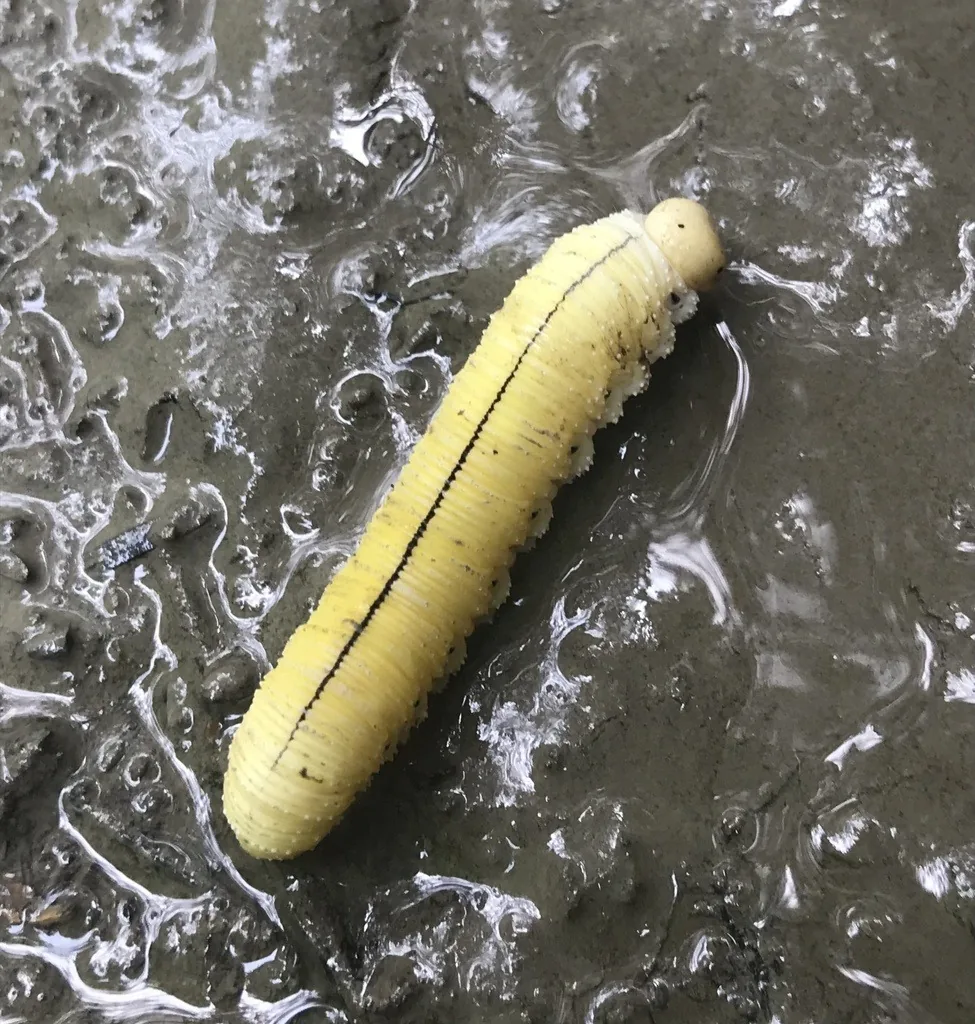
- Larvae are pale yellow-green to yellowish white and wrinkled, with a black stripe down the back and black spiracles or spots along the sides, and they often lie curled up when resting or disturbed. Full-grown size is given as 2 1/4 inches by NC State, Iowa State and Arkansas, up to 2 inches by South Dakota State, and 1.5 to 2 inches by Missouri Extension.[2][4][3][1][5]
- A fun way to tell a sawfly larva from a real caterpillar: count the stubby legs on the belly. Moth and butterfly caterpillars usually have five pairs of prolegs; sawfly larvae typically have six or more. Sawfly prolegs also lack the tiny hooks caterpillars have, and a sawfly larva usually has one simple eye on each side of the head instead of six.[1][4]
Look-alikes
| Look-alike | How to tell them apart |
|---|---|
| Northern giant hornet | Iowa State says the elm sawfly has been the native insect most often reported as a suspected Asian giant hornet. The sawfly is only about 1 inch long, compared with up to 2 inches for the hornet, and Iowa State says sawflies cannot sting.[2] |
| Cicada killer | Our largest wasp, 1 1/4 to 1 5/8 inches long, black with pale yellow stripes and spots and translucent orange wings.[2] |
Where it lives
Native to North America, from Newfoundland to Florida, west to northern Texas and north to British Columbia, the Yukon and Alaska; NC State calls it uncommon in North Carolina. GBIF holds about 1,970 U.S. records since 1990 from 49 state-level areas, the most from Texas (550), Alaska (187) and Vermont (137).[4][5][6]
Biology and life cycle
There is one generation a year. Adults appear from early May to mid-June depending on latitude (NC State says late May through June), mate, and feed on tree sap.[4][3][5]
Females saw slits or small pockets in the leaves and lay eggs inside, up to 12 per leaf and 30 to 150 in all. Eggs hatch in about a week; Arkansas gives 7 to 10 days.[5][4][3]
Larvae feed on the leaves through summer. NC State says they are full grown within a month or so; Arkansas says they feed until late summer or early autumn, and South Dakota State for the rest of the growing season.[5][4][3]
Mature larvae drop to the ground and spin tough, papery cocoons about 1 inch long in the leaf litter or just under the soil, where they spend the winter as non-feeding prepupae. Most pupate the next spring, but NC State says some stay in their cocoons for two or more winters, so a generation can take two or three years.[5][4]
Damage and signs
- Larvae prefer elm and willow and also feed on maple and basswood; birch and poplar are occasionally attacked, and NC State adds reports from alder, apple, boxelder, ironwood and plum.[5][2][1]
- Adults cut gashes in the bark of small limbs to feed on sap, sometimes girdling and killing the limbs.[4][5]
- Defoliation is sporadic. South Dakota State says feeding damage is usually minimal, but large numbers can defoliate a tree and small trees may be stunted. In the Midwest and farther north the species has caused serious defoliation and tip dieback of windbreak and street trees.[3][4][5]
Health risk
It feeds on trees, and no cited source describes any risk to people or pets.[2][3]
Control
Prevention
Watch susceptible elms and willows for the large curled larvae from late June to August.[2]
Traps and physical control
On small trees, pick the larvae off and dispose of them. South Dakota State notes this is not practical on large trees.[3]
Biological control
Natural enemies help: elm sawfly eggs are attacked by parasites, larvae are parasitized by wasps and flies, and shrews and deer mice eat the prepupae in their cocoons.[5]
Pesticides
Treatment is rarely needed. South Dakota State says larger trees, where hand-picking is not practical, could warrant an insecticide, and to use products specifically labeled for sawflies; NC State says sawflies are sensitive to insecticides, so anything labeled for leaf-feeding pests of elm should give adequate control.[3][5]
Where the sources disagree
Adult size: Iowa State says about 1 inch, while South Dakota State describes males as about 3/4 inch.[2][3]
Larval size: NC State, Iowa State and Arkansas give 2 1/4 inches, South Dakota State up to 2 inches, and Missouri Extension 1.5 to 2 inches.[5][2][4][3][1]
Female markings: Iowa State says females have yellow spots along the sides of the abdomen, South Dakota State white segments on the abdomen.[2][3]
Larval feeding period: NC State says larvae are full grown within a month or so, Arkansas says they feed until late summer or early autumn, and South Dakota State for the rest of the growing season.[5][4][3]
Egg laying: NC State says females saw small pockets in elm leaves, Arkansas that they cut slits in the undersides of leaves.[5][4]
Hosts: Missouri Extension lists elm and willow as preferred, with birch, maple and poplar occasionally attacked; Iowa State lists elm, maple, willow and basswood; NC State adds alder, apple, boxelder, ironwood and plum.[1][2][5]
Insecticides: South Dakota State says to use products specifically labeled for sawflies, while NC State says anything labeled for leaf-feeding pests of elm should give adequate control.[3][5]
Common questions
- What is the big blue wasp on my elm?
- Probably an adult elm sawfly, a wasp relative about 3/4 to 1 inch long that Iowa State calls non-stinging.[2][3][5]
- Is the elm sawfly a giant hornet?
- No. Iowa State says it is the native insect most often reported as a suspected giant hornet; it is about half the hornet's length and metallic blue.[2]
- What is the big yellow caterpillar curled on elm or willow leaves?
- Likely an elm sawfly larva, up to about 2 inches or a bit more, yellow-green with a black stripe down the back. It is not a true caterpillar: it has six or more pairs of belly prolegs.[2][3][1]
- Do I need to spray?
- Rarely. South Dakota State says damage is usually minimal and management rarely necessary; larvae can be picked off small trees, and larger trees could warrant an insecticide labeled for sawflies.[3]
Sources
- University of Missouri Extension, “Caterpillars in Your Yard and Garden (IPM1019), page 15: Elm sawfly.” extension.missouri.edu/publications/ipm1019/15 (accessed 2026-11-13)
- Iowa State University Extension and Outreach, “Elm Sawfly and other Asian Giant Hornet Look-Alikes (Yard and Garden, June 2020).” yardandgarden.extension.iastate.edu/article/2020/06/elm-sawfly-and-other-asian-giant-hornet-look-alikes (accessed 2026-11-13)
- South Dakota State University Extension, “A fly? A hornet? Nope, it's a sawfly!.” extension.sdstate.edu/fly-hornet-nope-its-sawfly (accessed 2026-11-13)
- University of Arkansas, Arthropod Museum, “Elm sawfly (Arthropod Museum).” arthropod.uark.edu/elm-sawfly/ (accessed 2026-11-13)
- NC State Extension, “Elm Sawfly (PDIC Factsheet).” content.ces.ncsu.edu/elm-sawfly (accessed 2026-11-13)
- Global Biodiversity Information Facility (GBIF), “Cimbex americana: U.S. occurrence records since 1990 by state (GBIF occurrence search).” api.gbif.org/v1/occurrence/search?taxonKey=1249710&country=US&hasGeospatialIssue=false&occurrenceStatus=PRESENT&year=1990%2C2026&facet=stateProvince&facetLimit=400&limit=0 (accessed 2026-11-13). Exact count at access: 1,971 U.S. records since 1990 (Texas 550; Alaska 187; Vermont 137; Minnesota 91).
- Global Biodiversity Information Facility (GBIF), “Cimbex americana Leach (GBIF Backbone Taxonomy).” api.gbif.org/v1/species/1249710 (accessed 2026-11-13)