On this page
How to identify it
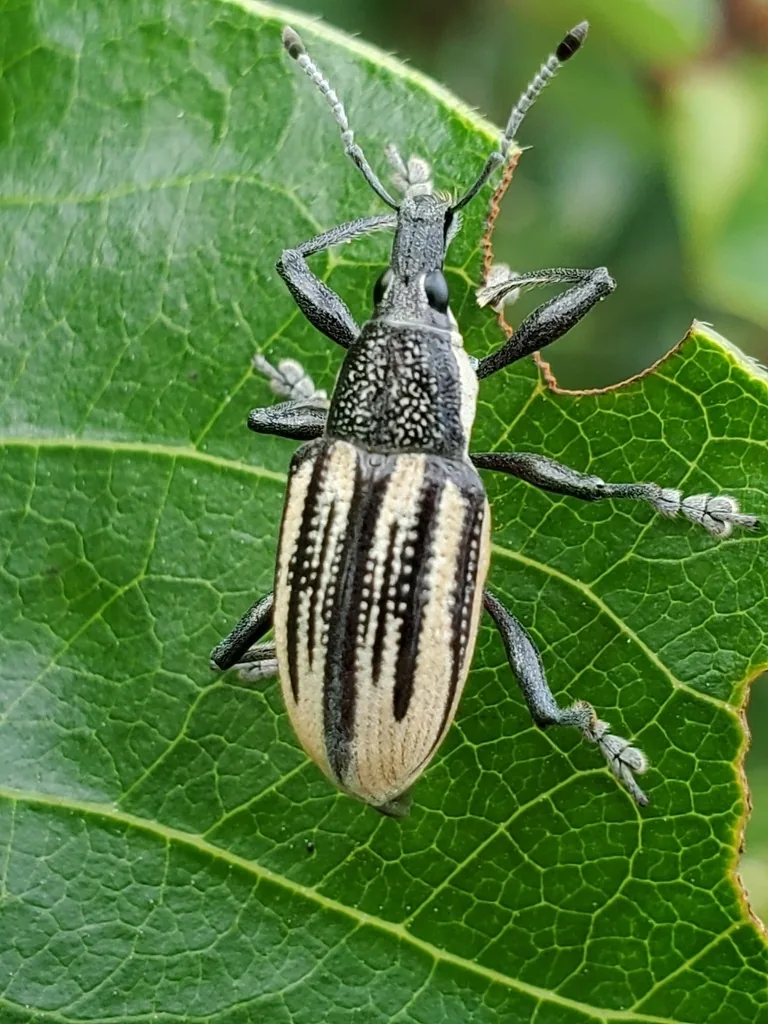
- Adults are 0.95 to 1.90 cm long, black and covered with tiny white, red-orange or yellow scales on the wing covers. The scales often rub off the tops of the ridges, so the weevil looks striped black on a lighter background. UF/IFAS gives the same 0.95 to 1.90 cm (3/8 to 3/4 inch) and says newly emerged adults carry a pair of temporary jaws that break off as they tunnel up through the soil.[2][3]
- Eggs are oblong, about 1.2 by 0.4 mm, smooth and pale yellowish-white, laid in a single-layer cluster sealed between leaves.[2][4]
- Larvae are white, legless and C-shaped, reaching about 2.5 cm when grown. Pupae lie in an earthen cell in the soil. UF/IFAS gives the same 2.5 cm (1 inch) and says the head capsule has variable light and dark areas.[2][3]
Look-alikes
| Look-alike | How to tell them apart |
|---|---|
| Other root weevils | Leaf notching alone doesn't prove Diaprepes: grasshoppers, caterpillars and related root weevils also notch leaf edges, so confirm by finding the striped adults on the plant.[2][1] |
Where it lives
Native to the Caribbean, it was introduced to Florida in 1964, probably on nursery stock from Puerto Rico, and has spread over most of southern and central Florida. It later reached Texas, Louisiana and California, likely on nursery stock, and EFSA also lists Mississippi. In California it is established in coastal San Diego, Orange and southern Los Angeles Counties. GBIF has about 3,300 U.S. records from 1990 to 2026, mostly from Florida, then Texas, California and Louisiana. UF/IFAS says it was first reported in Florida from a nursery near Apopka, is also found in Puerto Rico, Jamaica, the Dominican Republic and the lower Antilles, and is now considered a problem in the southern two-thirds of Florida.[4][2][5][3]
Biology and life cycle
Females lay clusters of 30 to 265 eggs between leaves they glue together (EFSA gives 30 to more than 250), and one female can lay about 5,000 eggs. Eggs hatch within a week.[4][2]
Newly hatched larvae drop to the ground and burrow into the soil, where they feed on roots for several months before pupating.[2][4]
Adults emerge from the soil and gather on host plants to feed on leaves before mating. In central Florida adult emergence has two peaks between mid-spring and mid-autumn, suggesting two generations a year; in California adults emerge in one peak, July to October. UF/IFAS gives the main emergence period in central Florida as May through October and November, though adults can emerge year-round, and suspects South Florida is more like the Caribbean, where adults are found all year.[2][3]
Adults are strong fliers but usually stay on the first host plant they find, so long-distance spread is mainly on nursery stock.[4]
Cold limits it. Eggs suffer 95 percent mortality after 4.2 days at 12 degrees C, and USDA-ARS researchers found its northern limit in Florida matches areas with 15 to 20 winter days of soil at or below 12 degrees C; it has not spread north of where it was introduced in Lake County.[6][2]
It is recorded on about 270 kinds of plants, including citrus, sugarcane, vegetables, potatoes, sweet potatoes, papaya, guava, mahogany and container and field-grown ornamentals.[1][2]
UF/IFAS says long-distance spread is through contaminated soil and container plants, which can hold every life stage, and larvae can ride in soil on vehicles.[3]
UF/IFAS lists predators including the stink bug Euthyrhynchus floridanus, the regal jumping spider and several ants that eat eggs and newly hatched larvae, though the larvae give off an ant-repellent chemical. Three Caribbean egg parasitoids released in South Florida have begun to parasitize 35 to 100 percent of eggs in different crops.[3]
Damage and signs
- Notching along the margins of young leaves is the telltale sign of adults.[1][2]
- Larvae often girdle the taproot, cutting off water and nutrients. A single larva can kill a young plant, several can cause serious decline of established ones, and the wounds let in Phytophthora root rot.[1][2]
- Because the larvae are underground, an infestation is hard to spot before the top of the plant starts to decline. In Florida it has infested more than 40,000 ha of citrus.[1][2]
Health risk
It feeds on plants. The Texas and California agriculture departments and EFSA describe it only as a plant pest and don't mention any risk to people or pets.[1][4][2]
Control
Prevention
Texas enforces a Diaprepes root weevil quarantine (Texas Administrative Code Title 4, Chapter 19, Subchapter P). Quarantined areas inside Texas are parts of Cameron, Hidalgo and Harris Counties; outside Texas the rule names a list of central and south Florida counties, Puerto Rico, the West Indies and any other area where the weevil is found. The latest change the department lists, on May 27, 2020, expanded the Cameron County area to newly confirmed infested groves and removed a field in McAllen from the Hidalgo County area.[1]
California gives it a B pest rating. It has turned up in California nurseries and is sometimes intercepted on nursery stock from Florida and Puerto Rico, and EFSA names plants for planting with soil as a pathway for every life stage.[4][2]
UF/IFAS says horticultural oils separate leaves glued over egg masses, so eggs dry out or are exposed to predators and parasites, and also keep females from gluing eggs to leaves. To limit spread, restrict moving soil, plants, leaves, grass clippings, sod and stumps from infested areas, and see the current UF/IFAS citrus pest management guide for citrus root weevils.[3]
Traps and physical control
UF/IFAS says to look for adults on the foliage during the day; shaking the plant over a light-colored canvas helps, but not right after heavy rain, which knocks weevils off.[3]
Biological control
Natural enemies that attack the eggs, and others that attack larvae and pupae in the soil, have been described and used in the field in the U.S.[2]
Where the sources disagree
Egg clusters: CDFA says 30 to 265 eggs per cluster and an average of 5,000 eggs per female; EFSA says 30 to more than 250 per cluster and up to 5,000 per female.[4][2]
U.S. range: CDFA lists Florida, Texas, Louisiana and California; EFSA also lists Mississippi.[4][2]
Official control: CDFA's rating says the weevil is not known to be under official control by any state or nation; the Texas Department of Agriculture enforces a quarantine on it, with quarantined areas inside and outside Texas.[4][1]
Egg hatch: UF/IFAS says larvae emerge in seven to eight days; EFSA says hatching occurs within 1 week.[3][2]
Flight: CDFA calls adults strong fliers that usually stay on the first host they find; UF/IFAS says they don't fly far from where they emerged, an estimated less than 300 m (984 ft).[4][3]
Common questions
- What's notching my citrus leaves?
- Diaprepes root weevil adults are one cause, but grasshoppers, caterpillars and other weevils notch leaves too, so look for the weevils themselves.[1][2]
- Where's the real damage?
- Underground. Larvae girdle roots, which can kill young plants and lets Phytophthora root rot in.[1][2]
- Is the Diaprepes root weevil under quarantine?
- Yes in Texas, which quarantines parts of Cameron, Hidalgo and Harris Counties and lists outside areas including much of Florida and Puerto Rico. California rates it a B pest.[1][4]
- How do I check a plant for Diaprepes adults?
- UF/IFAS suggests looking on the leaves during the day and shaking the plant over a light-colored cloth, but not right after heavy rain.[3]
Sources
- Texas Department of Agriculture, “Diaprepes Root Weevil (Pest and Disease Alerts; quarantine, Texas Administrative Code Title 4, Chapter 19, Subchapter P).” www.texasagriculture.gov/Regulatory-Programs/Plant-Quality/Pest-and-Disease-Alerts/Diaprepes-Root-Weevil (accessed 2026-11-13)
- EFSA Journal (European Food Safety Authority), via PubMed Central, “EFSA Panel on Plant Health (2023), Pest categorisation of Diaprepes abbreviatus, EFSA Journal 21(11):e08392.” pmc.ncbi.nlm.nih.gov/articles/PMC10648563/ (accessed 2026-11-14). Cited from the open-access full text (PubMed 38027434).
- University of Florida IFAS Extension (EDIS), “Diaprepes Root Weevil, Diaprepes abbreviatus (Linnaeus), EENY-024/IN151 (Featured Creatures).” ask.ifas.ufl.edu/publication/IN151 (accessed 2026-11-14)
- California Department of Food and Agriculture (Pest Ratings), “California Pest Rating: Diaprepes abbreviatus (Diaprepes Root Weevil).” blogs.cdfa.ca.gov/Section3162/?p=3014 (accessed 2026-11-14)
- Global Biodiversity Information Facility (GBIF), “Diaprepes abbreviatus (Diaprepes root weevil): occurrence records in the U.S., 1990-2026 (GBIF occurrence search).” api.gbif.org/v1/occurrence/search?taxonKey=5010133&country=US&hasGeospatialIssue=false&occurrenceStatus=PRESENT&year=1990%2C2026&facet=stateProvince&facetLimit=400&limit=0 (accessed 2026-11-13). State counts are records reported (iNaturalist research-grade, museum specimens, surveys, including some interceptions), not abundance.
- Environmental Entomology, via PubMed, “Lapointe SL, Borchert DM, Hall DG (2007), Effect of low temperatures on mortality and oviposition in conjunction with climate mapping to predict spread of the root weevil Diaprepes abbreviatus, Environmental Entomology 36(1):73-82 (USDA-ARS, Fort Pierce).” pubmed.ncbi.nlm.nih.gov/17349119/ (accessed 2026-11-13). Cited from the PubMed abstract.
- Global Biodiversity Information Facility (GBIF), “Diaprepes abbreviatus (Linnaeus, 1758) (GBIF Backbone Taxonomy).” api.gbif.org/v1/species/5010133 (accessed 2026-11-13)
- iNaturalist, “Diaprepes abbreviatus taxon page (order and family).” www.inaturalist.org/taxa/132094 (accessed 2026-11-11)