On this page
How to identify it
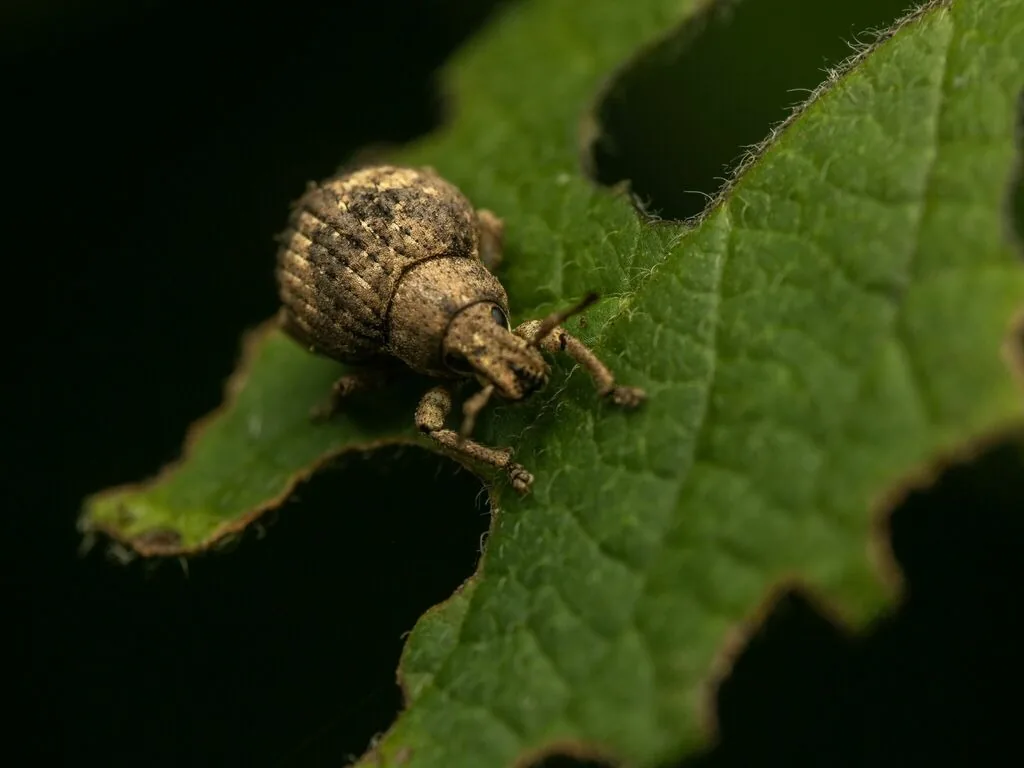
- Adults are small and pear-shaped with a short, blunt snout: about 1/4 inch long according to Iowa State (UMass gives about 0.24 inch, Rutgers 3/16 inch). UF/IFAS gives about 5 mm and Virginia Cooperative Extension about 0.25 inch (6 mm); UF/IFAS adds that the wing covers are much broader than the thorax.[1][2][3][4][5]
- They are light to dark mottled brown to gray, with two dark bands across the wing covers, which makes them easy to overlook. Virginia Cooperative Extension describes a broad gray band outlined in dark brown across the wing covers, and bristly hairs on the head, legs and wing covers.[1][2][3][5]
- The wing covers are fused, so they cannot fly.[1][3]
- Larvae are white and legless; UMass gives about 0.30 to 0.33 inch when fully grown, and Rutgers about 1/4 inch. UF/IFAS gives 7.5 to 8.5 mm (about 3/10 inch), and Virginia Cooperative Extension describes them as C-shaped grubs with a brown head. Eggs are small and cream-colored, and the pupa is white with yellow-brown bristles, 6.25 mm long.[1][3][4][5]
- Fun fact: Japanese scientists used a 5 mm twobanded Japanese weevil to test a 3-D X-ray microscope that builds images like a medical CT scan.[6]
Look-alikes
| Look-alike | How to tell them apart |
|---|---|
| Black vine weevil and other root weevils | Leaf notching by twobanded Japanese weevils can be confused with damage from Otiorhynchus root weevils such as the black vine weevil, so look for the small mottled brown, banded weevils themselves during the day.[1] |
| Fuller rose beetle | Virginia Cooperative Extension says marginal notching on broad-leaved evergreens resembles damage by root weevils such as the Fuller rose beetle and black vine weevil.[5] |
| Pseudocneorhinus obesus | A closely related weevil recently recognized in the eastern United States, thought to have a similar life history.[5] |
Where it lives
Native to China, Japan, Korea, Mongolia and eastern Siberia, it was first found in the U.S. near Philadelphia in 1914 and has spread through New England and other regions. It reached Iowa by 2016, when it was collected in Ames. UF/IFAS says it was most likely introduced with infested nursery stock from Japan. In the Southeast it was first collected in North Carolina in 1955, Georgia in 1959, South Carolina in 1966 and Alabama in 1970, and its presence in Florida, at Chipley in Washington County, was confirmed in July 2005. Since it can't fly, its spread there is probably due to movement of infested ornamental plants.[1][2][4]
Biology and life cycle
All adults found in the U.S. are female and lay viable eggs without mating. Eggs are laid in pod-like structures inside a folded leaf edge, 1 to 9 per pod. UF/IFAS says males are known in China but generally not encountered in the U.S.[1][4]
How many eggs a female lays depends on what she eats: 355 eggs were recorded from females on multiflora rose against 7 on mountain laurel.[1]
Newly hatched larvae drop to the soil and feed on roots; larvae and pupae have been found at least 9 inches deep. Adults, eggs and larvae can all overwinter in leaf litter under host plants. UF/IFAS says eggs hatch in 14 to 18 days and larvae stay in the soil under the canopy of the infested plant, mostly three to six inches deep; up to 150 larvae per square foot were found under heavily infested privet hedges.[1][2][4]
There is one generation a year. Overwintered adults become active around April in New York, egg laying starts about mid-May, and adults are most abundant by September. In Iowa, new adults appear in late June to early July. UF/IFAS adds that egg laying peaks from September to early October and stops by November, new adults emerge from late June to early July, and by mid-October the weevils leave the plants to hibernate in debris underneath.[1][2][4]
Adults feed during the day and drop to the ground and play dead when disturbed. They spread slowly on foot, since they cannot fly. Virginia Cooperative Extension says they often hide under leaves or in crotches of limbs, so light infestations are easy to miss.[1][3][5]
Damage and signs
- Hosts include ash, azalea, camellia, deutzia, dogwood, euonymus, firethorn, forsythia, hemlock, holly, Japanese barberry, lilac, mimosa, mountain laurel, privet, rhododendron, rose, spirea and viburnum. UF/IFAS puts the host range at over 100 plant species, with field catches highest on multiflora rose, and Virginia Cooperative Extension says it is an occasional pest of soybeans and vegetables in Virginia.[1][3][4][5]
- Adults chew notches along leaf margins, sometimes eating whole leaves or everything but the midvein. New leaves, shoots and the inner foliage take the most damage, and spring growth can hide the feeding at first; Rutgers sees notching on lower leaves in late July. Virginia Cooperative Extension notes the holes are always cut inward from the margin, never in the inner part of the leaf, and the notches can signal larvae in the soil nearby.[1][2][3][5]
- Infestations can be heavy: 265 adults were once collected from a single spirea. Larvae feed on roots of privet and forsythia; UMass says how much harm root feeding does is not well known, while Rutgers says it causes stunted growth and decline. UF/IFAS cites old records of it stripping privet hedges 50 feet long and causing irreparable damage to hemlocks; Virginia Cooperative Extension says populations in the thousands were reported in the past but there are no recent records of such outbreaks.[1][3][4][5]
- Iowa State notes the leaf damage is mostly cosmetic, and most homeowners don't need to manage it.[2]
Health risk
It feeds on plants; UMass, Iowa State and Rutgers mention no risk to people or pets.[1][2][3]
Control
Prevention
From early spring, check new growth on the inner parts of host shrubs for notched leaves, starting with plants that look weak. Adults can be found from about mid-May to September. Virginia Cooperative Extension advises buying pest-free nursery stock; notched leaves on a potted plant may mean larvae are in the container soil.[1][5]
Traps and physical control
Spread a white cloth or sheet under the shrub before touching it, then shake the plant hard. The weevils drop and play dead, and you can tip them into a container of soapy water; Rutgers also suggests handpicking or freezing them. Virginia Cooperative Extension also suggests putting them in a freezer for several days.[1][3][5]
Biological control
Natural enemies include spiders, birds, parasitic fungi and nematodes. Rutgers lists entomopathogenic nematodes and the fungus Beauveria bassiana among biorational options, along with horticultural oil, neem oil and azadirachtin.[3]
Pesticides
Chemical control is difficult: contact sprays reach only the active adults, while larvae and pupae are protected in the soil. Rutgers' nursery list includes contact pyrethroids and the systemics acephate, imidacloprid and acetamiprid, notes the weevil is resistant to carbaryl, and warns these will harm non-target species. If you spray, wait until after bloom to protect pollinators, and read and follow the label.[1][3]
Is it worth treating?
For most yards, no. Iowa State Extension calls the leaf damage primarily cosmetic. UMass notes that adult feeding on leaves is thought to be the most damaging stage, so a badly notched shrub that looks to be declining is the one to check and hand-collect first.[2][1]
Where sources disagree
Overwintering: UMass says adults, eggs and larvae can all spend the winter in leaf litter, while Rutgers names only adults. UF/IFAS says adults, eggs or larvae overwinter in the Northeast, while Virginia Cooperative Extension says it overwinters in the soil, with some adults in leaf debris.[1][3][4][5]
Size: adults are about 1/4 inch per Iowa State and UMass but 3/16 inch per Rutgers; full-grown larvae are 0.30 to 0.33 inch per UMass but about 1/4 inch per Rutgers. UF/IFAS gives adults as about 5 mm and full-grown larvae as 7.5 to 8.5 mm; Virginia Cooperative Extension gives adults as 6 mm.[2][1][3][4][5]
Spray timing: UF/IFAS says the best time is spring, when overwintered adults resume feeding and the first leaf damage shows, while Virginia Cooperative Extension suggests the second or third week of June, after adults have emerged from the soil but before they lay many eggs.[4][5]
Common questions
- What's notching my shrub leaves?
- If the notches are along the leaf edges and you find small mottled brown weevils that drop when touched, it is probably the twobanded Japanese weevil. Black vine weevils make similar notches.[1][2]
- How do I catch them?
- Lay a white cloth or sheet under the plant first, then shake it. They fall and play dead, and you can drop them into soapy water.[1][3]
- Can twobanded Japanese weevils fly?
- No. Their wing covers are fused, so they walk, which is why they spread slowly.[1][3]
- How did it get to the U.S.?
- UF/IFAS says it was first collected near Philadelphia in 1914 and was most likely introduced with infested nursery stock from Japan; Virginia Cooperative Extension says moving infested nursery stock is thought to carry it to new areas.[4][5]
Sources
- UMass Extension, Center for Agriculture, Food, and the Environment, “Pseudocneorhinus bifasciatus (Formerly: Callirhopalus bifasciatus) (Landscape Insect & Mite Guide).” www.umass.edu/agriculture-food-environment/landscape/publications-resources/insect-mite-guide/pseudocneorhinus-bifasciatus-formerly-callirhopalus-bifasciatus (accessed 2026-11-12)
- Iowa State University Extension and Outreach, “Twobanded Japanese Weevil: Another Invasive Pest (Yard and Garden, 2016).” yardandgarden.extension.iastate.edu/article/2016/09-02/weevil.html (accessed 2026-11-12)
- Rutgers Cooperative Extension, Nursery IPM, “Two-Banded Japanese Weevil (Pseudocneorhinus bifasciatus).” sites.rutgers.edu/nursery-ipm/?p=1158 (accessed 2026-11-12)
- University of Florida IFAS Extension (EDIS), “Twobanded Japanese Weevil, Pseudocneorhinus bifasciatus Roelofs, EENY361/IN646 (J. Gyeltshen and A. Hodges; Featured Creatures).” ask.ifas.ufl.edu/publication/IN646 (accessed 2026-11-14)
- Virginia Cooperative Extension, “Twobanded Japanese Weevil, 444-624 (ENTO-630NP) (T. A. Dellinger and E. Day; revised Aug. 11, 2025).” www.pubs.ext.vt.edu/444/444-624/444-624.html (accessed 2026-11-14)
- Journal of Electron Microscopy (2005), via PubMed, “Micro-CT of Pseudocneorhinus bifasciatus by projection X-ray microscopy.” pubmed.ncbi.nlm.nih.gov/16076862/ (accessed 2026-11-12). Cited from the PubMed abstract.
- iNaturalist, “Pseudocneorhinus bifasciatus taxon page (order and family).” www.inaturalist.org/taxa/474853 (accessed 2026-11-12)