On this page
How to identify it
- Older caterpillars are commonly dark with prominent lengthwise yellow or olive stripes and a large brown head, and are relatively smooth. UC IPM gives about 1 inch when grown; the Forest Service says about 1 1/4 inches and describes a lighter, more common phase with dark stripes on green or yellow.[1][2]
- Young caterpillars are small and yellowish green with dark side stripes.[1]
- Adults are tan to gray or silvery moths with prominent wing veins, a body about 1/2 inch long and about a 1-1/4 inch wingspread; males have feathery antennae. UC IPM places it in the family Dioptidae, while the GBIF backbone lists it under Notodontidae.[1][5]
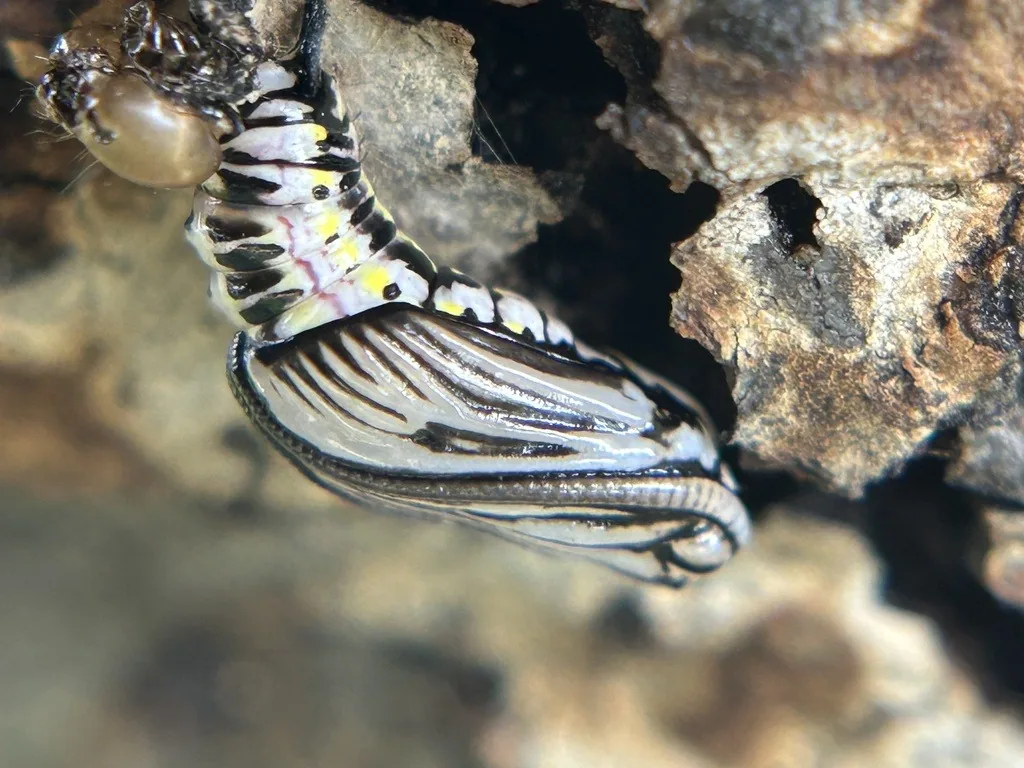
- Pupae are white to pinkish with black marks, hanging from limbs, trunks or nearby objects.[1]
- Eggs are laid in groups under leaves and start white, then develop red centers. UC IPM says groups of about two or three dozen; the Forest Service says masses of 2 to 60, about 225 per female, laid high in the crown.[1][2]
Look-alikes
| Look-alike | How to tell them apart |
|---|---|
| Tussock moth and tent caterpillars | These also feed on oaks but are quite hairy; oakworms are relatively smooth.[1] |
| Fruittree leafroller | UC IPM says it's the most common oak defoliator in the warmer Central Valley. Its caterpillars are green with brown or black heads and drop on silk threads.[1] |
Where it lives
It occurs only in California, mostly along the coast and in the coastal mountains, from about Humboldt and Del Norte counties south to Long Beach, with reports from San Diego and inland to Sacramento and Placer counties. Damage is most common on coast live oak around San Francisco and Monterey bays.[1][2]
Biology and life cycle
Fall eggs hatch within weeks, and caterpillars overwinter on evergreen oak leaves, pupating in May or early June.[1]
Moths emerge in June and July, and a summer generation feeds July through September. Northern California usually has two generations; a third sometimes occurs at warm inland sites, and in Southern California moths may appear almost any month from March to November.[1][2]
The winter brood depends on evergreen live oaks, since overwintering larvae rarely survive on deciduous oaks. In a Stanford study, though, larvae grew better and laid more eggs on deciduous valley oak leaves than on coast live oak.[2][1][3]
Caterpillars crawl across lawns and up walls to pupate, hanging head down on posts, buildings and lower oak trunks.[1][2]
Damage and signs
- Young caterpillars skeletonize the leaf surface, and older ones chew through whole leaves.[1]
- Populations swing unpredictably from very high to undetectable; outbreaks usually last one or two years. On coast live oak, feeding peaks in June and again in September and October.[1][2][4]
- Overwintering larvae can strip a tree by May or June, and the canopy looks brown or gray. Healthy oaks regrow leaves from dormant buds, but trees stressed by drought may decline.[1][2]
- In outbreaks caterpillars may feed on nearby non-oak plants. UC IPM says they can't mature there and most die; the Forest Service lists reports on American chestnut, eucalyptus, azaleas and tanoak.[1][2]
Health risk
It feeds on oaks. UC IPM calls the pupae that form on drapes and walls harmless but annoying; neither source mentions any risk to people.[1][2]
Control
Prevention
Spraying usually isn't warranted; healthy oaks generally tolerate heavy leaf loss. Water only when needed, and UC IPM says not to fertilize unless a leaf test shows the tree lacks nitrogen.[1]
Biological control
Natural enemies include green lacewings, pirate bugs, the spined soldier bug, yellowjackets, parasitic wasps (Itoplectis behrensii, Brachymeria ovata) and tachinid flies, plus a virus disease and a fungus. They sometimes kill enough oakworms to control them.[1][2]
Pesticides
If spraying is justified, UC IPM says Bacillus thuringiensis (Bt) works best on young caterpillars, timed for March-April or July-August, and advises against broad-spectrum insecticides such as carbaryl, malathion and permethrin.[1]
Monitoring
UC IPM suggests checking 25 shoot tips. More than 8 to 10 oakworms longer than 1/4 inch means defoliation may follow; 25 per 100 tips has also been suggested as a threshold.[1]
Collecting the frass (droppings) that falls under the tree over a set period, such as 24 hours each week, helps track how many are feeding; the dark pellets get bigger as the caterpillars grow.[1]
Common questions
- Is the oakworm going to kill my oak?
- Unlikely. Healthy oaks generally tolerate heavy leaf loss and regrow leaves from dormant buds, though trees already stressed by drought may decline.[1][2]
- Why are moths fluttering around my oak in summer?
- Oak moths from the summer generation fly around oaks in the late afternoon in June and July.[1]
- Why are caterpillars crawling on my house?
- Grown oakworms wander to find places to pupate and may enter homes. UC IPM calls the pupae harmless but annoying.[1]
Sources
- University of California Statewide IPM Program, “Pest Notes: California Oakworm (Publication 7422).” ipm.ucanr.edu/home-and-landscape/california-oakworm/ (accessed 2026-11-13)
- USDA Forest Service (Forest Insect & Disease Leaflets), “California Oakworm (FIDL 72).” www.fs.usda.gov/foresthealth/docs/fidls/FIDL-72-CaliforniaOakworm.pdf (accessed 2026-11-13)
- Oecologia, 1986 (via PubMed), “Utilization of evergreen and decidous oaks by the Californian oak moth Phryganidia californica (abstract).” pubmed.ncbi.nlm.nih.gov/28311717/ (accessed 2026-11-13)
- Oecologia, 1989 (via PubMed), “Seasonal variation in leaf chemistry of the coast live oak Quercus agrifolia and implications for the California oak moth Phryganidia californica (abstract).” pubmed.ncbi.nlm.nih.gov/28313475/ (accessed 2026-11-13)
- Global Biodiversity Information Facility (GBIF), “Phryganidia californica Packard, 1864 (GBIF Backbone Taxonomy).” api.gbif.org/v1/species/1824080 (accessed 2026-11-13)