On this page
How to identify it
- The full-grown caterpillar is up to 25 mm long and bright green, with a thin dark green stripe down the middle of the back, a white stripe on each side of the back that runs onto the head, and a white stripe along the spiracles. The head is brown with a cream herringbone pattern on each lobe and a green frontal triangle.[1]
- BAMONA and GBIF list the moth as Packard's girdle (moth).[3][4]
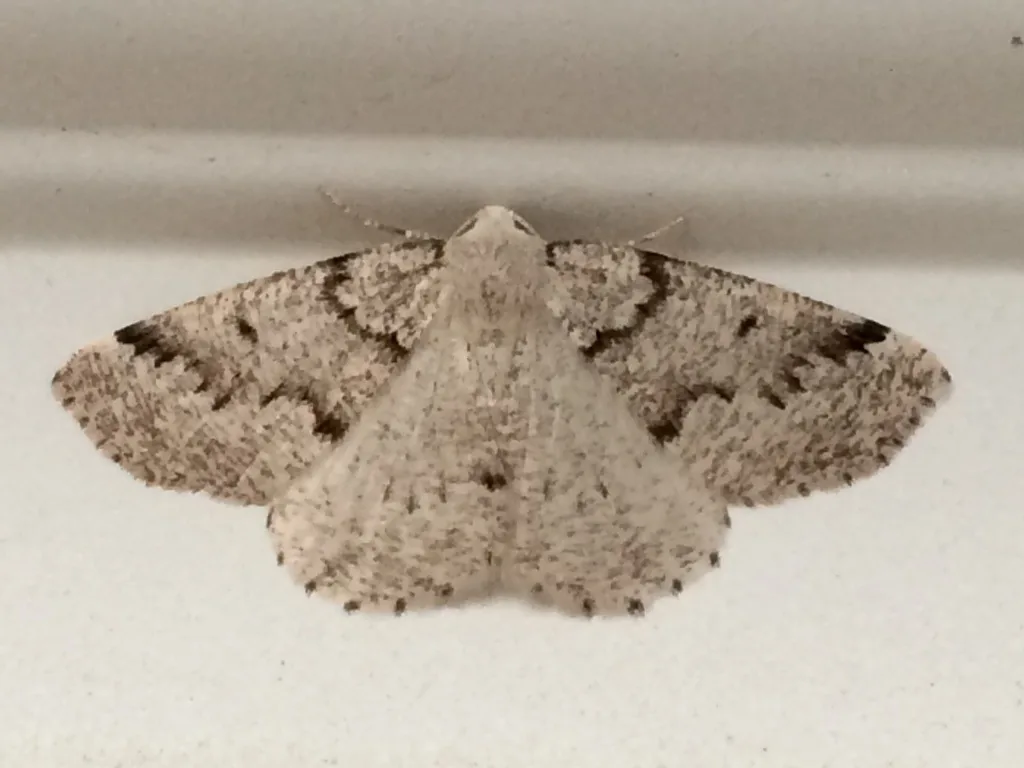
- The USDA manual describes the mature larva as green with two conspicuous near-white stripes down the back, and the adult as similar to that of the variable girdle moth (Enypia venata), which has a wingspan of 37 to 39 mm and pale gray-brown wings with fine darker bands.[2]
Look-alikes
| Look-alike | How to tell them apart |
|---|---|
| Enypia griseata | Natural Resources Canada says Enypia griseata is very similar and is told apart by its different distribution.[1] |
| Variable girdle moth (Enypia venata) | Shares essentially the same hosts and has a similar adult, but the USDA manual describes its mature caterpillar as 26 to 31 mm long and pale golden brown with several broken blackish lines, not green with white stripes.[2] |
Where it lives
Natural Resources Canada says it is generally distributed throughout coastal British Columbia and occurs north to southern Alaska and south to California. GBIF holds 76 U.S. records since 1990, the most from California (42) and Washington (27), with Oregon (4), Alaska (1) and Arizona (1). The USDA manual calls it a coastal form occurring from southern Alaska to southern California, and says all four Enypia species are confined to the West.[1][5][2]
Biology and life cycle
Natural Resources Canada names Douglas-fir and western hemlock as the principal hosts; other hosts include amabilis fir, grand fir, western redcedar, Sitka spruce and mountain hemlock. The caterpillars are free-living defoliators that feed on and move about freely on the foliage.[1]
The species overwinters as a fourth- or fifth-instar caterpillar, which resumes feeding in spring and finishes in May or June. The pupal stage lasts about 21 days between June and July, and the moths fly from June to August. Females lay about 55 eggs on foliage; the caterpillars hatch about two weeks later and feed until cold weather sets in.[1]
The USDA manual says Enypia caterpillars feed singly on the current year's conifer foliage.[2]
Damage and signs
Health risk
It feeds on conifer needles. Natural Resources Canada doesn't mention any risk to people or pets.[1]
Control
Prevention
Natural Resources Canada calls it a common innocuous solitary defoliator and gives no control measures. The USDA manual records no significant damage from Enypia larvae.[1][2]
Where the sources disagree
Hosts: the Natural Resources Canada text names amabilis fir, grand fir, western redcedar, Sitka spruce and mountain hemlock as other hosts; its host table also lists lodgepole pine, vine maple and western white pine.[1]
Range: Natural Resources Canada describes a coastal species from southern Alaska to California; GBIF's U.S. records since 1990 include one from Arizona.[1][5]
Common questions
- What is the green inchworm with white stripes on my Douglas-fir?
- On the Pacific coast from Alaska to California, a bright green caterpillar up to 25 mm long with white stripes along the back and sides, a thin dark green midline and a brown herringbone-patterned head on Douglas-fir or western hemlock is Packard's girdle moth.[1]
- What is its scientific name?
- Natural Resources Canada, BAMONA and GBIF all list it as Enypia packardata; GBIF's English name for it is Packard's Girdle.[1][3][4]
- Does it need treatment?
- No. Natural Resources Canada classes it as a common innocuous solitary defoliator and gives no control measures. The USDA manual says Enypia larvae cause no significant damage.[1][2]
- Is it the same as the redheaded looper?
- Yes. The USDA Forest Service manual Western Forest Insects calls Enypia packardata the redheaded looper.[2]
Sources
- Natural Resources Canada, Canadian Forest Service, “Packard's gridle [girdle] moth, Enypia packardata, Trees, insects and diseases of Canada's forests.” tidcf.nrcan.gc.ca/en/insects/factsheet/8595 (accessed 2026-11-14)
- USDA Forest Service, “Western Forest Insects, Miscellaneous Publication 1339 (R. L. Furniss and V. M. Carolin, November 1977; scanned copy).” archive.org/details/CAT78702369 (accessed 2026-11-14). Scanned copy on the Internet Archive; read from the archive's full-text (djvu.txt) file.
- Butterflies and Moths of North America (BAMONA), “Packard's Girdle Moth, Enypia packardata (Taylor, 1906).” www.butterfliesandmoths.org/species/Enypia-packardata (accessed 2026-11-13). Cited only for the name shown; the page's text fields are empty.
- Global Biodiversity Information Facility (GBIF), “Enypia packardata Taylor, 1906 (GBIF Backbone Taxonomy).” api.gbif.org/v1/species/1977205 (accessed 2026-11-13). ACCEPTED; order Lepidoptera, family Geometridae; vernacular name Packard's Girdle
- Global Biodiversity Information Facility (GBIF), “Enypia packardata: U.S. occurrence records since 1990 by state (GBIF occurrence API).” api.gbif.org/v1/occurrence/search?taxonKey=1977205&country=US&hasGeospatialIssue=false&occurrenceStatus=PRESENT&year=1990%2C2026&facet=stateProvince&facetLimit=400&limit=0 (accessed 2026-11-13). 76 records from 5 state-level areas; California 42, Washington 27, Oregon 4, Alaska 1, Arizona 1; fetched 2026-11-13.