On this page
How to identify it
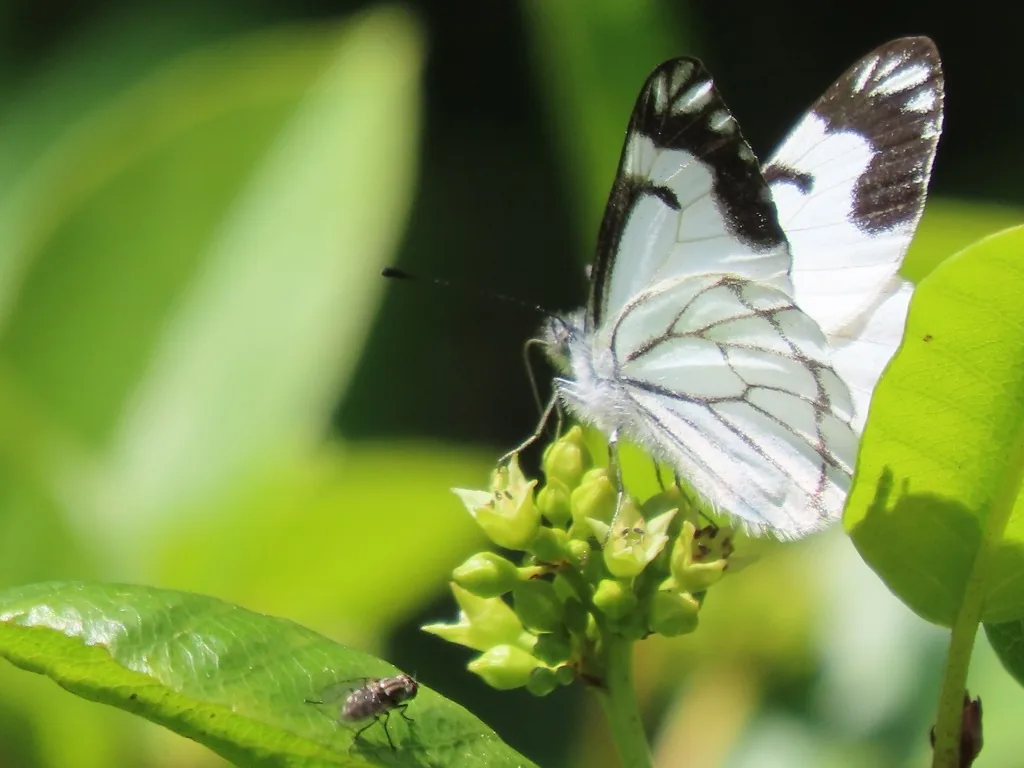
- Adults have about a 2-inch wingspan and are white with black markings, much like a cabbage butterfly. Females have a yellowish cast and heavier markings, and some show orange-red spots along the hindwing edge.[1][2]
- Caterpillars are green with two white side stripes, about 1 inch long when grown. Sources differ on the head: the PNW handbook says black, while the Oregon Department of Forestry says young larvae have black heads and mature ones green heads.[1][2]
- Emerald green eggs are laid in a single row along a needle, tilted at about a 45-degree angle.[1][2]
Look-alikes
| Look-alike | How to tell them apart |
|---|---|
| Cabbage white butterfly | The adults look very similar; the pine white's dark green, white-striped caterpillars feed on pine needles.[1] |
Where it lives
Native to pine and Douglas-fir forests of the western U.S. and British Columbia. Ponderosa pine is the preferred host; ODF also lists lodgepole and western white pine, western larch and western hemlock. Big outbreaks have hit Washington, Idaho, Montana and Oregon, and South Dakota State University calls it the more common pine defoliator in South Dakota.[2][3][1][4]
Biology and life cycle
Eggs laid in late summer overwinter on current-year needles in the upper canopy and hatch in late spring as new needles appear.[2][1][3]
Young larvae feed together, often on a single older needle; older larvae feed alone or in small groups. Larval feeding takes about 6 to 8 weeks, and defoliation is generally done by late July.[2][1][3]
They pupate on needles, branches, bark or plants below; adults fly from mid-July into September, peaking in mid- to late August.[2][3][1]
Most sources describe one generation a year, but a 2017 study found two separate flights, in July and in September to October, at two California Coast Range sites, and the two groups differed in wing shape, color and genetics.[2][1][5]
Damage and signs
- Outside outbreaks, damage is slight and goes unnoticed because the larvae feed high in the canopy. Outbreaks usually last 2 to 5 years (Forest Service researchers say up to 6) and can cover tens of thousands of acres, leaving branches with only a tuft of new needles at the tip.[1][2][3]
- Defoliation by itself may not kill a tree, but it slows growth and leaves trees open to bark beetles; Forest Service researchers link most mortality to defoliation followed by western pine beetle. SDSU says defoliation lasting two years or more can kill about a third of the trees in a stand.[2][3][4]
Health risk
The caterpillars feed on conifer needles; none of the sources consulted (PNW handbook, Oregon Department of Forestry, USDA Forest Service) describes any risk to people or pets.[1][2][3]
Control
Prevention
Keep stands healthy and mixed between outbreaks; ODF says tree vigor predicts recovery, and thinning should happen before an outbreak, not during one.[2]
Traps and physical control
On small trees, pick off the larvae; on large trees, cultural controls aren't practical because the larvae feed in the treetops.[1]
Biological control
Natural enemies end most outbreaks: ODF names the parasitic wasp Theronia atalantae (which lags the outbreak by a year or two), a parasitic fly and a predatory stink bug, along with larval starvation and winter egg deaths. Birds presumably eat them too.[2][1]
Bt sprayed in early summer, before larvae mature, works with few effects on other species. ODF says small treatments can protect high-value trees, but large-scale spraying often fails because of reinfestation, and yearly treatment for several years may be needed.[2]
Outbreaks and fire
Oregon's Blue Mountains have had outbreaks in 1908 to 1911, 1940 to 1943, 1982 and from 2008 on, according to Forest Service researchers.[3]
In a Blue Mountains study, prescribed burning didn't make ponderosa pine stands more prone to defoliation; repeated fall burns may have meant slightly less, though the effect was small.[3]
Common questions
- What are the white butterflies around my pines in late summer?
- They may be pine whites, which fly from mid-July into September, peaking in mid- to late August, and lay their eggs on pine needles.[3][1]
- Do pine white caterpillars hurt landscape pines?
- Rarely. Damage is slight except during outbreaks, which mostly hit forest ponderosa pine; small trees can be protected by picking off larvae.[1][2]
Sources
- Pacific Northwest Pest Management Handbooks (OSU, WSU, University of Idaho), “Pine (Pinus): Pine white butterfly (Insect Management Handbook).” pnwhandbooks.org/insect/hort/landscape/hosts-pests-landscape-plants/pine-pinus-pine-white-butterfly (accessed 2026-11-13)
- Oregon Department of Forestry (Forest Health Fact Sheets), “Pine Butterfly (Forest Health Fact Sheet, March 2017).” www.oregon.gov/odf/Documents/forestbenefits/PB_2017.pdf (accessed 2026-11-13)
- USDA Forest Service, Pacific Northwest Research Station (Treesearch), “Effect of season and interval of prescribed burn on ponderosa pine butterfly defoliation patterns (Kerns & Westlind, Can. J. For. Res. 43: 979-983, 2013).” research.fs.usda.gov/treesearch/48266 (accessed 2026-11-13)
- South Dakota State University Extension, “Tree Pest Alert, Vol. 21, No. 22 (July 19, 2023).” extension.sdstate.edu/sites/default/files/2023-07/S-00014-88.pdf (accessed 2026-11-13)
- PLoS One, via PubMed, “Sympatric, temporally isolated populations of the pine white butterfly Neophasia menapia, are morphologically and genetically differentiated (Bell, Hamm, Shapiro & Nice, 2017).” pubmed.ncbi.nlm.nih.gov/28562656/ (accessed 2026-11-13)
- Global Biodiversity Information Facility (GBIF), “Neophasia menapia (Felder & Felder, 1859) (GBIF Backbone Taxonomy).” api.gbif.org/v1/species/5137511 (accessed 2026-11-13)
- iNaturalist, “Neophasia menapia taxon page (order and family).” www.inaturalist.org/taxa/81734 (accessed 2026-10-06)