On this page
How to identify it
- The caterpillar is pale yellow with a brown head. From its third instar it rolls a leaf into a small tube and feeds inside on the leaf tissue.[1]
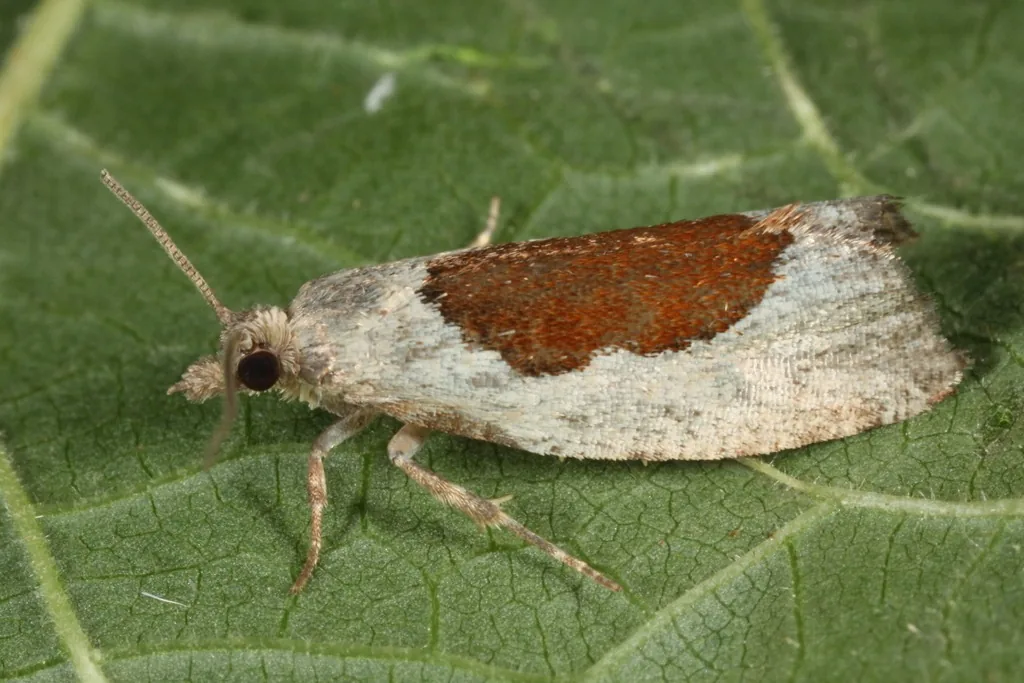
- The moth has a wingspan of about 20 mm, and Natural Resources Canada's photographs show that the wing pattern varies a great deal from one adult to the next.[1]
- Other leafroller species attack hardwoods in the northern forest, so to be sure of the insect, unroll the leaf and look closely at the caterpillar.[1]
Where it lives
Natural Resources Canada says it is found throughout the range of birch in Canada, from southern Ontario to the Northwest Territories. In Alaska the Forest Service's 2025 ground survey recorded it 65 times, on alder, Alaska paper birch and balsam poplar.[1][2]
Biology and life cycle
The main host is white birch; trembling aspen, alders and yellow birch are also attacked. In Alaska the Forest Service recorded it on alder, Alaska paper birch and balsam poplar.[1][2]
The female lays her eggs singly at the base of buds. In spring the young caterpillars bore into the swollen buds and feed on them, then eat the leaves before they have fully opened.[1]
In the third instar the caterpillar rolls a leaf into a small tube and feeds inside it on the leaf tissue.[1]
The moth was known in Europe from 1758 and was first reported in North America in British Columbia in 1909. Infestations followed by quiet periods are regularly reported in Ontario and Quebec.[1]
The Forest Service says Alaska's birch leafrollers, a group that includes this species, have one generation a year and overwinter as eggs. Larvae hatch from mid-May to early June, feed in buds and then in rolled leaves, and pupate in fragile cocoons between the humus layer and the mineral soil; adults emerge from late July through August.[2]
Damage and signs
- Damage starts with the buds, which the young caterpillars hollow out, and continues on the unfolding leaves and in the rolled feeding tubes. Natural Resources Canada's photographs include a trembling aspen stand defoliated by this insect.[1]
- Natural Resources Canada calls the damage usually sporadic and local and the insect a pest of secondary importance. In Alaska most of the 93 birch leafroller observations in the 2025 survey were rated at 5 percent damage or less, though the Forest Service says drastic, repeated defoliation can cause minor growth loss and branch dieback.[1][2]
Health risk
Natural Resources Canada and the Forest Service in Alaska describe it only as a leaf feeder on hardwoods; neither mentions bites, stings or any effect on people or pets.[1][2]
Control
Prevention
Natural Resources Canada rates it as a pest of secondary importance with sporadic, local damage, and infestations are followed by lull periods, so a bad year is not usually a sign of a lasting problem.[1]
Biological control
The Forest Service says leafroller populations in Alaska are controlled naturally by adverse weather, parasites, predators and disease.[2]
Where the sources disagree
Damage: Natural Resources Canada calls it a pest of secondary importance with sporadic, local damage; the Forest Service in Alaska says birch leafroller damage can cause branch dieback and occasionally tree mortality.[1][2]
Hosts: Natural Resources Canada names white birch, trembling aspen, alders and yellow birch; in Alaska's survey it was found on alder, Alaska paper birch and balsam poplar.[1][2]
Common questions
- What rolls birch leaves into little tubes in early summer?
- A pale yellow, brown-headed caterpillar in a rolled birch or aspen leaf is likely the birch-aspen leafroller. Unroll the leaf to check, since other leafrollers use hardwoods too.[1]
- Will it kill my birch?
- Unlikely. Natural Resources Canada calls the damage usually sporadic and local and the insect a pest of secondary importance; the Forest Service in Alaska says heavy, repeated feeding can cause branch dieback and occasionally tree death.[1][2]
- Where does it occur?
- Across the range of birch in Canada, from southern Ontario to the Northwest Territories, and in Alaska, where the Forest Service calls it the most common leafroller on birch.[1][2]
Sources
- Natural Resources Canada, Canadian Forest Service, “Birch-aspen leafroller, Trees, insects and diseases of Canada's forests.” tidcf.nrcan.gc.ca/en/insects/factsheet/11020 (accessed 2026-11-13)
- USDA Forest Service, Alaska Region, “Birch Leafroller (Forest Health, Alaska Region).” www.fs.usda.gov/r10/natural-resources/forest-health/birch-leafroller (accessed 2026-11-13)
- Global Biodiversity Information Facility (GBIF), “Epinotia solandriana (Linnaeus, 1758) (GBIF Backbone Taxonomy).” api.gbif.org/v1/species/1745558 (accessed 2026-11-13)
- iNaturalist, “Epinotia solandriana taxon page (order and family).” www.inaturalist.org/taxa/219346 (accessed 2026-11-10)