On this page
How to identify it
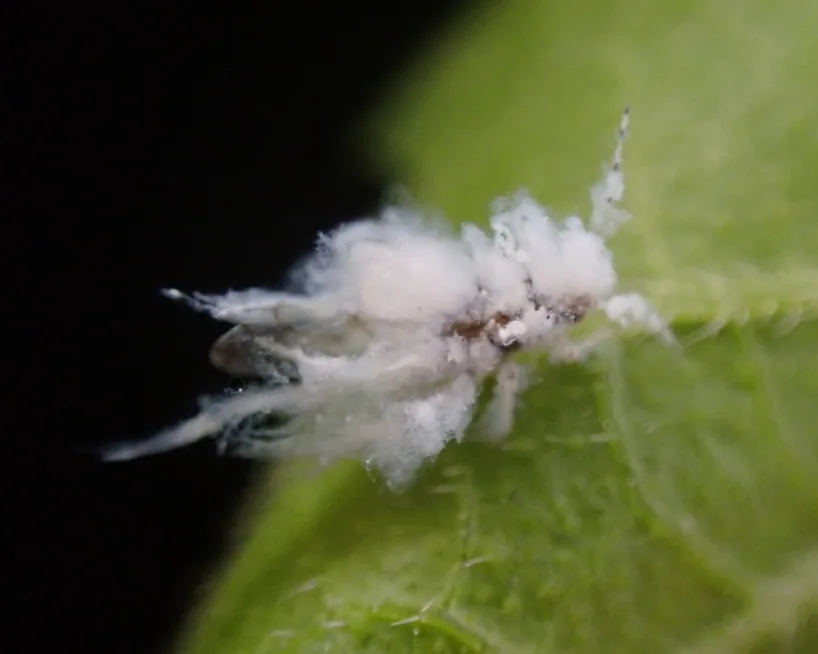
- Colonies on shoot tips and leaves look like fuzzy, bluish or white masses, each about 1/10 inch or less across. UF/IFAS describes copious bluish white wax and says to look for small balls of fuzzy wax, up to 2 mm, on the backs of hackberry leaves, in both urban and natural landscapes.[1][3]
- Under the wax the aphids are dark green to pale green, sometimes pinkish, and adults are 1/12 to 1/10 inch (2 to 2.5 mm) long. UF/IFAS also gives 2 to 2.5 mm.[4][3]
- Winged adults have black borders along the forewing veins (often partly hidden by wax) and antennae banded dark and light. UF/IFAS adds that the darkened antennal joints give the antennae a striped look and that the tail (cauda) is finger-like.[1][4][3]
- Sticky honeydew dripping from the tree is often the first sign.[1][2]
Look-alikes
| Look-alike | How to tell them apart |
|---|---|
| Citricola scale | The only other insect that makes annoying honeydew on hackberry in California. Its brown to gray, oval scales sit on twig bark from fall through spring and are easy to overlook, so check for aphids before deciding which one to treat.[1] |
Where it lives
It comes from Asia. UC Riverside's Center for Invasive Species Research says it was first found in North America on native hackberry in Georgia in 1996, spread through the Southeast, and turned up in California's San Joaquin Valley in 2002; it now appears to occur throughout California wherever hackberries are planted. UC IPM says it ranges from Florida to Texas and north to at least Illinois, and GBIF holds U.S. records from 25 states plus Washington, D.C., most from Texas, Tennessee and California. UF/IFAS says it was first found in Florida in Jacksonville, Duval County, on sugarberry on 13 August 1997, about a year after its discovery in Georgia, and has since been collected in counties across most of Florida.[2][1][5][3]
Biology and life cycle
Through most of the season, winged and wingless adults give birth to live young, and spring and summer adults are all females. In fall winged males appear, and mated females lay eggs that overwinter on the twig tips and dormant buds; they hatch in spring as the leaves come out. In Gainesville, Florida, UF/IFAS found winged males and wingless egg-laying females in October.[1][4][3]
It spends its whole life cycle on hackberry (Celtis), feeding on leaves, stems and fruit stalks, mostly on leaf undersides. Chinese hackberry is the main host in California. UF/IFAS says it is probably restricted to Celtis, infests sugarberry in Florida, and has occasionally been recorded on Arundo donax.[4][1][2][3]
In the San Joaquin Valley numbers are usually highest in spring and fall and lower in summer, and there are many generations a year.[1][2]
Damage and signs
- Copious honeydew grows black sooty mold on leaves and on cars, walkways and anything else under the tree. No long-term or serious damage to the trees has been found after years of infestation. UF/IFAS has also seen no long-term damage, though aphids can become quite numerous on some trees in late summer.[1][2][3]
- The mess is enough that some California cities have put hackberry on their no-plant lists, even though Chinese hackberry makes up as much as 10% of some Central Valley urban forests.[2]
Health risk
It feeds only on hackberry; UC IPM and UC Riverside describe it as a nuisance because of honeydew, not a risk to people.[1][2]
Control
Prevention
Treat only when the honeydew can't be tolerated, since tree health isn't threatened. Landscape managers can track honeydew with water-sensitive cards under the tree to decide when to act. UF/IFAS says chemical treatment probably isn't warranted to protect the health of infested trees.[1][3]
Give trees appropriate water without waterlogging the soil near the trunk, and don't fertilize unless a deficiency is confirmed; excess nitrogen increases aphids on some plants.[1]
Traps and physical control
On trees small enough to reach, a forceful stream of water dislodges and kills some aphids and washes off honeydew.[1]
Biological control
Lady beetles, syrphid flies and lacewing larvae eat it, though often not enough in California. Avoid broad-spectrum, persistent sprays, which also kill the parasites that keep citricola scale in check. Researchers have collected parasitic wasps in China for study as a long-term control.[1][2]
Pesticides
Oil, insecticidal soap or pyrethrin sprays give only partial control because the wax shields the aphids and big trees are hard to cover. A systemic insecticide applied to the soil or trunk can give season-long control; don't apply it during or just before flowering, avoid trunk injections or implants, and skip fall treatments because the leaves will soon drop.[1][2]
Relatives and natural enemies
The genus Shivaphis has six described species from East and Central Asia, found mainly on hackberries; no other Asian woolly hackberry aphid is known in the Western Hemisphere.[3]
Two parasitic wasps in the genus Trioxys have been described from this aphid, but UF/IFAS says their effectiveness is not known and no parasitized aphids had been found in Florida.[3]
Where the sources disagree
Peak season: UC IPM says San Joaquin Valley numbers are highest in spring and fall and lower in summer; UF/IFAS says aphids may become quite numerous on some trees in late summer.[1][3]
First U.S. record: UC Riverside dates the first North American find to Georgia in 1996; UF/IFAS says it was found in Georgia about a year before its 1997 Florida discovery.[2][3]
Common questions
- Why is everything under my hackberry sticky?
- Woolly hackberry aphid honeydew drips onto surfaces below and grows black sooty mold.[1][2]
- Will the aphids kill the tree?
- No. Years of infestation haven't caused serious or long-term damage.[1][2]
- When is it worst?
- In California's San Joaquin Valley, spring and fall, with fewer aphids and less honeydew in summer.[1][2]
- When did it reach Florida?
- UF/IFAS says it was first found in Jacksonville on 13 August 1997, on sugarberry, and has since spread to counties across most of the state.[3]
Sources
- University of California Statewide IPM Program, “Pest Notes: Woolly Hackberry Aphid (Publication 74111).” ipm.ucanr.edu/home-and-landscape/hackberry-woolly-aphid/ (accessed 2026-11-14)
- Center for Invasive Species Research, University of California, Riverside, “Asian Woolly Hackberry Aphid, Shivaphis celti (text by Andrew Lawson, California State University, Fresno).” cisr.ucr.edu/invasive-species/asian-wooly-hackberry-aphid (accessed 2026-11-14)
- University of Florida/IFAS Extension (Featured Creatures), “Asian Woolly Hackberry Aphid, Shivaphis celti Das, IN565.” ask.ifas.ufl.edu/publication/IN565 (accessed 2026-11-14)
- University of California Statewide IPM Program, “Woolly Aphids (Pest Notes / Home and Landscape).” ipm.ucanr.edu/home-and-landscape/woolly-aphids/ (accessed 2026-11-14)
- Global Biodiversity Information Facility (GBIF), “Shivaphis celti: occurrence records in the U.S., 1990-2026 (GBIF occurrence search).” api.gbif.org/v1/occurrence/search?taxonKey=2071363&country=US&hasGeospatialIssue=false&occurrenceStatus=PRESENT&year=1990%2C2026&facet=stateProvince&facetLimit=400&limit=0 (accessed 2026-11-14). State counts are records reported (iNaturalist research-grade, museum specimens, surveys), not abundance.
- iNaturalist, “Shivaphis celti taxon page (order and family).” www.inaturalist.org/taxa/335282 (accessed 2026-11-14)