On this page
How to identify it
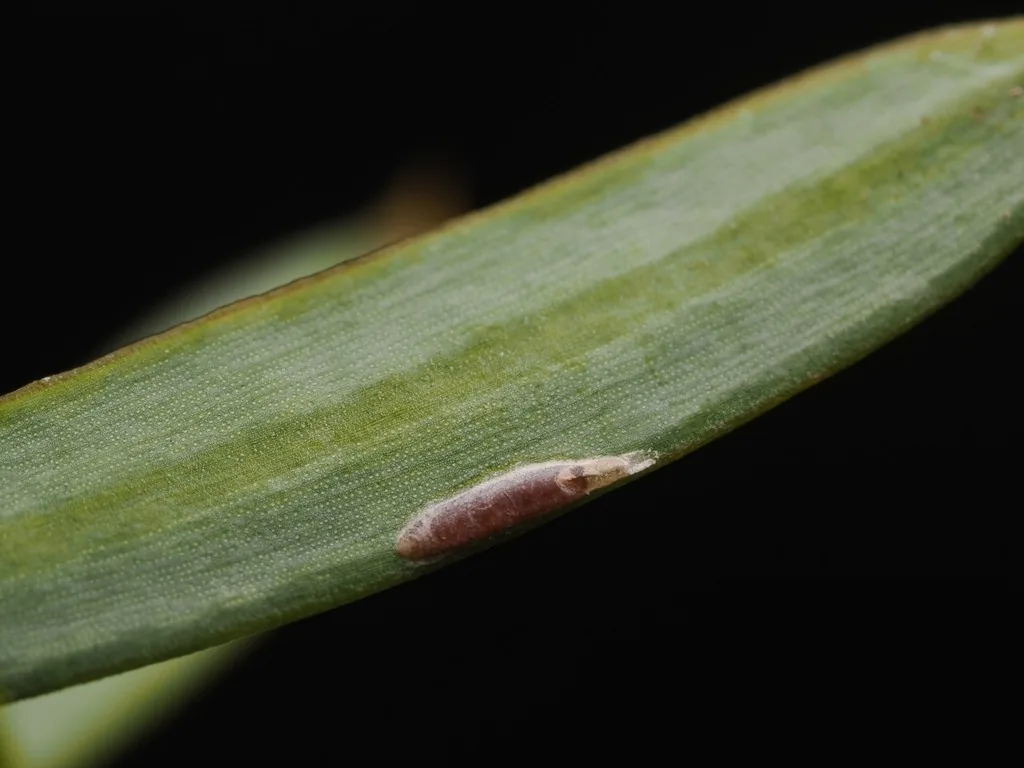
- Female armor is brown (UMass says light brown, sometimes whitish at the rear), up to 1/16 inch long and oystershell-shaped; under it the female's body is white. Male armor is smaller, narrower and light brown.[1][2]
- Young scales' armor is pale brown and almost translucent. NC State describes the crawlers as flat and yellow; UMass calls them pale yellow to white.[1][2]
- In established populations many scales are dead, because the armor stays on the needles long after the insect dies. Being an armored scale, it makes no honeydew, so there is no sooty mold.[1][2]
Where it lives
UMass reports it in New Jersey, New York, Delaware, Pennsylvania and at least seven more states, says it is likely more widespread than known, and notes it had not officially been reported in Massachusetts; NC State covers it in North Carolina.[2][1]
Biology and life cycle
Little has been published on its biology. Eggs laid under the female's armor hatch in one to three weeks depending on weather; crawlers settle on needles, build pale armor and molt twice, the second time about a week after the first.[1][2]
NC State says females begin laying eggs for a new generation about two months after settling. In New Jersey, mated females overwinter, lay 3 to 6 eggs each in May on Japanese black pine, and crawlers come out in the second half of June; a partial second generation has been recorded there.[1][2]
Winged males crawl or fly to find females and soon die after mating; they lack mouthparts.[1]
Crawlers have been reported in June and again in August. UMass gives about 470 growing degree days (base 50 F, from January 1) for the start of first-generation crawlers.[2]
Damage and signs
- Junipers are the most frequently reported hosts. NC State also lists arborvitae, Chamaecyparis, Cryptomeria, cypress, deodar cedar, Norfolk Island pine and red cedar; UMass adds plum pine (Podocarpus), plum yew (Cephalotaxus), umbrella pine and Japanese black pine, and says it has been reported from at least 21 plant genera in 15 families.[1][2]
- On Cryptomeria it can brown foliage and cause twig dieback. Rutgers adds needle browning and branch dieback on umbrella pine (Sciadopitys) and Japanese black pine and says heavy infestations can kill trees; UMass says heavily infested plants may yellow and some may die without intervention, especially where other stresses are present.[2][1][3]
- Rutgers says Maskell scale and the closely related pine oystershell scale are major problems for black pine in New Jersey, particularly in the southern and coastal counties. The two look alike and are very hard to tell apart.[3]
Health risk
It is a sap-feeding scale on conifer needles. NC State, UMass and Rutgers describe it only as a plant pest; none of them mentions bites, stings or any effect on people or pets.[1][2][3]
Control
Prevention
Scout needles in early spring and again through June and August for crawlers, and check plants with yellowing, browning or thinning foliage. On black pine, Rutgers says most scales hide down between the needles in the fascicles, so look closely at the needle bases; light infestations are hard to spot.[1][2][3]
Sanitation
Prune out and destroy discolored or heavily infested branches, reduce other stresses and plant hosts on suitable sites.[2]
Biological control
Natural enemies matter, though sources differ on how many are known. NC State says tiny wasps often heavily parasitize Maskell scale, though populations occasionally escape them, and advises monitoring instead of spraying when you see chewed-open scales or round exit holes in the armor. UMass lists only one recorded parasitoid, the aphelinid wasp Aphytis hispanicus.[1][2]
Pesticides
Horticultural oil is the main home-landscape option: a dormant-season oil for scales on trunks and branches, and a growing-season oil aimed at crawlers, each at the label's directions for that season. Rutgers suggests a dormant oil in March for light infestations and, for heavy ones, sprays aimed at the crawlers in June and again in August. Sources differ on imidacloprid (see where the sources disagree).[1][2][3]
Checking whether the scales are alive
Because the armor clings to needles after the insect dies, an old infestation can look worse than it is. Before treating, look for live, yellow crawlers or plump bodies under the armor.[1][2]
Round holes in the armor mean parasitic wasps have emerged, and chewed-open scales point to predators; NC State says either sign can justify watching rather than spraying.[1]
Where the sources disagree
Crawler color: NC State describes the crawlers as flat and yellow; UMass calls them pale yellow to white, and Rutgers pale yellow.[1][2][3]
Host range: UMass says it has been reported from at least 21 plant genera in 15 families; Rutgers says it is reported to attack as many as 13 genera of conifers.[2][3]
Natural enemies: NC State says tiny wasps often heavily parasitize it; UMass lists only one recorded parasitoid, Aphytis hispanicus.[1][2]
Generations: Rutgers treats the June and August crawlers as a first and second generation; UMass says only a partial second generation has been recorded in New Jersey.[3][2]
Imidacloprid: NC State says it does not kill armored scales; Rutgers lists it among the materials labeled for Maskell scale.[1][3]
Common questions
- What are the tiny brown specks on my juniper needles?
- Possibly Maskell scale, a 1/16-inch, oystershell-shaped brown armored scale. It makes no honeydew, which helps tell it from soft scales.[1][2]
- Are the scales alive?
- Not necessarily; armor stays on the plant long after the scale dies, so check for live insects or crawlers before treating.[1][2]
- How do I treat Maskell scale?
- Prune out the worst branches and use horticultural oil, a dormant oil in late winter or a growing-season oil timed to crawlers, following the label. NC State says imidacloprid does not kill armored scales, so don't count on it.[1][2][3]
Sources
- NC State Extension, “Maskell Scale (PDIC Factsheet).” content.ces.ncsu.edu/maskell-scale (accessed 2026-11-13)
- UMass Extension Landscape, Nursery and Urban Forestry Program (Landscape Insect & Mite Guide), “Lepidosaphes pallida (Maskell Scale).” www.umass.edu/agriculture-food-environment/landscape/publications-resources/insect-mite-guide/lepidosaphes-pallida (accessed 2026-11-13)
- Rutgers Cooperative Extension, Rutgers NJAES, “Maskelled Bandit (Plant & Pest Advisory, June 11, 2013, Richard Buckley).” plant-pest-advisory.rutgers.edu/maskelled-bandit (accessed 2026-11-13)
- Global Biodiversity Information Facility (GBIF), “Lepidosaphes pallida Maskell, 1895 (GBIF Backbone Taxonomy).” api.gbif.org/v1/species/9600092 (accessed 2026-11-13)
- iNaturalist, “Lepidosaphes pallida taxon page (order and family).” www.inaturalist.org/taxa/391463 (accessed 2026-10-06)