On this page
How to identify it
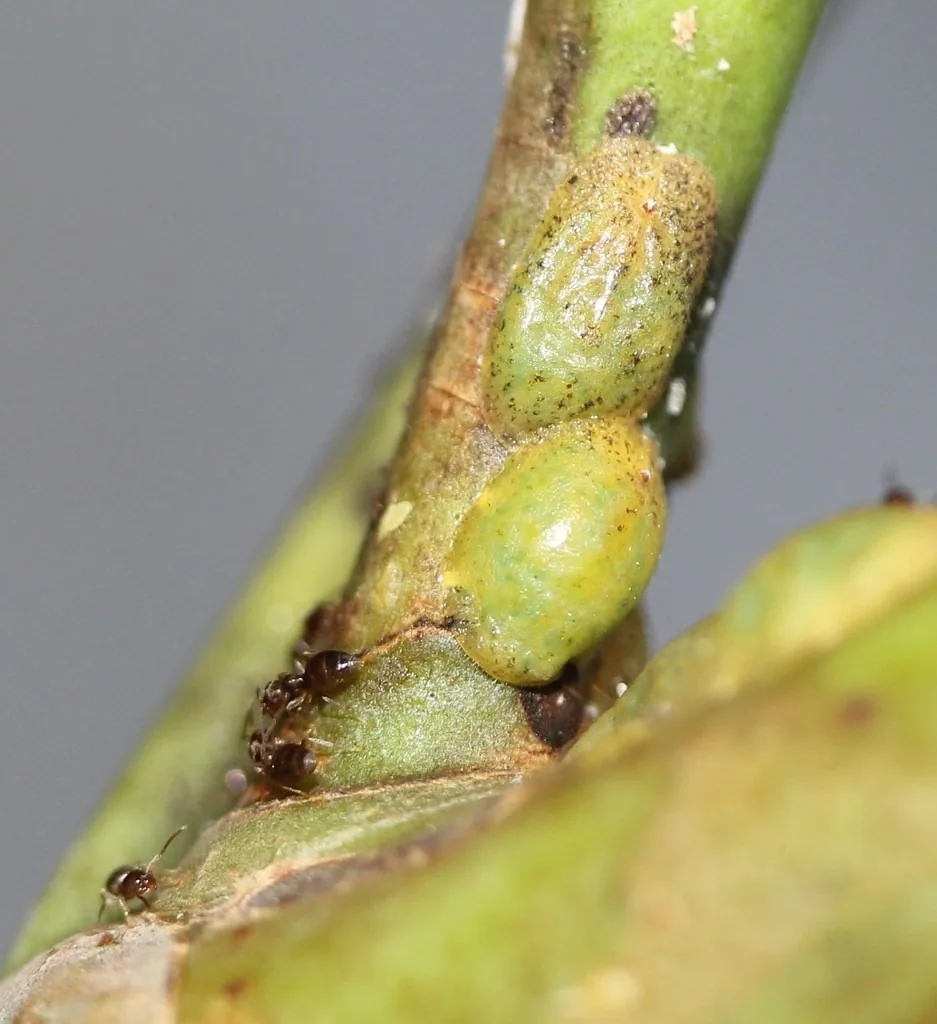
- Adult females are oval, about 4 mm long and 2 mm wide, bright green to yellow-green or olive-green, with dark striations or black speckling on the back.[1][5]
- Immature males crowd together on leaf undersides in whitish-gray patches. Adult males are small, orange-bodied, gnat-like insects.[1][5]
- Nymphs are pale green, and many overlapping generations are usually present at once on stems, leaf stalks and leaves, with females common along the main veins under the leaves.[5][1]
- Females don't make a white, cottony egg sac.[1][5]
Look-alikes
| Look-alike | How to tell them apart |
|---|---|
| Green scale | Green scale has what look like two black dots for eyes; croton scale has black mottling or speckling.[1] |
| Philephedra tuberculosa (a soft scale) | Looks very similar before it lays eggs, but it produces a conspicuous white, waxy, cottony egg sac; croton scale never does.[1][5] |
| Other scale insects | Croton scale was new enough to science to be described in 2010 as a new genus and species, and it is the only species in that genus.[1][5] |
Where it lives
Its native home is unknown. Since its 2008 discovery in Florida it has been reported from Guatemala, French Guiana and across the Caribbean, including Barbados, Guadeloupe, the British Virgin Islands, the Bahamas, the Cayman Islands and Puerto Rico, and from Hawaii, where it was first found in March 2019 on potted crotons at a Honolulu garden center. California's agriculture department intercepts it on plant material from Hawaii, Puerto Rico, Florida and South Carolina but does not know it to be established there. GBIF's U.S. records with a state are all from Florida.[3][1][5][6]
Biology and life cycle
Each female can lay about 400 eggs, which hatch almost at once.[5][3]
Females pass through three immature stages and males four, including a prepupa and pupa. Generations overlap, about one a month in tropical conditions, and it spends the winter as the adult female.[5][3]
Crawlers usually settle close to their mother. Air currents and animals can carry them farther, and the trade in infested plants moves them fastest and farthest.[5][3]
It feeds mostly on woody plants, and croton is the main host. Counts of host families differ: at least 35 (California), at least 36 (Hawaii and the UK field guide) and, for Florida, 72 known host plants in 34 families (Cayman Islands Department of Agriculture). Recorded hosts include mango, guava, avocado, Annona and Ficus.[3][1][5][4]
Damage and signs
- Sap feeding makes leaves yellow, twist, wilt and drop early. Heavy infestations bring tip dieback and decline, and small plants, especially young crotons, can be killed.[1][5][4]
- Females excrete large amounts of honeydew, which grows black sooty mold. The mold blocks sunlight from the leaves; California's rating cites Florida reports of immense quantities of honeydew on croton.[5][4][3]
- Infested fruit trees are weakened and yield less. Hawaii's advisory warns it could become a problem for homes, nurseries and commercial landscapes because croton is widely planted.[4][1]
Health risk
It feeds only on plants; the agriculture-agency sources describe it only as a plant pest.[1][5]
Control
Prevention
Look for honeydew, sooty mold, and ants or wasps visiting a plant. Light infestations and young nymphs are hard to see, so check stems and leaf undersides closely, including on new plants, since it spreads mainly on infested plants.[5][4]
Biological control
Lady beetles eat it. The Cayman department reports Thalassa montezumae feeding on croton scale and asks growers to favor treatments that spare natural enemies; the UK field guide shows a Chilocorus lady beetle feeding on it and lists the mealybug destroyer and a pyralid moth as natural enemies in Florida.[4][5]
Pesticides
For lightly infested home plants, the Cayman Islands Department of Agriculture lists insecticidal soap and horticultural or neem oil, sprayed to cover stems and leaf undersides and repeated every 7 to 10 days until the scale is controlled. These are less harmful to beneficial insects.[4]
For heavy infestations it names systemic neonicotinoids and a pyrethroid, applied by trained applicators and rotated between chemical groups to slow resistance; a plant that got a neonicotinoid soil drench should not also get a foliar spray from that group.[4]
More from the Hawaii Department of Agriculture
The Hawaii Department of Agriculture's 2019 advisory reports the state's first find, on potted crotons at a Honolulu garden center in March 2019; it notes the scale is recorded from plants in at least 36 families, that crowded immature males form whitish-gray patches on leaf undersides, and that it has black speckling the similar green scale lacks and no white cottony egg mass like the look-alike Philephedra tuberculosa.[1]
Common questions
- What are the green bumps under my croton leaves?
- Possibly croton scale: green to yellow-green oval scales with black speckling, crowded along the leaf veins and on stems.[1][5]
- Why are ants all over my shrub?
- Ants feed on the sugary honeydew that scale insects excrete, so heavy ant traffic is a clue to look for scale.[5][4]
- Can croton scale kill my plant?
- It can. Heavy infestations cause leaf drop and dieback, and small plants, particularly crotons, may be killed.[5][4]
Sources
- Hawaii Department of Agriculture, Plant Pest Control Branch, “New Pest Advisory No. 19-02: Croton Scale, Phalacrococcus howertoni.” dab.hawaii.gov/pi/files/2019/09/FINAL-Phalacrococcus-howertoni-NPA-1.pdf (accessed 2026-11-11)
- iNaturalist, “Phalacrococcus howertoni taxon page (order and family).” www.inaturalist.org/taxa/804291 (accessed 2026-11-11)
- California Department of Food and Agriculture, “California Pest Rating Proposal: Phalacrococcus howertoni Hodges & Hodgson, croton scale (comment period March-April 2021).” blogs.cdfa.ca.gov/Section3162/wp-content/uploads/2021/03/Phalacrococcus-howertoni.pdf (accessed 2026-11-11)
- Cayman Islands Department of Agriculture, “Croton Scale, Phalacrococcus howertoni: A Pest of Croton, Fruit Trees and Other Plants in the Cayman Islands (brochure).” doa.gov.ky/wp-content/uploads/2022/08/Croton-Scale-Bochure.pdf (accessed 2026-11-11)
- Fera Science Ltd for the GB Non-Native Species Secretariat, “Field Guide to Invasive Alien Plant Pests in the Caribbean UK Overseas Territories, Part 5: Hemiptera (Scale insects), 2nd ed. (Malumphy et al., 2019), section 6.32 Croton scale.” www.nonnativespecies.org/assets/Field_Guide_invasives_pests_in_Caribbean_UKOTs_Part_5_Hemiptera_Scale_insects.pdf (accessed 2026-11-11)
- Global Biodiversity Information Facility (GBIF), “Phalacrococcus howertoni: US occurrence records by state, 1990-2026 (GBIF occurrence search).” api.gbif.org/v1/occurrence/search?taxonKey=9417050&country=US&hasGeospatialIssue=false&occurrenceStatus=PRESENT&year=1990%2C2026&facet=stateProvince&facetLimit=400&limit=0 (accessed 2026-11-11). State counts are records reported (iNaturalist research-grade, museum specimens, surveys), not abundance.