On this page
How to identify it
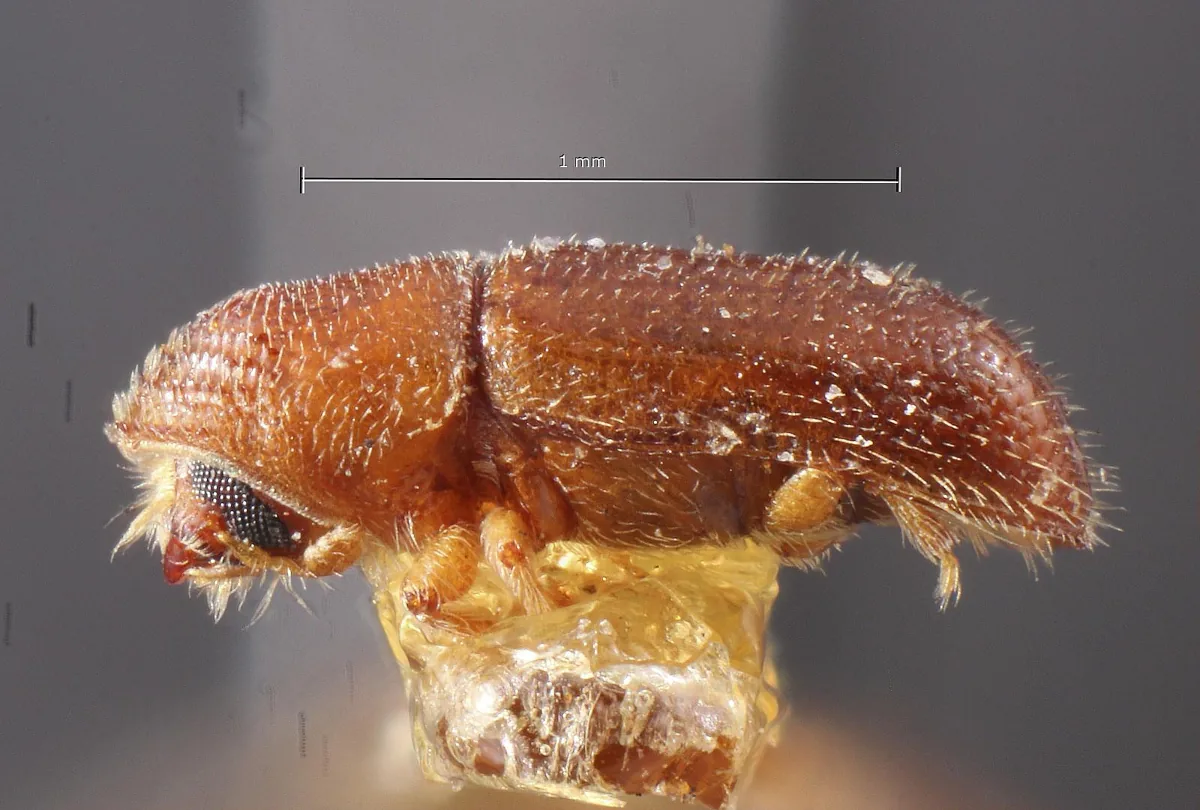
- It's a minute bark beetle, 1.5 to 1.9 mm long, yellowish brown and about three times as long as wide.[1]
- Despite its name, it tunnels in branches over about 2 cm thick, not twigs; look for tiny exit holes and shallow tunnels under the bark.[1]
- UC IPM describes it as about 1/16 inch (1.5 mm) and reddish brown, with four to six concentric ridges on the shield behind the head. Each push-pin-sized entry hole sits in a small canker that often bleeds dark ooze.[6][7]
Where it lives
Native to Arizona, New Mexico and Chihuahua, and possibly California, it spread with walnut die-offs across the western states from the 1990s. The Forest Service says it now appears to be wherever susceptible walnut grows in the West. A July 2010 find in Knoxville, Tennessee, was the first east of the 100th meridian, and the disease has since been confirmed in Virginia, Pennsylvania, Ohio and North Carolina.[1][8][4]
Biology and life cycle
Sources describe the life cycle differently. CSU says that in Colorado adults overwinter, become active by late April and produce a second generation in early summer, with flight peaking mid-July to late August. Utah State reports two to three generations and overwintering as larvae and adults, and UC IPM says California has likely two to three overlapping generations, with flight nearly year-round and peaks in May to June and September to October.[1][9][6]
Cankers from the Geosmithia fungus form around beetle tunnels and merge, depleting the tree's reserves.[1]
It breeds only in walnut, butternut and wingnut trees.[6][8]
Damage and signs
- How deadly the disease is depends on where you are. CSU says black walnut often dies within three years of first symptoms in the Rocky Mountain states, and the Oregon Department of Forestry says most black walnuts have died where the beetle has been found. Pennsylvania's Department of Agriculture says native black walnut there is largely unaffected and that the disease causes branch dieback but hasn't been shown to kill the tree.[1][2][4]
- Hickories and pecan are immune. Black walnut is the most susceptible North American walnut; English and other walnuts show intermediate resistance, and Arizona and little walnut develop only restricted cankers.[1][3][2]
- Symptoms can take 5 to 10 years or longer to show after a tree is first infested. In California orchards, growers usually remove infested trees before they die, so UC IPM says deaths there haven't been measured.[1][6]
Health risk
CSU, Utah State, UC IPM and the Pennsylvania and Minnesota agriculture departments discuss it only as a tree pest. None of them mentions any risk to people or pets.[1][9][6][4][5]
Control
Prevention
Surveys work best in July and August, checking smooth-barked limbs 2 to 5 cm thick for beetle tunnels and exit holes.[1]
Take down infested trees and chip, grind or burn the wood where that's allowed, and don't move walnut logs, branches, burls or firewood out of infested areas. CSU warns that even a small scrap of walnut with bark can carry beetles.[1][6][2]
When to call a professional
No treatment is known to save an infested tree. CSU says trunk sprays didn't stop the disease in trees with early symptoms, and UC IPM says no insecticide has been shown to reduce tree deaths and advises against chemical control for now.[1][6][7]
Quarantines then and now
Several states set walnut quarantines after 2010. Pennsylvania's covered six southeastern counties by 2014 and was repealed in 2022; Minnesota's exterior quarantine ran from August 2011 to August 2021.[1][4][5]
The Minnesota Department of Agriculture says seventeen other states once had exterior quarantines and that they are being repealed because the disease hasn't become a significant problem in the East. Pennsylvania says most states have repealed theirs. Walnut nuts don't carry the beetle and weren't covered.[5][4][1]
Not every source sees the East the same way: the Oregon Department of Forestry says the beetle has taken a heavy toll on black walnut in the western U.S. and the Ohio region.[2]
Rules can still change. The Forest Service says state plant regulatory officials may restrict walnut from infested counties, and it and APHIS have funded an eastern trap network since 2012, with survey maps through 2025.[8]
Utah State's advice still applies where the beetle is present: find infested trees quickly, then remove and debark them.[9]
Other tools are still being studied. Pennsylvania reports that logs treated with the insect-killing fungi Beauveria bassiana or Metarhizium brunneum gave suitable control, and in a California orchard a limonene and trans-conophthorin repellent cut beetle landings, but only at the lower trap position.[4][10]
Common questions
- Why is my black walnut dying from the top down?
- Thousand cankers disease, spread by walnut twig beetle, causes crown yellowing and branch dieback.[1]
- Does thousand cankers disease affect pecans?
- No; CSU's pest alert says hickories and pecan are immune.[1]
- Is there still a walnut quarantine for thousand cankers disease?
- In most states, no. Pennsylvania repealed its quarantine in 2022 and Minnesota in 2021, but moving walnut wood with bark can still spread the beetle.[4][5][1]
Sources
- Colorado State University Extension, “Pest Alert: Walnut Twig Beetle and Thousand Cankers Disease of Black Walnut.” extension.colostate.edu/resource/pest-alert-walnut-twig-beetle/ (accessed 2026-11-13)
- Oregon Department of Forestry, “Oregon Tree Health Threats Bulletin, July 2025.” www.oregon.gov/odf/forestbenefits/documents/oregon-tree-health-threats-bulletin-july-2025.pdf (accessed 2026-11-13)
- J Chem Ecol 2025;51:1, via PubMed, “Characterizing pathogen-induced changes in black walnut volatile organic compounds following inoculation with Geosmithia morbida (Tobin et al., 2025).” pubmed.ncbi.nlm.nih.gov/39838224/ (accessed 2026-11-13)
- Pennsylvania Department of Agriculture, “Thousand Cankers Disease.” www.pa.gov/agencies/pda/plants-land-water/plant-industry/plant-protection/thousand-cankers-disease.html (accessed 2026-11-13)
- Minnesota Department of Agriculture, “Thousand Cankers Disease.” mda.state.mn.us/thousand-cankers-disease (accessed 2026-11-13)
- UC Statewide IPM Program, “Walnut Twig Beetle (Walnut Pest Management Guidelines).” ipm.ucanr.edu/agriculture/walnut/walnut-twig-beetle/ (accessed 2026-11-13)
- UC Statewide IPM Program, “Thousand Cankers Disease (Walnut Pest Management Guidelines).” ipm.ucanr.edu/agriculture/walnut/thousand-cankers-disease/ (accessed 2026-11-13)
- USDA Forest Service, Forest Health Protection, “Thousand Cankers Disease Survey Maps.” www.fs.usda.gov/science-technology/data-tools-products/fhp-mapping-reporting/thousand-cankers-disease-survey-maps (accessed 2026-11-13)
- Utah State University Extension, “Walnut Twig Beetle.” extension.usu.edu/planthealth/ipm/ornamental-pest-guide/arthopods/bark-beetles/walnut-twig-beetle.php (accessed 2026-11-13)
- J Econ Entomol 2021;114(3):1180-1188, via PubMed, “Assessment of semiochemical repellents for protecting walnut trees from walnut twig beetle attack in a commercial orchard setting in California (Audley, Bostock & Seybold, 2021).” pubmed.ncbi.nlm.nih.gov/33822085/ (accessed 2026-11-13)
- Global Biodiversity Information Facility (GBIF), “Pityophthorus juglandis Blackman, 1928 (GBIF Backbone Taxonomy).” api.gbif.org/v1/species/1239759 (accessed 2026-11-13)
- iNaturalist, “Pityophthorus juglandis taxon page (order and family).” www.inaturalist.org/taxa/305405 (accessed 2026-10-06)