On this page
How to identify it
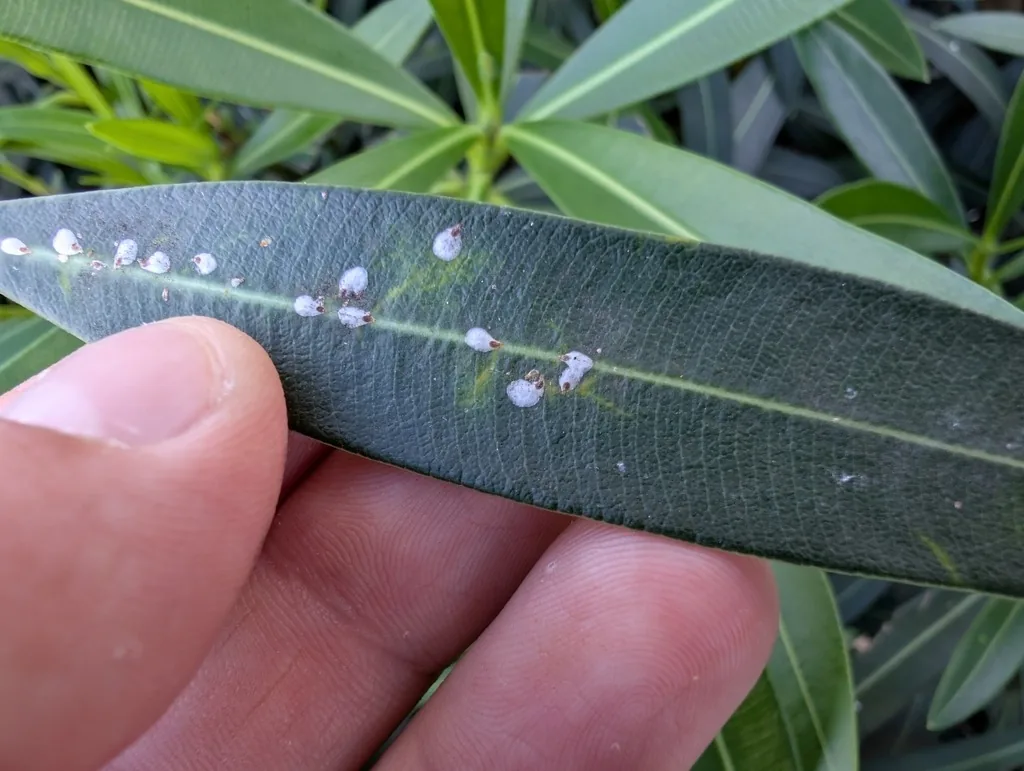
- Female covers are flat, pear-shaped and white, about 2 to 3 mm (under 1/8 inch) long, mostly on the upper leaf surface; the pointed end is yellowish brown.[4][1]
- Male covers are smaller (about 1 mm), elongate and snow-white with three ridges. They cluster on the undersides of leaves.[4][1]
- Feeding causes yellow (chlorotic) spots. As an armored scale it makes no honeydew, so leaves do not get sooty mold.[1][4][3]
- Mississippi State notes it is also called magnolia white scale.[1]
Look-alikes
| Look-alike | How to tell them apart |
|---|---|
| Euonymus scale | Causes similar yellow spotting and leaf drop, but on euonymus.[3] |
| Tea scale | Causes similar symptoms on camellia leaves.[3] |
Where it lives
Native to China. It has spread through the southeastern coastal states and is common in many southern states, including Georgia and the southern half of Mississippi; in North Carolina it reaches only the warmest southeastern area around Wilmington and is less common by Raleigh.[3][4][1]
Biology and life cycle
Crawlers, the only mobile stage, wander briefly and then settle and insert their mouthparts; after that most female scales stay in one spot for life. Crawlers are spread by people, animals, birds, ants and wind.[1][4]
A female lays about 20 yellow eggs under her cover; crawlers hatch in 2 to 3 days in summer, and egg to adult takes about a month.[4]
There are several generations a year, at least three overlapping in North Carolina, so all life stages can be present at once in summer. NC State says it may overwinter in any stage.[3][4][2]
It usually stays on older foliage.[4]
Damage and signs
- Hosts include southern magnolia, aucuba, boxwood, oleander, banana shrub, sago palm and other cycads, gardenia, English ivy, bischofia, camellia and cabbage palmetto.[4][1][3]
- Heavy infestations cause leaf drop, stunting and general decline. In Mississippi landscapes the heaviest infestations are usually on sago palms and magnolias; in southeastern North Carolina it is very common on southern magnolia.[1][3][4]
- It is a major pest in ornamental nurseries.[4][3]
- Researchers in Kunming, China, reported it seriously infesting Camellia japonica, and researchers there found some camellias resist it better than others.[5]
Health risk
It feeds only on plant sap; none of the sources describes any harm to people or pets.[1][4]
Control
Prevention
Inspect new plants for white scale covers before bringing them into a nursery or landscape.[4]
Pesticides
Contact sprays such as horticultural oil, insecticidal soap or pyrethroids kill only crawlers; the waxy covers protect older stages. Because crawlers can be present for much of the year, plan on several applications with thorough coverage.[4][3][1]
Soil-applied systemics containing dinotefuran (and, per UGA, thiamethoxam) move from the roots into the leaves and are among the most effective treatments for armored scales. Mississippi State suggests treating two years in a row; the dinotefuran products named are sold only in commercial quantities.[1][4]
UGA reports that a foliar imidacloprid application reduced nymphs eight weeks after treatment, and that the insect growth regulators pyriproxyfen and buprofezin suppressed populations for up to 28 days. Dead scales stay on the leaves. Follow the label.[4]
Where sources disagree
Host range: UGA says it can infest over 100 plant species; NC State says hundreds.[4][3]
Crawler timing: UGA gives mid-April to early May in Georgia; NC State says crawlers are present throughout the year in North Carolina, so there is no single best spray date.[4][3]
Common questions
- What are the white specks on my magnolia leaves?
- Often false oleander scale. Pear-shaped white covers on top of the leaves and narrow, ribbed white males underneath, with yellow spots, point to it.[1][4]
- Will it hurt my sago palm?
- Heavy infestations yellow the leaves, cause leaf drop and slow growth; in Mississippi landscapes sago palms and magnolias get the worst infestations.[1][4]
- Does it make honeydew?
- No. It is an armored scale, so there is no honeydew or sooty mold.[1][4]
Sources
- Mississippi State University Extension (Bug's Eye View), “False Oleander Scale, Vol. 5, No. 12.” extension.msstate.edu/newsletters/bugs-eye-view/2019/false-oleander-scale-vol-5-no-12 (accessed 2026-11-11)
- NC State Extension, Entomology, “Time to Monitor False Oleander Scales (Frank, March 2019).” entomology.ces.ncsu.edu/2019/03/time-to-monitor-false-oleander-scales (accessed 2026-11-11)
- NC State Extension, Entomology, “Monitor False Oleander Scales (Frank, May 2020).” entomology.ces.ncsu.edu/2020/05/monitor-false-oleander-scales/ (accessed 2026-11-11)
- University of Georgia, Turf and Ornamental Pest Management, “False oleander scale: White spots on the leaves (Joseph, May 2025).” site.caes.uga.edu/entomologyresearch/?p=1015 (accessed 2026-11-11)
- Plant Cell Reports, via PubMed, “Transcriptomic analysis of Camellia japonica to scale insects infestation (Dao et al. 2025).” pubmed.ncbi.nlm.nih.gov/40745418/ (accessed 2026-11-11)
- iNaturalist, “Pseudaulacaspis cockerelli taxon page (order and family).” www.inaturalist.org/taxa/536683 (accessed 2026-11-11)