The short answer
- Spring, tent in the fork or crotch of branches, leaves not inside the tent: eastern tent caterpillar.[4][3]
- Late summer to fall, loose web over the ends of branches with leaves enclosed: fall webworm.[3][1][2]
- Fine webbing over leaves that are stippled with light dots: spider mites.[8][7]
- Spindle-shaped silk bags covered with bits of foliage hanging on evergreens: bagworms.[5][6]
Profiles of pests that make webs or bags
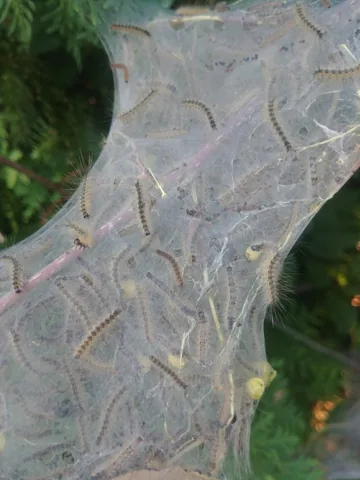 Fall Webworm
Hyphantria cunea
The fall webworm is a native caterpillar that spins large, loose webs over the ends of branches on a long list of deciduous trees and shrubs. The webs look alarming from midsummer into fall, but on healthy, established trees the damage is mostly cosmetic.
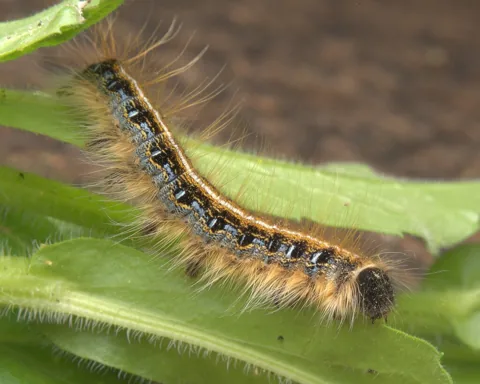 Eastern Tent Caterpillar
Malacosoma americana
Eastern tent caterpillars build silk tents in the crotches of wild cherry, apple and crabapple in spring. They can nearly defoliate a tree, but the tree usually recovers and puts out new leaves. It is a native insect with many natural enemies, and often no spraying is needed.
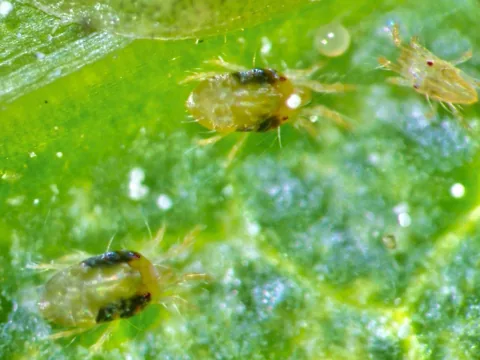 Spider Mites
Tetranychus urticae
Spider mites are tiny arachnids, relatives of spiders and ticks, that live in colonies on leaf undersides and suck out plant cells. The twospotted spider mite is the most important species in yards and gardens and on house plants, and Minnesota says it can infest over 200 species of plants.
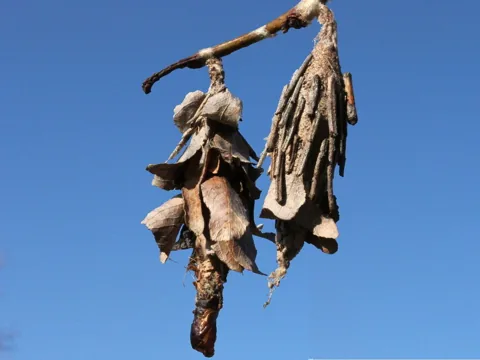 Bagworm
Thyridopteryx ephemeraeformis
Bagworms are caterpillars that build spindle-shaped bags of silk and bits of plant material and feed from inside them. Ohio State says they are hard to control because they often go unnoticed until the larvae are mature, by which time arborvitae, cedar or juniper can be badly defoliated; Missouri Extension notes complete defoliation is not uncommon.
Webbing clues and the likely culprit
Eastern tent caterpillar and fall webworm nests are often confused. Kentucky and UMass separate them by the web's position and the season.[3][4]
- Silk tents in the crotches and forks of branches in spring and early summer, often on wild cherry, crabapple or apple; caterpillars rest in the tent and come out to feed: eastern tent caterpillar.[4][3]
- Loosely woven webs at the outer tips of branches that enclose the leaves being eaten, along with caterpillars, partly eaten leaves and droppings, from late summer through early fall: fall webworm.[1][2][3]
- Fine webbing over leaves, twigs or fruit, with leaves stippled with light dots and sometimes bronzed: spider mites.[8][7]
- No web, but spindle-shaped silk bags 1½ to 2½ inches long, camouflaged with bits of foliage and bark: bagworms.[5]
How to confirm the cause
- Check whether the web wraps the leaves the caterpillars are eating (fall webworm) or sits in a branch fork with foliage outside it (eastern tent caterpillar).[3][2][4]
- For spider mites, check the undersides of stippled or webbed leaves. The mites are tiny and may need a hand lens.[8][7]
- Bagworm bags hang from the plant and contain a brown or tan larva.[5]
What to do next
- Fall webworm: it may defoliate a tree occasionally but rarely kills it. Webbed branches within reach can be pruned and destroyed.[1]
- Eastern tent caterpillar: remove egg masses in winter; in early spring small tents can be removed by hand, and larger ones pruned out or wound onto a stick.[3]
- Bagworms: on small trees and shrubs, hand-pick and destroy all bags, and cut off the silk band that can girdle the branch.[6][5]
- Spider mites: sprays of water, insecticidal oils or insecticidal soaps can be used.[8]
Common questions
- Will fall webworm kill my tree?
- Rarely. Penn State says it may defoliate a tree occasionally but rarely kills it; webs mostly reduce ornamental value.[1]
- Why are there webs in my tree in spring?
- Spring tents in branch forks, especially on cherry, crabapple and apple, are usually eastern tent caterpillars. Fall webworm webs come later, in late summer.[4][3]
- Can webs on houseplants be spider mites?
- Yes. Webbing on leaves is a sign of spider mites, which build colonies on leaf undersides.[7][8]
Photo credits
- Fall Webworm: Andalyne Tofflemire, public domain (CC0), via iNaturalist
- Eastern Tent Caterpillar: (c) Norman Kuring, some rights reserved (CC BY) — via iNaturalist, CC BY 4.0
- Spider Mites: (c) Mike Bowie, some rights reserved (CC BY) — via iNaturalist, CC BY 4.0
- Bagworm: (c) Peter Chen 2.0, some rights reserved (CC BY) — via iNaturalist, CC BY 4.0
Sources
- Penn State Extension, “Fall Webworm (updated June 24, 2026).” extension.psu.edu/fall-webworm (accessed 2026-11-12)
- University of California Statewide IPM Program, “Fall Webworm.” ipm.ucanr.edu/home-and-landscape/fall-webworm/ (accessed 2026-11-12)
- University of Kentucky Entomology, “ENTFACT-423: Eastern Tent Caterpillar (revised January 2026).” entomology.mgcafe.uky.edu/ef423 (accessed 2026-11-12)
- UMass Extension Landscape, Nursery and Urban Forestry Program, “Eastern Tent Caterpillar (Landscape fact sheet).” ag.umass.edu/landscape/fact-sheets/eastern-tent-caterpillar (accessed 2026-11-12)
- Ohio State University Extension, “HYG-2149: Bagworm and Its Control.” ohioline.osu.edu/factsheet/HYG-2149-10 (accessed 2026-11-12)
- University of Missouri Extension, “Bagworms in Missouri (G7250, reviewed August 2025).” extension.missouri.edu/publications/g7250 (accessed 2026-11-12)
- University of Minnesota Extension, “Twospotted spider mites in home gardens (J. Hahn, S. Wold-Burkness).” extension.umn.edu/yard-and-garden-insects/spider-mites (accessed 2026-11-12)
- University of California Statewide IPM Program, “Spider Mites (Pest Notes, Home and Landscape).” ipm.ucanr.edu/home-and-landscape/spider-mites/ (accessed 2026-11-12)