On this page
How to identify it
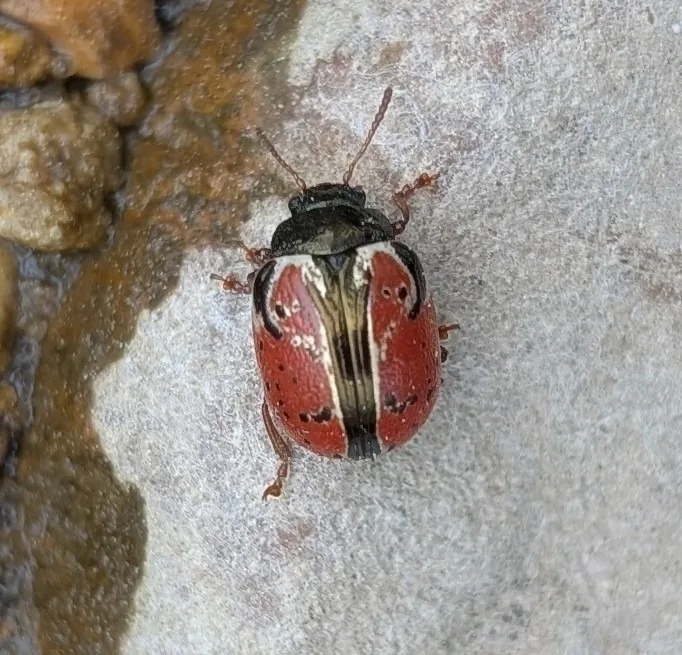
- Adults are oval and domed, 1/3 to 1/2 inch long, with a black head. Minnesota Extension's two pages describe the colors differently: its insect page says red wing covers with ornate black and white patterns, and its ninebark diagnosis page says yellowish to reddish brown with ornate black and gold markings.[1][3]
- Calligraphy beetles get their name from the scrawled, handwriting-like lines on their backs.[2]
Look-alikes
| Look-alike | How to tell them apart |
|---|---|
| Dogwood calligraphy beetle | Many of the nearly 40 calligraphy beetles in North America look alike, so the Missouri Department of Conservation says to identify them by host plant. The dogwood calligraphy beetle (Calligrapha rowena) feeds on dogwoods, not ninebark.[2] |
Where it lives
Minnesota Extension and the Missouri Department of Conservation both cover it, so it occurs in at least those two states. Neither page gives a full range map.[1][2]
Biology and life cycle
In Minnesota, adults are out in May and June.[1]
Most calligraphy beetles specialize on particular plants, and this one feeds on common ninebark, Physocarpus opulifolius.[2][1]
Damage and signs
Health risk
It feeds on ninebark leaves. Minnesota Extension and the Missouri Department of Conservation describe leaf feeding only and don't mention any risk to people or pets.[1][3][2]
Control
Prevention
Start by confirming the host: a calligraphy beetle chewing ninebark leaves in May or June is most likely this species. Minnesota's ninebark diagnosis page lists it alongside powdery mildew, which leaves white patches instead of holes.[1][2][3]
Common questions
- What is the red beetle with black and white squiggles on my ninebark?
- Probably the ninebark calligrapha. Minnesota Extension notes it is out in May and June and chews holes in the leaves.[1][3][2]
- Will the beetles hurt my ninebark?
- They chew holes in the leaves, and Minnesota Extension says feeding may be heavy. Neither source reports the beetle killing shrubs.[3][1][2]
Sources
- University of Minnesota Extension (What insect is this?), “Ninebark calligrapha.” apps.extension.umn.edu/garden/diagnose/insect/trees-shrubs/beetles/medium/ninebarkcalligrapha.html (accessed 2026-11-13)
- Missouri Department of Conservation, “Ninebark Calligraphy Beetle (Field Guide).” mdc.mo.gov/discover-nature/field-guide/ninebark-calligraphy-beetle (accessed 2026-11-13)
- University of Minnesota Extension, “Ninebark: spots or blotches on leaves (What's wrong with my plant?).” apps.extension.umn.edu/garden/diagnose/plant/deciduous/ninebark/spotsorblotches.html (accessed 2026-11-13)
- Global Biodiversity Information Facility (GBIF), “Calligrapha spiraeae (Say, 1826) (GBIF Backbone Taxonomy).” api.gbif.org/v1/species/4990883 (accessed 2026-11-13)
- iNaturalist, “Calligrapha spiraeae taxon page (order and family).” www.inaturalist.org/taxa/141619 (accessed 2026-10-06)