On this page
How to identify it
- Look for large amounts of white, woolly wax, mostly on the undersides of oak leaves. Under the wax the aphid bodies are pale, and young nymphs can be pale green and move around more than the adults.[3][1]
- Honeydew the aphids excrete forms brown droplets in the wax.[3]
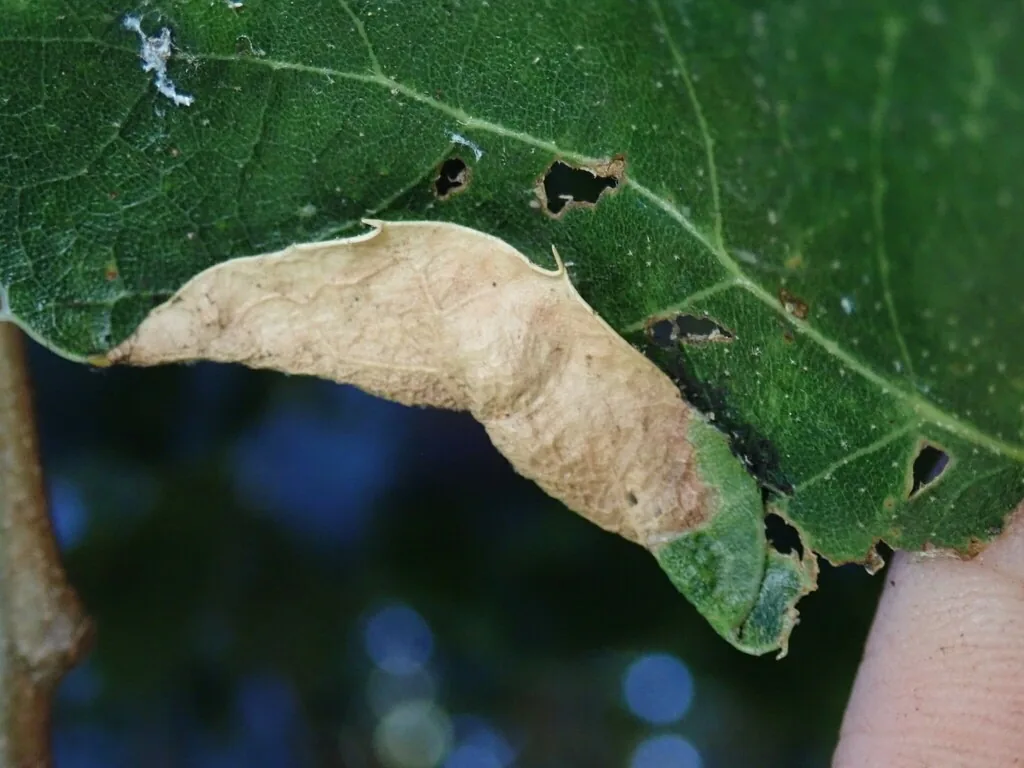
- In mid to late spring, infested leaves of red oaks curl noticeably, with patches of woolly secretion inside the curl.[1]
- Adults are tiny, about 1 to 2 mm long (1/25 to 1/12 inch). UC IPM describes the California species as pale grayish green to olive green, pale greenish yellow or brownish yellow, or yellowish green with a brown head, depending on the species.[4]
- Woolly aphids in general have short antennae and cornicles (the two tubes on the rear of most aphids) that are undeveloped or hard to see. Gently brushing the wax away shows the insect underneath.[4][3]
Look-alikes
| Look-alike | How to tell them apart |
|---|---|
| Mealybugs | The white wax leads people to mistake woolly oak aphids for mealybugs. Gently brush the wax aside to see the insect underneath.[3][4] |
| Whiteflies | Also confused with woolly oak aphids because both leave white, waxy material on leaf undersides; adelgids and psyllids can look similar too.[3][4] |
Where it lives
Florida's two woolly oak aphids, Stegophylla brevirostris and Diphyllaphis microtrema, both occur in eastern North America, and NC State reports several Stegophylla species on red oaks in North Carolina. UC IPM's California page lists S. essigi, S. querci (= S. quercicola) and S. quercifoliae. Most U.S. GBIF records of the genus come from California and Oregon, mostly of the two western species S. quercifoliae and S. essigi, with a few from Virginia and other eastern states.[3][1][4][5]
Biology and life cycle
Much of their biology is unknown. In Florida, Stegophylla brevirostris has never produced egg-laying females or males in years of rearing: every form is a live-bearing female, and no winged forms are known there.[3][1]
Farther north the pattern changes. One egg-laying female and one winged male of S. brevirostris are known from Maryland, and UC IPM describes the California species as overwintering as eggs on oak buds and shoots, reproducing without mating through spring and summer (mostly wingless), then producing winged aphids that mate in fall and lay the overwintering eggs.[3][4]
It is not known how they spread from tree to tree. Florida's state taxonomist suggests birds and larger flying insects may carry them off because of the sticky wax around their bodies.[3]
They spend their whole life cycle on oaks and are usually noticed in mid to late spring, when the leaves start to curl.[4][1]
Damage and signs
- Willow, red and live oaks are the most reported hosts. In Florida, 59% of state records of S. brevirostris came from live oak; Diphyllaphis microtrema uses a mix of oaks.[1][3]
- Sources differ on how much it matters. NC State says the curling is unsightly but does not seem to affect overall tree health; UC IPM adds that infested leaves may curl and discolor and that prolonged high populations may cause scattered dieback of shoot tips. Florida's Division of Plant Industry notes they can make a significant mess.[1][4][3]
- Like other woolly aphids they excrete honeydew, which can attract ants and yellowjackets and grow black sooty mold on surfaces underneath.[4][3]
Health risk
They feed only on oaks; the extension and state sources describe them only as a cosmetic tree pest.[3][4]
Control
Traps and physical control
On small trees, a strong spray of water from a garden hose dislodges and drowns many of the aphids.[1]
Biological control
These native aphids have native natural enemies, and in most cases no control is needed. Parasitic wasps, lacewing and aphid-fly larvae and lady beetles feed on woolly aphids when broad-spectrum sprays aren't used.[3][4]
Pesticides
Horticultural oil or insecticidal soap works on aphids it reaches, but the wax protects them and UC IPM calls foliar sprays partial control. Spraying large trees is difficult and, NC State says, not worth the effort, and no spray will uncurl leaves that are already damaged.[1][4]
UC IPM notes that thoroughly spraying the twig tips of small trees with horticultural oil in the dormant season can reduce species that overwinter as eggs on buds. Florida's Division of Plant Industry says control may be warranted only where populations are high and the tree's appearance matters.[4][3]
Common questions
- Is the white fuzz hurting my oak?
- Usually not much. NC State says the damage does not seem to affect overall tree health, though UC IPM says long, heavy infestations can kill back some shoot tips.[1][4]
- Should I spray my oak?
- Rarely. By the time curled leaves show it is too late to fix them for the year, and on big trees spraying is hard and gives only partial control.[1][4]
- Is it mealybugs?
- Probably not, if it is on oak leaves. Woolly oak aphids are often mistaken for mealybugs or whiteflies; brush away the wax to see the aphids.[3][4]
Sources
- NC State Extension, “Woolly Oak Aphids (PDIC Factsheet).” content.ces.ncsu.edu/woolly-oak-aphids-1 (accessed 2026-11-11)
- iNaturalist, “Stegophylla taxon page (order and family).” www.inaturalist.org/taxa/454656 (accessed 2026-11-11)
- Florida Department of Agriculture and Consumer Services, Division of Plant Industry, “Woolly oak aphids in Florida (Hemiptera: Aphididae), Entomology Circular No. 427 (S. E. Halbert, January 2013).” ccmedia.fdacs.gov/content/download/23858/file/ent427.pdf (accessed 2026-11-11)
- University of California Statewide IPM Program, “Woolly Aphids (Pest Notes / Home and Landscape).” ipm.ucanr.edu/home-and-landscape/woolly-aphids/ (accessed 2026-11-11)
- Global Biodiversity Information Facility (GBIF), “Stegophylla (woolly oak aphids): U.S. occurrence records by state and species, 1990-2026 (GBIF occurrence search).” api.gbif.org/v1/occurrence/search?taxonKey=2071807&country=US&hasGeospatialIssue=false&occurrenceStatus=PRESENT&year=1990%2C2026&facet=stateProvince&facet=speciesKey&facetLimit=400&limit=0 (accessed 2026-11-11). Counts are records reported (iNaturalist research-grade, museum specimens, surveys), not abundance. Species keys 2071815 = S. quercifoliae, 2071812 = S. essigi.