On this page
How to identify it
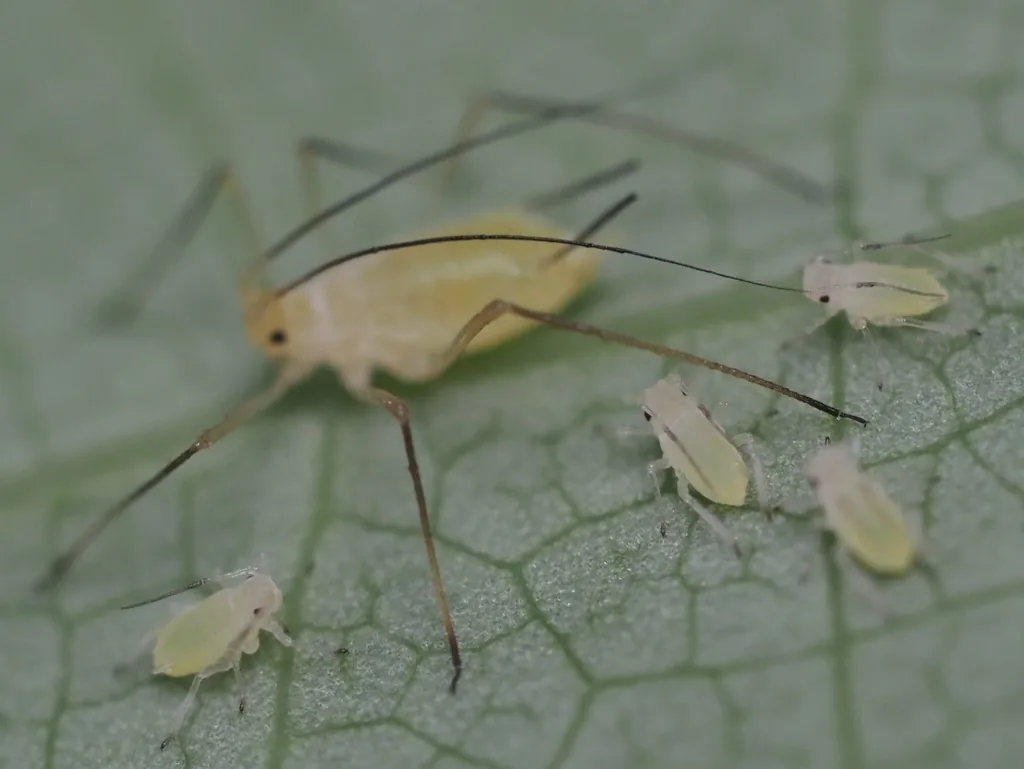
- Wingless adults are about 1/10 to 1/8 inch long, spindle-shaped and pale green to yellow, sometimes pinkish, with long legs.[1][3][5]
- Look for dark antennae longer than the body and long black cornicles (the tailpipes); winged forms have a reddish-brown head and thorax.[3][4]
- Colonies of mixed sizes sit under the leaves, mostly at branch ends, and shoot tips turn dull.[1][6]
Where it lives
It's native to North America and occurs wherever tulip trees grow, especially on landscape and street trees; Oregon State reported it spreading through Willamette Valley towns in 1985.[5][4][6]
Biology and life cycle
Adults lay eggs in fall in bark crevices near buds, where the eggs spend the winter.[1][3]
Eggs hatch at budbreak, and unmated females give birth to live young through summer, so numbers climb fast; winged adults that can move to new trees appear in fall.[1][3][4]
UMass lists them from mid-June into early fall, and Oregon State found them gone by late October.[5][6]
Damage and signs
- Copious honeydew coats the plants below, grows black sooty mold and is a sticky mess on decks, pavement and cars; flies, wasps, bees and ants come to feed on it.[1][2][3][5]
- Heavy infestations can yellow and drop outer-canopy leaves early, as soon as August on big trees, and repeated years of it can thin the canopy and slow growth. The sooty mold itself is a cosmetic problem.[5][4][6]
Health risk
It feeds on plants; none of the extension sources mentions a risk to people.[1][3][5]
Control
Prevention
Start checking for aphids and their natural enemies at budbreak; UMass says treatment is usually unnecessary.[1][5]
Avoid heavy nitrogen fertilizer and heavy watering, which produce the succulent growth aphids favor.[2]
Traps and physical control
Wash aphids off with a strong stream of water where you can reach them.[2][5]
Biological control
Lady beetles, syrphid fly larvae, green lacewings, minute pirate bugs and parasitic wasps usually knock numbers down by early summer; avoid broad-spectrum sprays that kill them.[2][3][4]
In hot, humid weather an insect-killing fungus can wipe out colonies, NC State notes. The parasitic wasp Aphidius polygonaphis attacks it in the East and was introduced into California.[3][5]
Is the tree in trouble?
Rarely. Oregon State nurseries reported no problems even during the 1985 outbreak, and NC State says heavy honeydew years usually end when natural enemies catch up.[6][3]
Oregon State cited earlier work estimating the aphid eats about four times its dry weight a day in sap and pulls roughly 17% of the leaves' nitrogen, which helps explain the early leaf drop in bad years.[6]
Tuliptree scale also drips honeydew from the same tree, so check bark and twigs for bumpy scales if the stickiness lasts into late summer.[4]
Common questions
- Why is my car sticky under the tulip tree?
- Tuliptree aphids, and sometimes tuliptree scale, produce honeydew that falls on whatever is below.[1][2][4]
- When do tuliptree aphids start?
- Overwintering eggs hatch at budbreak in spring, so start checking then.[1]
- Will the aphids go away without spraying?
- Usually. Lady beetles, lacewings, syrphid larvae and parasitic wasps tend to bring them down by early summer.[3][4][5]
Sources
- Pacific Northwest Pest Management Handbooks (OSU, WSU, University of Idaho), “Tuliptree (Liriodendron): Tuliptree aphid (Insect Management Handbook).” pnwhandbooks.org/insect/hort/landscape/hosts-pests-landscape-plants/tuliptree-liriodendron-tuliptree-aphid (accessed 2026-11-13)
- Pacific Northwest Pest Management Handbooks (OSU, WSU, University of Idaho), “Landscape pests: Aphid (Insect Management Handbook).” pnwhandbooks.org/insect/hort/landscape/common/landscape-aphid (accessed 2026-11-13)
- NC State Extension, “Tuliptree Aphid (PDIC Factsheet).” content.ces.ncsu.edu/tuliptree-aphid (accessed 2026-11-13)
- NC State Extension, Department of Entomology, “Tulip Tree Aphids and Scales Feeding and Dropping Honeydew.” entomology.ces.ncsu.edu/news/tulip-tree-aphids-and-scales-feeding-and-dropping-honeydew/ (accessed 2026-11-13)
- UMass Amherst Extension, Center for Agriculture, Food, and the Environment, “Illinoia liriodendri (Insect & Mite Guide).” www.umass.edu/agriculture-food-environment/landscape/publications-resources/insect-mite-guide/illinoia-liriodendri (accessed 2026-11-13)
- Oregon State University Extension, “Ornamentals Northwest Archives, Winter 1986, Vol. 10, Issue 1 (tuliptree aphid).” agsci.oregonstate.edu/sites/agscid7/files/horticulture/osu-nursery-greenhouse-and-christmas-trees/onn100107.pdf (accessed 2026-11-13)
- Global Biodiversity Information Facility (GBIF), “Illinoia liriodendri (Monell, 1879) (GBIF Backbone Taxonomy).” api.gbif.org/v1/species/2074776 (accessed 2026-11-13)