On this page
How to identify it
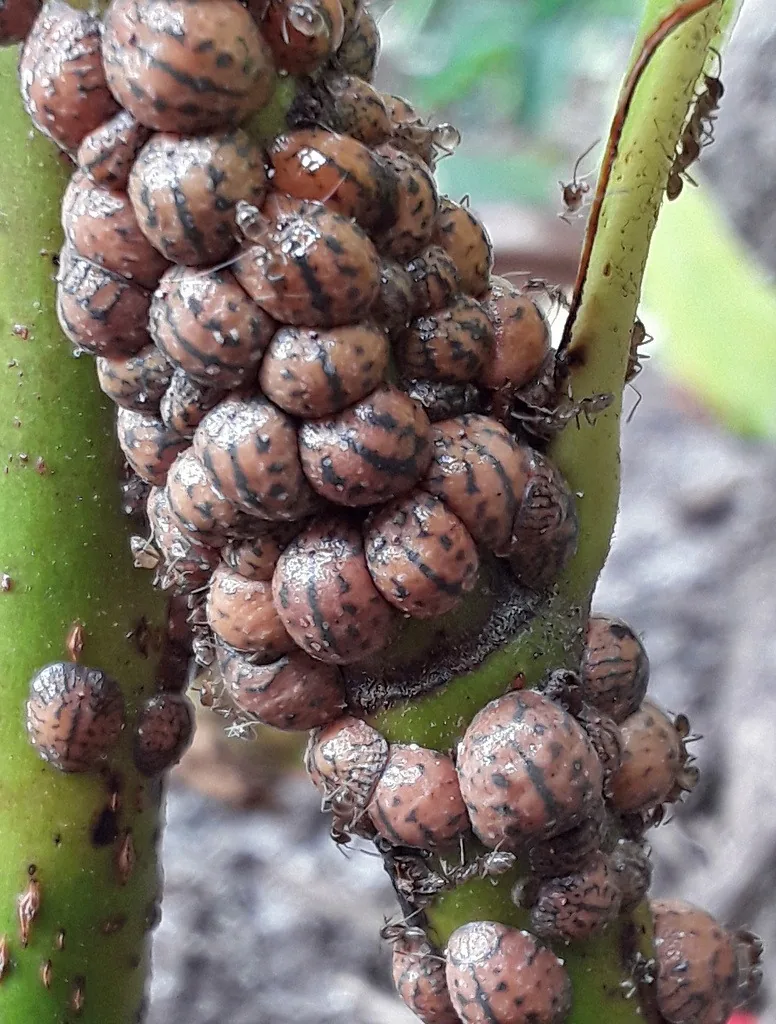
- Mature females are puffy, oval and convex. Kentucky gives them as 3/8 inch long and gray, yellow, orange or pinkish-black; Penn State gives 6 to 7 mm across, light grayish green to pinkish orange mottled with black, with a distinct flange around the margin.[1][2]
- Overwintering immature scales are conspicuously black. Crawlers are dark red and about 0.5 mm long.[1][2]
- Crowded scales give twigs a warty, bumpy look. Honeydew is often the first sign, along with ants and wasps that come to feed on it.[1][2]
- Adult males are small with one pair of wings and can look like tiny parasitic wasps crawling over the plant.[2]
- UF/IFAS says adult females usually range from 2.6 to 7 mm, with some reports up to 12 mm that may come from confusion with the larger magnolia scale. After a female dies late in the season she turns brownish and may stay attached to the branch.[4]
Look-alikes
| Look-alike | How to tell them apart |
|---|---|
| Magnolia scale | Larger, with a similar life cycle, but it attacks only magnolias. Penn State notes that tuliptree scale is often misidentified as magnolia scale.[2] |
Where it lives
A pest of yellow poplar (tuliptree) in the eastern United States; Kondo and Williams redescribed it from specimens collected in its native range on tuliptree, and the designated type specimen comes from Auburn, Alabama. ScaleNet lists records from Alabama, California, the District of Columbia, Florida, Georgia, Illinois, Indiana, Kentucky, Louisiana, Maryland, Michigan, New Jersey, New York, North Carolina, Ohio, Pennsylvania, South Carolina, Tennessee, Texas and Virginia, and from Cuba. UF/IFAS says it is native to the eastern United States, following its main host, tuliptree, in most states east of the Mississippi River and especially common from New York south, with records also from parts of the Midwest, Texas and California; outside the U.S. it is known only from Cuba.[3][5][4]
Biology and life cycle
It overwinters as immature (second-instar) nymphs on the twigs, which resume feeding in early spring and mature by summer. Winged males emerge in June to mate.[2][1][3]
In August each female gives birth to as many as 3,000 crawlers over several weeks. Crawlers spread by walking, by wind or on birds, die within about three days if they don't find a host, and feed briefly before settling down for the winter.[2][1]
There is one generation a year. ScaleNet notes that in the far south of the range, such as Florida, stages overlap and all can be found in winter.[1][2][3]
Females are ovoviviparous: the eggs hatch inside the body and the crawlers crawl out. UF/IFAS says each female produces an average of 3,000 offspring, crawlers emerge from about mid-August through October, and wind can carry them up to 30 meters, though only a small share reach a suitable host.[4]
Within a few weeks crawlers molt into the second, overwintering stage and lose their working legs, so they stay put. Males begin to change shape in early May, pupate in late May under a white covering and emerge around mid-June; females grow rapidly and give off copious honeydew from mid-May to mid-August.[4]
Tuliptree is the main host. Other important hosts are magnolias such as Magnolia grandiflora, M. × soulangeana, M. kobus and M. stellata, with lindens less common. In Florida, 85% of host records in the state plant industry database are from magnolias, and UF/IFAS says it has been recorded on plants in at least 12 genera and eight families.[4]
Damage and signs
- Feeding thins the canopy and causes twig dieback. Honeydew drips onto leaves, twigs and anything below, where black sooty mold grows on it. UF/IFAS adds yellowing leaves and early leaf drop, and says sooty mold interferes with photosynthesis.[1][2][4]
- Large populations weaken or can kill young trees; ScaleNet cites a report of as few as 38 scales killing two-year-old trees. Penn State says heavy infestations can cover every twig and branch and cause rapid decline.[3][2]
- It has also turned up on saplings planted for reforestation, where it can occasionally become abundant enough to kill single trees or small natural stands.[4]
Health risk
It feeds on tree sap; none of these sources reports any risk to people or pets.[1][2]
Control
Prevention
Scales thrive on stressed plants. Water and fertilize to keep trees healthy, but avoid over-fertilizing, which favors scale buildup. Prune out small infestations.[1]
Biological control
Ant control matters: at least 10 ant species tend tuliptree scale for honeydew and defend it from natural enemies, and in one study ant-tended scales had 50% higher survival. In Florida the invasive ant Nylanderia fulva builds shelters of soil, grass and mud over scales on southern magnolia. Ants on trunks and branches can signal scale before sooty mold shows.[4]
Pesticides
Apply horticultural oil at the dormant rate to kill overwintering nymphs: Kentucky says in winter, Penn State says in early spring before new growth and after hard freezes are over. Oil on green tissue will burn the plant.[1][2]
Treat crawlers when they appear, from mid-August through mid-September in Pennsylvania. Check twigs in August, or wrap double-sided or sticky-side-out black tape near the scales to see when crawlers start moving; repeat applications may be needed.[2][1]
A systemic soil treatment labeled for soft scales works best applied in spring (April to May in Kentucky) when the soil is moist; water around the tree first if it is dry.[1][2]
Checking whether treatment worked
Live scales release liquid when crushed; dead ones are dry. New foliage should look healthier, and buds should break a little earlier once the scale load is gone. Control may take repeated work over a couple of seasons.[1]
Natural enemies
The larvae of the pyralid moth Laetilia coccidivora prey on tuliptree scale, but Penn State says predators and parasitoids seldom control an infestation. Ants that tend the scales for honeydew protect them from these enemies and may need managing. UF/IFAS lists more enemies: the lady beetles Hyperaspis proba, H. signata, Chilocorus stigma and Adalia bipunctata, the syrphid fly Pelecinobaccha costata and several parasitic wasps, which attack at different times of the season.[2][4]
Where sources disagree
Female size and color: 3/8 inch and gray, yellow, orange or pinkish-black (Kentucky) versus 6 to 7 mm and grayish green to pinkish orange mottled with black (Penn State).[1][2]
Dormant oil timing: in winter (Kentucky) or in early spring before new growth (Penn State).[1][2]
How much natural enemies help: Penn State says predators and parasitoids seldom control an infestation, while UF/IFAS says scale populations are typically kept in check by natural and biological controls and that enemies active at different times can give season-long control.[2][4]
Offspring per female: Kentucky and Penn State say as many as 3,000; UF/IFAS gives an average of 3,000.[1][2][4]
Common questions
- What are the bumps on my magnolia twigs?
- Possibly tuliptree scales, which make twigs look warty and drip honeydew that grows black sooty mold. Magnolia scale looks similar but is larger and attacks only magnolias.[1][2]
- When are crawlers active?
- In August in Kentucky; Penn State treats crawlers from mid-August through mid-September.[1][2]
- Can tuliptree scale kill a tree?
- It can weaken or kill young trees, and very heavy infestations can cause rapid decline. Feeding also thins the canopy and causes twig dieback.[3][2][1]
- Why are ants all over my tulip poplar or magnolia?
- Ants collect the honeydew tuliptree scales produce and guard the scales from their natural enemies, so ant traffic on trunks and branches is a good sign to check the twigs for scale.[4]
Sources
- University of Kentucky Entomology (ENTFACT), “Managing Tuliptree Scale (ENTFACT-435).” entomology.mgcafe.uky.edu/ef435 (accessed 2026-11-11)
- Penn State Extension, “Tuliptree Scale (G. A. Hoover).” extension.psu.edu/tuliptree-scale (accessed 2026-11-11)
- ScaleNet (USDA ARS Systematic Entomology Laboratory and partners), “Toumeyella liriodendri (catalogue entry: hosts, distribution, biology, economic importance).” scalenet.info/catalogue/Toumeyella%20liriodendri/ (accessed 2026-11-11)
- University of Florida IFAS Extension (EDIS), “Tuliptree Scale, Toumeyella liriodendri (Gmelin), EENY-667/IN1150 (M. Borden and A. Dale; Featured Creatures).” ask.ifas.ufl.edu/publication/IN1150 (accessed 2026-11-14)
- Journal of Insect Science, via PubMed, “Kondo and Williams (2008), Neotype designation and redescription of Toumeyella liriodendri (Gmelin).” pubmed.ncbi.nlm.nih.gov/20331398/ (accessed 2026-11-11)
- iNaturalist, “Toumeyella liriodendri taxon page (order and family).” www.inaturalist.org/taxa/507877 (accessed 2026-10-06)