On this page
How to identify it
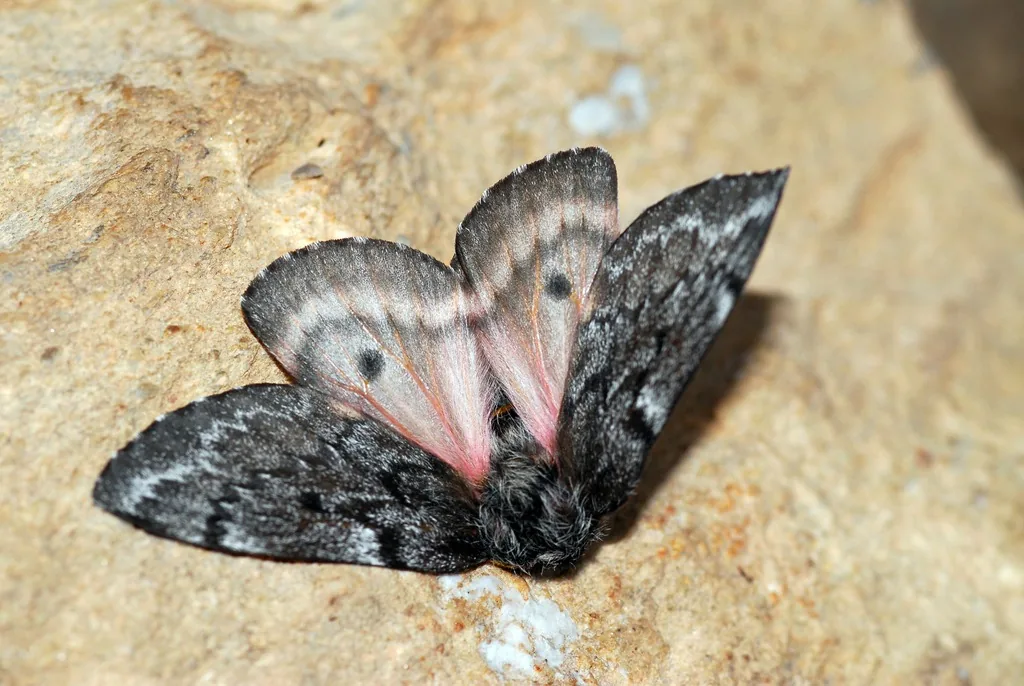
- Adults are large, heavy-bodied, gray-brown moths with a small dark spot near the center of each wing and pink hairs at the base of the hind wings. The PNW handbook gives a wingspan of 2.7 to 4 inches and the Forest Service 70 to 110 mm (2.75 to 4.3 inches).[1][2]
- The caterpillars are spiny. PNW describes them as brownish to yellowish green and about 1 inch long when grown; the Forest Service says mature larvae are 2 1/4 to 3 inches, brown or black to dark green with white lines along the sides, a pattern that resembles a pine branch.[1][2]
- Caterpillars travel in single file to new feeding spots, and eaten needles leave stubs on the twigs.[1]
- Eggs are round, about 3 mm, pale blue-green at first and later bluish gray to white, laid singly or in clusters on needles, bark, fence posts or buildings.[2]
- Other signs are heavy frass on the forest floor and large numbers of moths around street and parking-lot lights, which can mean an outbreak is starting or underway nearby.[2]
Where it lives
The Forest Service says it occurs through most of the West, with outbreaks recorded in Arizona, California, Colorado, Utah, Oregon and Wyoming; central Oregon outbreaks developed on loose volcanic soils where larvae burrow easily. The PNW handbook calls it a sporadic pest of forest and landscape pines.[2][1]
Biology and life cycle
Sources differ on timing. The Forest Service says moths fly in late July and early August and live about a week, eggs hatch in September, and young larvae feed in small colonies; the PNW handbook says moths emerge in midsummer and larvae feed on new foliage through the summer. A female lays an average of 145 eggs.[2][1]
Larvae overwinter on the tree, feed again in spring, when the heaviest defoliation occurs, and by late June crawl down to pupate in the soil. The second winter is spent as pupae, so a generation takes two years, and a few pupae wait a third year.[2][1]
Mature larvae are a traditional food of the Paiute people of the Owens Valley and Mono Lake areas, and the Klamath and Modoc tribes roast the pupae. The PNW handbook notes the larvae are considered a delicacy.[2][1]
Outbreaks aren't in step everywhere: recent northern Arizona outbreaks defoliated trees in odd years and central Oregon outbreaks in even years.[2]
Damage and signs
- Defoliation can strip the needles completely, and crowns stay thin as trees recover. Because heavy feeding comes every other year, trees partly recover, but outbreaks have caused growth loss and some tree deaths, usually tied to bark beetle attacks during drought.[2][1]
- Large numbers of larvae and moths near homes, towns or campgrounds are considered a nuisance.[2]
Health risk
The caterpillars are spiny, but none of the cited sources describes a sting or any other risk to people or pets.[1][2]
Control
Prevention
Control isn't needed except in outbreak years; watch for increasing defoliation or clusters of larvae in winter.[1]
Prescribed fire can kill up to 70% of the pupae, but results vary, and the Forest Service advises burning only when it serves other goals such as fuel reduction. Thinning pine stands may also reduce growth loss and tree deaths.[2]
Traps and physical control
Hand-pick larvae you find, and prune out severely defoliated sections.[1]
Biological control
Natural enemies often end outbreaks: a virus disease that kills grown larvae, three egg-attacking wasps and at least six insect parasites of larvae, birds, and golden-mantled ground squirrels that eat pupae in California and Oregon.[2]
Pesticides
The Forest Service says Bt and several chemical insecticides are effective, but they shouldn't be used where tribes collect larvae for food. Landowners can ask county extension or state forestry offices which products are currently registered.[2]
Outbreak history
Tree-ring records from central Oregon show 22 outbreaks over the past 622 years, at intervals from 9 to 156 years. The first recorded outbreak was in central Oregon in the 1890s.[2]
Common questions
- Do I need to spray for pandora moths?
- Usually not; the PNW handbook says control isn't needed except in outbreak years.[1]
- Why are caterpillars marching in a line on my pine?
- Pandora moth caterpillars travel in single file when moving to new feeding areas.[1]
- Why are there huge moths on my lights near pine forest?
- Pandora moths are drawn to lights. Large numbers around lights can mean an outbreak is starting or underway in nearby pines.[2]
Sources
- Pacific Northwest Pest Management Handbooks (OSU, WSU, University of Idaho), “Pine (Pinus): Pandora moth (Insect Management Handbook).” pnwhandbooks.org/insect/hort/landscape/hosts-pests-landscape-plants/pine-pinus-pandora-moth (accessed 2026-11-13)
- USDA Forest Service (Forest Insect & Disease Leaflets), “The Pandora Moth (FIDL 114).” www.fs.usda.gov/foresthealth/docs/fidls/FIDL-114-PandoraMoth.pdf (accessed 2026-11-13)
- Global Biodiversity Information Facility (GBIF), “Coloradia pandora Blake, 1863 (GBIF Backbone Taxonomy).” api.gbif.org/v1/species/5124468 (accessed 2026-11-13)